


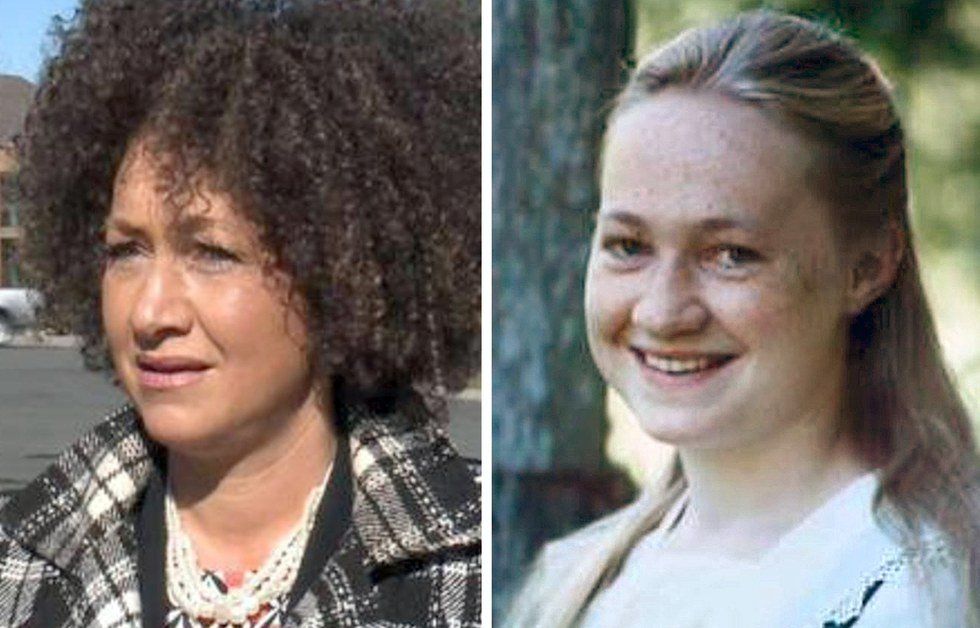
Most thought they had heard the last of Rachel Dolezal, a black rights activist and teacher who turned out to be a white woman in disguise just two years ago. Her exposure sparked a ton of conversation around “blackface,” race, and identity. She resigned from her position as branch president of the NAACP, was fired from her position at Eastern Washington University, lost her local newspaper column and was removed from her position as Spokane’s police ombudsman commission. Even her parents contributed to “outing” her as a white woman posing as black. Needless to say, she lost everything.
Recently, white women have been targeted once again for their perpetuation of race inequality under the guise of innocence, progressiveness and even research. (Thanks, Get Out.) In 2014, American sociologist Alice Goffman conducted a study called On the Run: Wanted Men in a Philadelphia Ghetto where she basically attempted to immerse herself in a disadvantaged neighborhood in Philly that was comprised of predominantly African Americans. The study is famous because of the allegations that came out against her of inaccuracy and criminal conduct, as well as unethical research practices.
Like Dolezal, this young white woman believed she had successfully integrated into this African American community, and was “one of them.” Unlike Dolezal, she believed this without altering her phenotype. Still, this similar mindset persists, the one that a privileged group can pick up the identity of the marginalized and then put it down when they don’t want it anymore. This is otherwise known as cultural appropriation.
Rachel Dolezal has resurfaced in her attempt to take her cultural appropriation to the next level. Most people are probably wondering what could possibly lie beyond denouncing your whiteness, coloring your skin and replacing your hair with textured hair on the spectrum of cultural appropriation. Well, that would be legally changing your name to the most African name possible: Nkechi Amare Diallo. A blogger who goes by the username Awesomely Luvvie says,
NKECHI. AMARE. DIALLO. Bhet why. A name that is so properly West African that I’m hoping jollof rice appears in front of me at the mention of it. Well, “Amare” might be Latin, but she knows she picked it because it sounds positively onyx. She didn’t want to just be Black: she wanted to be African. Before we know it, she’s gonna want to be Eve herself.
The name change supposedly happened this past October, but the story only just seems to be making waves now, being covered literally left and right. Progressives are talking about it, and even Milo Yiannopoulos and Breitbart are covering it. Who would’ve thought?
The only point of empathy towards Dolezal is her comments about being ostracized because of the controversy around her identity. White people think she is a race-traitor, and black people don’t want her in their community, either. Though this was self-inflicted, this "othering" is what many mixed-race people go through every day. It the constant bargaining of identity, and never being enough for the communities you are so desperate to be a part of. That being said, perhaps we should save our empathy for them instead.
Everyone likes to remind each other that race is socially constructed, and use that claim to say it’s not even real. But because society believes so deeply in these categories, it has become its own kind of social reality. And yes, identity exploration is incredibly important. It is up to us to identify our positionality in society, and discern where we hold privilege, and where we are oppressed.
It is important to acknowledge how our social identities inform our everyday experiences. At the same time, it is important to recognize that despite how we identify, the people around us may perceive us differently than how we might like. But Rachel Dolezal’s claim to blackness is the exception, because it is unfounded.
Dolezal, *ahem* “Nkechi Amare Diallo” is currently unemployed, and struggling to find work. Assuming she changed her job resume to reflect her legal name, we can congratulate her on finally living part of the black woman experience. As in, being part of the racial bias of hiring.

















