
In the midst of the Black Lives Matter movement, there has been a lot of confusion about what it truly means to be black and what it means to be American as if there's a distinct difference. There have been several criticisms of the movement that not only downplay history but completely alter the purpose of the movement itself. Promoting blackness is not to slander whites, but to provide perspective from another side of history that did not make the textbooks. We now live in a time where blacks are speaking out more and more about the systematic oppression taking place in American and are no longer allowing day-to-day microaggressions dictate the lives of the black community. I am one of those people.
1. Black History Is American History

For centuries, American history has been told through the Euro-American perspective. What this means is that majority of the history textbooks and education curriculum has been dominated by the white men of America giving them the authority to tell history in the least offensive yet prideful way; they basically painted American history the way they wanted you to see it. After taking a semester of African American Literature (as if African American literature isn't American literature) it has become so apparent to me how one-sided American history truly is.
While it is extremely unfair to leave out 500 years worth of history, it makes quite a lot of sense actually. Without knowing the truth, people are very easily manipulated and swayed into believing pretty much anything. For example, Frederick Douglass writes in his slave narrative "My Bondage, My Freedom" about how a man is made into a slave. He focuses on the psychological breaking points of a man which ultimately reduces him from his humanity.
Douglass then discovers that education is the ultimate key to freedom and liberty, as it gives slaves the power and ability to understand and think critically for themselves. When Douglass became more familiar with reading and writing, he began to see the truth behind the cruelty of slavery; with education comes enlightenment and awareness. Having an education denaturalizes the familiarity and commonplace of slavery.
Reading this portion of the narrative brought me to a certain place of awareness that made everything make sense. I cannot deny the fact that slaveholders' tactics of naturalizing slavery were very efficient, however, these tactics created a legacy that has carried into current day societal issues. This brings me back to my point, history has been told through the Euro-American perspective leaving out facts and truths that ultimately would have set African Americans free.
By understanding history the way it actually happened, we are then able to fully understand the dynamics of our society and why systemic racism played out the way it did. In order to do that, we have to treat African American history as American history.
2. Check Your Privilege
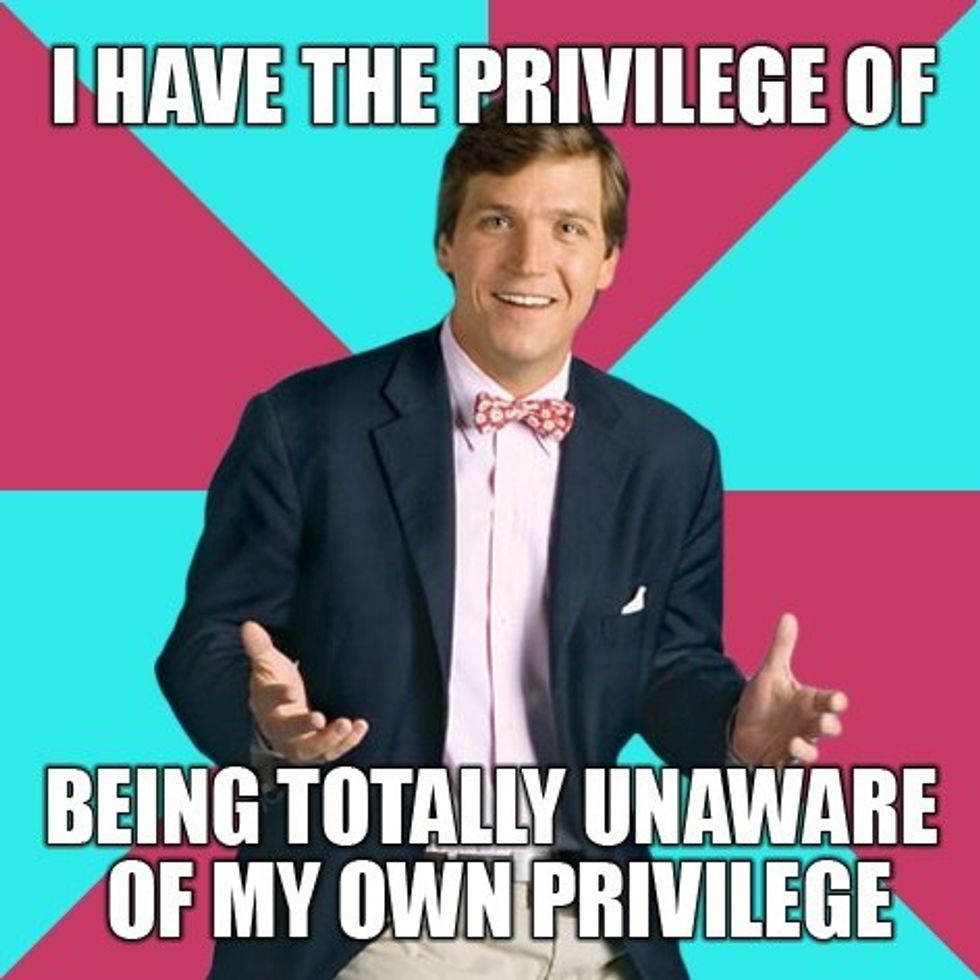
Depending on who is having the conversation, White Privilege will always be a controversial topic of discussion across the board. To some, White Privilege is a nonexistent myth while to others it is an unconstitutional and systematic oppression of a people. The majority of whites see racism as an individualistic problem when in reality race is structural; white privilege happens to be one of these structural racisms. To this day, white privilege is constantly pushing the stereotypes of African Americans, making it difficult for this group of people to prosper and achieve the so-called "American Dream." Privilege itself is a right or advantage only granted to a special person or specific group of people. With that being said, privilege paired as “white” privilege is the immunities, rights, and advantages that only White Americans benefit from on a day to day basis and African Americans suffer from.
As Peggy McIntosh (anti-racism activist) writes in her article "Unpacking the Invisible Knapsack,"
White privilege is not having to "educate my children to be aware of systemic racism for their own daily physical protection." Peggy McIntosh, an anti-racism activist, writes. I can easily find academic courses and institutions which give attention to only my race. I can be pretty sure that my children’s teachers and employers will tolerate them if they fit school and workplace norms; my chief worries about them do not concern others’ attitudes toward their race."
Now, when talking about white privilege with White Americans, there is often an uncomfortable tension that arises. This usually happens for several reasons: talk of race makes them uncomfortable, they feel attacked, or it just is irrelevant to them. To reiterate, when speaking on this topic, no one is individually calling out a white person saying, "You are racist," or, "You have it easy," but I'm trying to enlighten you on a set of privileges you benefit from because you are white. It's not pulling the race card; it's pointing out facts. It's not because blacks hate white people; it's pointing out the difference between white and black that is engrained in the society we live in.
3. Unapologetically Black

"The question is not whether Lincoln truly meant 'government of the people' but what our country has, throughout its history, taken the political term 'people' to actually mean...Thus, America's problem is not its betrayal of 'government of the people,' but means by which 'the people' acquired their names...Racism---the need to ascribe bone-deep features to people and then humiliate, reduce and destroy them---inevitably follows from this inalterable condition." (6-7)
Since the time of slavery, the term "black" has had such a negative stigma attached to it. Black is associated with violence, ugly, ghetto, thuggish, uneducated and other demeaning and reducing adjectives. Sadly, in order to fit into the "American culture," blacks have had to conform to the dominant race-white. Blacks have had to tone down their "blackness" and, in turn, try to adapt to the white perspective of what it means to be American.
Currently within the Black Lives Matter movement, more and more blacks have come to terms with their bodies transitioning from conformists to owners. By owners, I mean that blacks are no longer trying to fit the white American stereotype or trying to live in accordance with what has been the social norm. White is not the norm. White is not the default race. If we are to truly claim "American," then black is just as much American as white and any other race born in America. Sadly, the transition has not been the prettiest but it's about damn time.
Throughout history blacks were not even seen as people, but one-third of a person. Being black is nothing to be ashamed of and something to be proud of. It's time to stop treating racism and blackness as the huge white elephant in the room and time to start talking about it. Let's talk about American history the way it happened, let's admit privilege where it's being used, let's break the negative stigma and stereotype of being black.
While the legacy of slavery still lives on today we must continue to learn the truth behind the lies society tries to conform us to. In being educated and stubborn to the whiteness of our society, we are able to claim our black bodies. Claiming what is rightfully yours and being unapologetically black, is how you live in a black body.