
My two
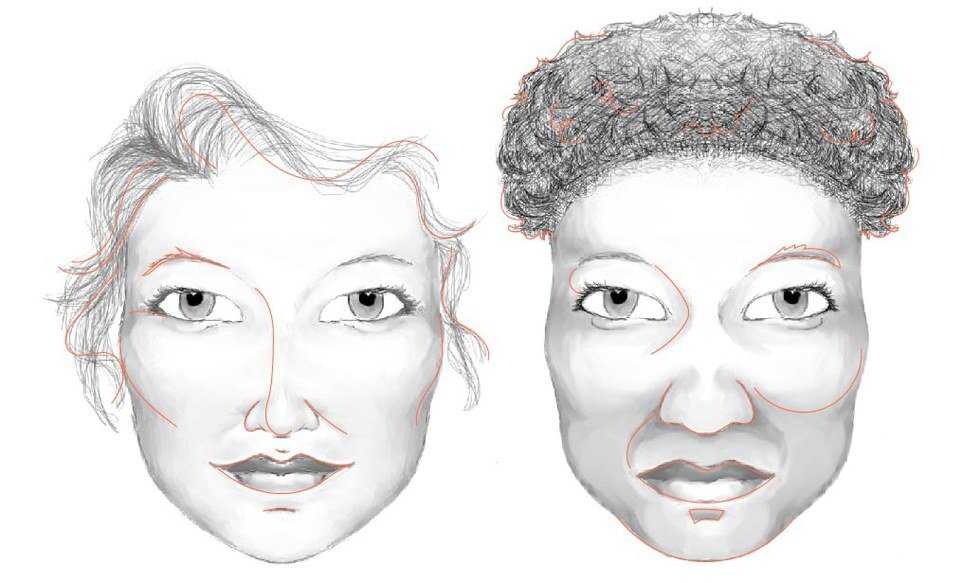
female characters started off White when I dreamed them up. Me and my dark
hands wrote into existence two fair-skinned beauties, queens, half-sisters, the
tawnier one ever jealous of the fairer. As I drew out their likenesses, my
fingers made lines for White faces. Straight lines. Calm lines on thin faces
with my mind coloring in between them using a palette of blended beiges and
peaches and light, light pinks. Just as I was trained to do. Trained by the
crayons in the crayon box and my pack of skin-toned colored pencils and the
shelves and shelves of "nude" stockings and concealers and finger
nail polish. The models in magazines. The complexion of lead actresses. The
faces of successful modern women. They are beautiful. They are White. They are
one and the same.
But there is another voice we Black women must learn, are slowly learning, to listen for, a nervous, soft-spoken other, malnourished, ill-fed, tamped down by layers and layers of White society training, by the stifling strata of societal Whitewashing. The voice says Black is beautiful. She says love your color. She says the blackberry is sweetest, the chocolate is the most inviting. She asks why my girls' skin is so pale. She asks: If these two I created to be icons of beauty will not represent that sweet blackberry allure you profess, then who will? She asks how can I say I believe Black is beautiful when my heart is so (a)fixed on the lightness of the majority's melanin.
After some fight, I decided to try it. My fair-haired goddess of beauty transformed into an ebony Barbie overnight, and I was uncomfortable, even as I colored her. My fingers tended toward tan. I kept clicking on the beiges, the lighter browns that tended like a trained compass toward the White North. I colored and re-colored. Her eyes stare back at me, wide and undaunted, while I myself sat bemused.
Because the Black doesn't fit. The Black bursts from the thin face and the smooth lines. It begs to bulge and curve. It begs to be given more notice than a White girl's mold. Like my waistline, too sloped for jeans made on White models. Like my bust line, too pronounced for close-chested dresses. Like my voice, too booming; my hair, too far-reaching in every direction, too wild for work, too casual for formal affairs. I am too much to fit into the Western world's mold. Her face is too tamed for those booming ebonies.
And I am unenchanted. Because when she was White she was beautiful. She was perfect. She snuck up on you and arrested your senses – that is her character, the character I wrote: an unassuming beauty, a White beauty. A conventional beauty that is absolute, not determined by personal preference. Black doesn't suit her. She doesn't wear it right. It's too loud, too bold, too self-aware, too idiosyncratic.
My Black Barbie shows me myself in relief. She stares back at me in Blackface with quiet admonishments and silent requests to be given a new face with new lines and new curves, to step into a new personality, a new definition of what beauty is. She says unconventional is beautiful too. She says unconventional is beautiful period. She says unconventional is not abnormal, isn't unique, any more than White is White. She says, because she must say so in order to convince me: White is Vanilla; but Chocolate is the temptress that waylays even the strongest resolve. Chocolate sucks you under, kicks you off the behave train, widens your waistlines, your bust-lines, your thighs and smiles at your new dimensions. Chocolate breaks you out of the mold that was your old normal. Chocolate is a queen of its own.
Pretty for a Black girl. That's how I see me. In spite of the words that I speak. In spite of the tunes that I sing, the posts I make public. Oreo they called me. Because I wore my Black skin like a veneer over my White heart who found beauty only in beiges and tans. My Black Barbie won't listen to me. She has her own mind. She makes a new mold. She found a voice even when silenced. My Black Barbie is beautiful in Black.

















