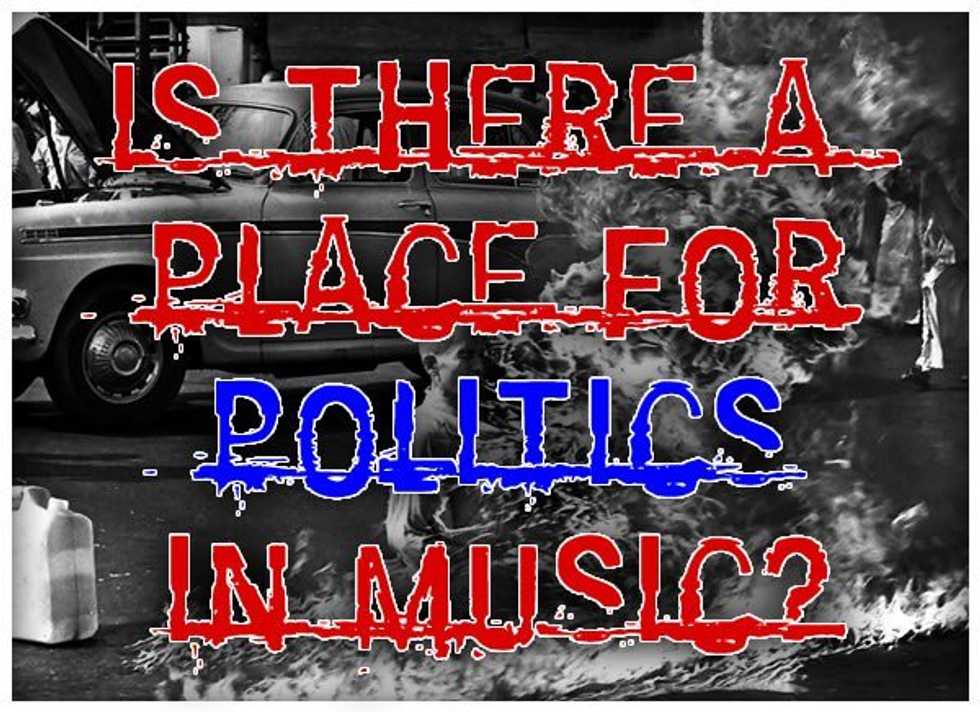
I’ve been noticing an ongoing argument pertaining to celebrities and their public political voices. Extreme controversy occurred recently when Beyonce performed “Formation” at Superbowl 50 wearing costumes in the style of the Black Panther Party. The single’s music video is intended to raise awareness of the Black Lives Matter campaign and police brutality. Another well known political protest took place last month when Bruce Springsteen and the E Street Band canceled their North Carolina concert in protest of the recent bill prohibiting transgender people from using bathrooms that differ from their birth gender.
And with any controversial political protest comes angry repercussions. As people share their views on both of these situations, I’ve tried to keep an open mind to both sides of the arguments. But one point of view was difficult to accept, namely, “Musicians have no business expressing their political opinions via song and should stick to what they know; music."
At a young age I was introduced to the music styles of almost every generation thanks to my parents, and am a firm believer that music has and will continue to impact history no matter what the most stubborn, argumentative protestor says. For example, can anyone deny the historical effect the music of the 60’s and 70’s on political decisions made regarding the Vietnam War?
So, rather than encourage the politically charged debate, I choose instead to celebrate the artists who, like Beyonce and Springsteen, used their fame to spread awareness and speak on behalf of those who aren’t as easily heard. Here's ten examples of a few of my personal favorites and what I believe to be some of the most powerful expressions.
1. Lead Belly’s “The Bourgeois Blues” (1930’s)
Lead Belly was a popular blues artist, likely unfamiliar to some who took an absolute risk with his protest single “The Bourgeois Blues.” It included lyrics such as
"The home of the Brave, The land of the Free
I don't wanna be mistreated by no bourgeoisie*”
*(Bourgeoisie is a member of the middle class or a property owner)
Belly wrote the song after visiting Washington D.C. and a response to the serious racism issues and Jim Crow laws of the time. Belly had first hand dealings with Jim Crow laws when he was refused service at hotels in the Washington D.C. area. The song is a significant part of Belly’s legacy and is honored by fellow artists such as Pete Seeger covering his song.
2. Bob Dylan’s "Blowing in the Wind" and "The Times They Are A Changin'" (1960's)
There is no doubt that Bob Dylan is one of the most famous political performers of the 60’s. In fact, he has been dubbed as “the voice of his generation.” Dylan wasn’t afraid to speak up for the movement for social change in the civil rights debate. Rather than focusing on the popularity of his music, he focused primarily on incorporating his political views into music. He cared more about social issues rather than fame and fortune. His song ”Blowin’ in the Wind” was described as one of the anthem’s for the civil rights movement, with lyrics such as:
“Yes, and how many ears must one man have
Before he can hear people cry?
Yes, and how many deaths will it take 'til he knows
That too many people have died? The answer, my friend, is blowin' in the wind”
Later on his single “The Times They Are A-Changin’” (one of my all-time favorite lyrical protest pieces) conveyed the progression of the civil rights movement,
“Come mothers and fathers
Throughout the land
And don't criticize
What you can't understand
Your sons and your daughters
Are beyond your command
Your old road is
Rapidly agin'
Please get out of the new one
If you can't lend your hand
For the times they are a-changin'.”
These lyrics in particular are calling out the older generation at the time who refused to accept civil rights reform. Although Dylan received backlash for these controversial pieces at the time, his music will be remembered for being brave and numb to the conformity that was often forced in the music industry.
3. Creedence Clearwater Revival’s “Fortunate Son” (1960’s)
Adding to the list of anti-war anthems during the 1960’s and the increasingly controversial Vietnam War was CCR’s “Fortunate Son.” What separates this song from other protest pieces was its focus on the elite, upper classes of Americans who seemed to be dodging the draft.
“Some folks inherit star spangled eyes
Ooh, they send you down to war, Lord
And when you ask them, "How much should we give?"
Ooh, they only answer More! more! more!”
The song exploits high society “fortunate sons” and their lack of commitment to the Vietnam War, when so many other young American’s were being forced into a war, dubbed almost pointless by most people of the generation, against their will.
4. Crosby, Stills, Nash, and Young’s “Ohio” (1970’s)
Needless to say, politically motivated music emerged during the Vietnam War era for obvious reasons. One of the most profound was CSN&Y’s “Ohio” about the Kent State shootings in mid 1970.
“What if you knew her
And found her dead on the ground
How can you run when you know?
Tin soldiers and Nixon coming,
We're finally on our own.
This summer I hear the drumming,
Four dead in Ohio”
These lyrics refer to the ordering of the National Guards to the rally at Kent State, and while it was confirmed that the Governor of Ohio was the one who initiated the orders, most American’s blamed Nixon for the involvement in the war altogether.
5. Pink’s “Dear Mr. President” (2000’s)
One of my favorites and, what I believe, one of the most underrated songs with a radical protest message is Pink’s 2006 song “Dear Mr. President.” This was one of the first politically charged songs that I associate with my own generation. In the piece, Pink calls out then President George W. Bush, criticizing the way he handled multiple situations during his presidency, including equal rights for homosexuals, the Iraq War, the No Child Left Behind Act, and situations regarding the poor and middle classes.
“How can you say
No child is left behind?
We're not dumb and we're not blind.
They're all sitting in your cells
While you pave the road to hell.
What kind of father would take his own daughter's rights away?
And what kind of father might hate his own daughter if she were gay?”
Pink received a lot of criticism about the song, but for the most part stood her ground, without regret, calling it one of the most important pieces of her career.
6. Marvin Gaye’s “What’s Going On” (1971)
Gaye’s entire “What’s Going On” album was a concept album from the eyes of a returning Vietnam veteran, returning to see corruption and hate. “What’s Going On” focused on police brutality after being inspired by an anti-war protest gone wrong:
“You see, war is not the answer
For only love can conquer hate
You know we've got to find a way
To bring some lovin' here today
Picket lines and picket signs
Don't punish me with brutality
Talk to me, so you can see
Oh, what's going on, what's going on”
Gaye realized after hearing about rioting and violence, and also the return of his brother Frankie from the Vietnam War, that he needed to steer away from his normal musical path of love songs, stating, “With the world exploding around me, how am I supposed to keep singing love songs?'
7. John Lennon: “Imagine”, “Give Peace a Chance” (1960’s and 70’s)
Like Dylan, John Lennon was a preeminent face of anti-war radicalism during the Vietnam War era. Lennon helped organize multiple peace rallies, including the ever famous bed-in with wife Yoko Ono, where the couple spent the two weeks, in both Amsterdam and Montreal, in bed to promote peace, which inspired his song and mantra “Give Peace a Chance.” The lyrics say it all; “All we are saying is give peace a chance” and became a common slogan for anti-Vietnam protestors. Lennon’s most famous “Imagine” was a piece of lyrical genius, often referred to as one of the simplest and best songs ever written, including lyrics;
“Imagine no possessions,
I wonder if you can.
No need for greed or hunger,
A brotherhood of man.
Imagine all the people
Sharing all the world”
Lennon was one of the most well-know peace advocates, using his music, fame, and money for the causes he felt passionate about.
8. Pete Seeger’s “Where Have All The Flowers Gone?” (1960’s)
While Pete Seeger originally wrote this song, it has been covered by multiple artists including the most well-known version by the trio Peter Paul and Mary. This song is one of my personal favorites, because it has no real definitive meaning to it. It can be interpreted in many different ways (which is its genius), although many believe the lyrics are clearly targeting anti-Vietnam protests.
“Where have all the young men gone?
Gone for soldiers, every one
When will they ever learn?”
Even though the piece has been voted one of the top political songs in history, when asked what the meaning behind it was, Seeger merely replied, “No, I think I'll just let the song stand on its own two feet. You know, a song can mean a thousand different things to different people, and when people ask me what the song means, I say, 'Whatever it means to you, it means.' But I'm not going to tell you what it means to me because that's my... well, I might destroy your illusions.”
9. Billie Holiday’s "Strange Fruit" (1930’s)
Written by teacher Abel Meeropol in the late 1930’s, “Strange Fruit” was originally a poem about racism in America and the lynching of African Americans, predominately (but not limited to) the South.
“Southern trees bear a strange fruit
Blood on the leaves and blood at the root
Black bodies swingin' in the Southern breeze
Strange fruit hangin' from the poplar trees”
Holiday at first feared repercussions, but finally agreed to include it in her act, where she performed regularly at an integrated nightclub in New York City. Many recording labels feared the backlash of recording such a controversial song at the time and rejected it and her. She eventually found the right producer who knew the song would move others the way it moved him.
10. Public Enemy’s “Fight the Power” (1980’s)
“Fight the Power” is said to be one of the most anthemic songs of its time; a period where our nation struggled with racial issues. The song elevated Public Enemy from just another hip-hop group, into political protestors.
“We got to pump the stuff to make us tough
from the heart
It's a start, a work of art
To revolutionize make a change nothin's strange
People, people we are the same”
The music video was a huge part of the song’s success, directed by Spike Lee. Lee created a mock political rally in Brooklyn, where extras carried signs that displayed the faces of Martin Luther King Jr., Chuck Berry, and Angela Davis.
Whether you agree or not, music will always be a huge part of history. These artists will continue to display their views through their work, and continue to be the voices for the rest of us who cannot be readily heard.
"I think music in itself is healing. It's an explosive expression of humanity. It's something we are all touched by. No matter what culture we're from, everyone loves music." - Billy Joel