My relationship with "Mr. Robot" is a lot like my relationship with coffee: people tell me it's good, and I really, really want to like it, but I really, really don’t. It’s bitter and dark, and it sets me on edge.
As network TV’s desperate offering to the Netflix generation, "Mr. Robot" subscribes to a specific brand of High Quality Camp™ — the sort of gritty, pseudo-realistic science fiction first popularized by "The Dark Knight." I’m not knocking the dark superhero aesthetic; plenty of shows have made it work (think Netflix’s "Daredevil"), but "Mr. Robot" sometimes lacks the self awareness necessary to justify its high concept. “I’m only a vigilante hacker by night,” our protagonist says without a trace of irony. “By day..."
I’m just a normal guy goes unsaid here, but its implied.
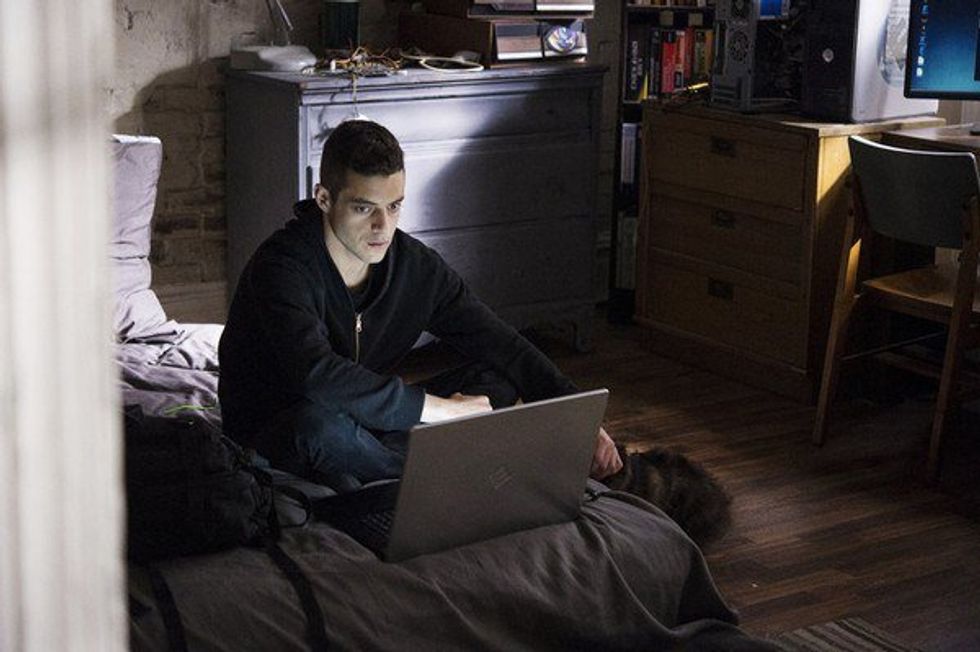
We soon find out that Elliot Alderson (Rami Malek) is not a normal guy; he’s a computer genius who spends his days Robin-Hooding digital info, taking down baddies by redistributing their internet histories.
He’s a nervy hacktivist with a heart of gold, and if that sounds cheesy —well, it kind of is.
Cheesy isn’t the problem here. Cheesy I can deal with. Honestly, my issue with "Mr. Robot" doesn’t have a whole lot to do with concept, or genre, or quality. In fact, it doesn’t have a whole lot to do with "Mr. Robot." It has to do with how TV as a whole is choosing to address social anxiety.
The internet turned me on to "Mr. Robot" a few weeks before I actually got around to watching it. There was the usual spectrum of online buzz, everything from lukewarm #cool show’s to more passionate tweets a la "this is the next 'Breaking Bad!'" (Always take those tweets with a grain of salt. I think every single show has at some point been called "the next 'Breaking Bad’" with the exception of "Better Call Saul," which is literally the next "Breaking Bad.")
I saw "Mr. Robot" praised for its directing, for its script, and for the performance of its lead actor. But the internet circles I run in are crowded with self-described fan activists; young adults, usually wielding Tumblr and Twitter accounts, who are dedicated to a) dissecting and b) viciously arguing over progressive politics in movies and TV. They’re not always right, they’re not always wrong, but they’re always on the lookout for shows that promise representation for marginalized groups.
So I found that most of the interest in "Mr. Robot" stemmed from that fact that its protagonist has a social anxiety disorder. Creator confirmed. Addressed in-script.
As someone who uses TV to deal with my own social anxiety (that stereotypical double whammy), I imagined myself the target audience of this show. I imagined a step forward in a media landscape that has been — and still is — saturated with wildly inaccurate portrayals of mental illness.
I guess you could say "Mr. Robot" is successful in this regard. Elliot displays all the typical symptoms of social anxiety: the hesitancy, the forced inaction, the harsh self criticism. He even expresses his frustration with these symptoms during a realistically staged therapy session.
But, for some reason, I was angry. I paused the pilot episode at the 40 minute mark, trying to understand where that anger was coming from. I readjusted my screen, IMDB'd an actor that I could place only vaguely (mystery solved: it was Carly Chaikin and she starred on a since-cancelled ABC sitcom), ate something unhealthy — all things that usually make me feel better.
Still, the anger remained. Its source, I realized, was this:
“I’m really good at reading people. My secret? I look for the worst in them...the world itself is just one big hoax. We’re cowards.”
A statement made by Elliot during his therapy session.
Here, Elliot insists that his social anxiety stems from a hatred of society en masse. He feels materialism has corrupted modern culture; he monologues about his distaste for "The Hunger Games," and he can't stand the forced intimacy of social media. In short, Elliot has difficulty talking to people because he dislikes them.
This is where "Mr. Robot" and shows like it fail in their representation of social anxiety — not in portrayal of symptoms, but in portrayal of cause. The onset and severity of this disorder, like many others, is dependent on a wide range of factors, from environment, to genetics, to stress levels. While some people may attribute their social anxiety to a fundamental dislike of other human beings, this is not the norm.
In feeding us a standard image of social anxiety, TV insinuates that this standard exists in real life, that the disorder affects all of its sufferers in the same way, and that every single one of those sufferers hates you.
No matter what "Mr. Robot" has to say, we really, really don't.