


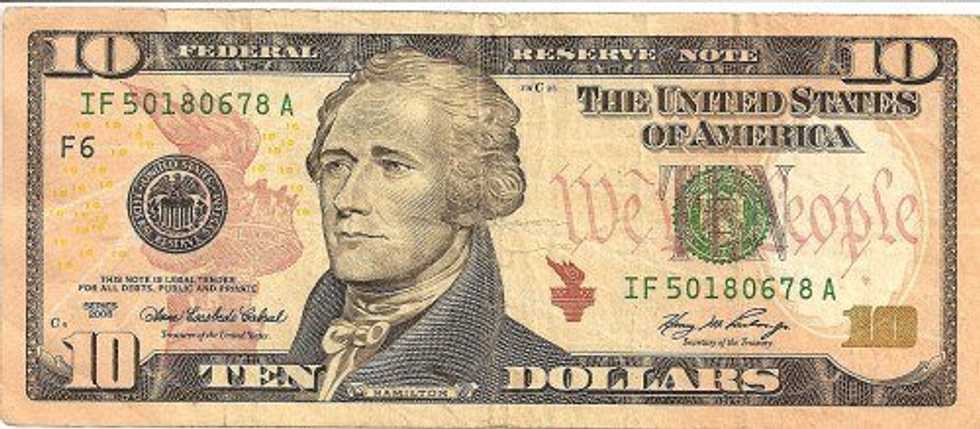
Something awesome this way comes! In June, the U.S. Department of Treasury announced plans to redesign the $10 bill in an effort to prevent counterfeit money. But instead of putting a former president or another politician on the face, they’re going to replace Alexander Hamilton with a woman. That’s right equality, we’re comin’ for ya.
U.S. Treasury Secretary, Jack Lew, isn’t just kicking us in the face with this crazy piece of news and then retreating back into his lair of badassery—oh no. He and the rest of the department have asked for the help of their fellow Americans in selecting the lucky lady. The hashtag #TheNew10 has been started for Lew and his officials to receive opinions and feedback regarding who it should be. And then, to top it all off, the bill will begin circulating in 2020—which just so happens to be the 100th anniversary of the 19th amendment to the Constitution, granting women voting rights. Jack Lew, you are one slick son of a gun.
Lew only had a few qualifications for candidates to be eligible for this honor. First, the woman must no longer be living; and second, she must highlight American Democracy in some way. So, where do we as a public even begin to look? The number of women who have shaped history is immeasurable. Can we honestly be expected to pick just one? Can they maybe take turns every few years? Are we sure Beyonce isn’t an exception?
Let’s start by looking at 6 incredibly notable women who would make fine representatives for women everywhere.
1. Clara Barton
Clara Barton founded the American Red Cross, and before that she voluntarily cared for soldiers on both sides during the Civil War. She was an ordinary civilian during war time who found resources to treat the soliders’ wounds, feed them, clothe them, house them, etc., and the woman never stopped. She got permission to enter battle fields to tend to them and everything. She traveled to Europe and discovered the International Red Cross before helping out during the Franco-Prussian War, and then decided she wanted to start the American Red Cross. So she came home to the U.S. of A, bugged a couple of presidents until they signed her bill and the Red Cross was born. If Clara Barton doesn’t scream democracy, who does? Read more about Barton at redcross.org.
2. Esther Peterson
Esther Peterson dedicated her life to worker’s rights. She participated in countless strikes in her younger years, eventually becoming an organizer, and joined several unions. This led her to Washington, D.C., as a union lobbyist and she got assigned to the new representative on the block, John F. Kennedy. Kennedy became president in 1961 and appointed her head of the Women’s Bureau in the Department of Labor before she became a driving force for the passage of the Equal Pay Act of 1963. Peterson went on to become the Assistant Director of Labor before being appointed as a United Nations General Assembly delegate by President Clinton in 1993. And that’s just the highlights folks. Peterson was a serious force to be reckoned with, find out more about her at aflcio.org.
3. Eleanor Roosevelt
Eleanor Roosevelt was married to former President Franklin D. Roosevelt, who was her distant cousin if you didn’t know. Eleanor was known as the “eyes and ears” for her husband; she informed him of what issues needed to be addressed and the like. Eleanor transformed the role of First Lady. She had an unprecedented understanding of social conditions, and this enabled her to connect with Americans on a new level. She traveled the nation, held conferences and broadcasts, wrote a daily column, went abroad to visit servicemen during World War II, etc. Soon she was hailed as a humanitarian for her passion and unwavering loyalty to the American people. She became a delegate for the United Nations after FDR’s death, and she worked for the passage of the Universal Declaration of Human Rights in 1948. She was dedicated to America’s people and democracy, using one of the most underrated positions to the advantage of our nation. You can learn more at whitehouse.gov.
4. Harriet Tubman
Harriet Tubman was born as a plantation slave around 1820 in Maryland. Tubman and two of her brothers were able to escape after the plantation owner’s death, but her brothers freaked out and returned to the plantation. She used the Underground Railroad to get to Pennsylvania, a free state. Tubman was a conductor on the Underground Railroad for more than ten years, and she was infamous for threatening to shoot anyone who got scared and tried to go back, telling them slavery was worse than death. She is responsible for the freedom of countless slaves. During the Civil War, Tubman served as a cook, nurse, spy and scout. She recruited freed slaves to make the African American ranks, and even led an assault that set 700 slaves free. After the Emancipation Proclamation, she became involved with women’s suffrage, and donated her land in Auburn, New York to be made into a home for the aged. And if that doesn’t get you right in the feels, she once underwent brain surgery and refused anesthesia, chewing on a bullet like soldiers during battle instead. I wouldn’t have ever messed with this chick. Find out more about her at harriet-tubman.org.
5. Constance Baker Motley
Constance Baker Motley was born to a huge family in Connecticut. Her mother, Rachel Baker, was the founder of the New Haven National Association for the Advancement of Colored People (no big deal or anything). After being kicked off a beach for being black, Motley decided to become a lawyer so she could get involved with civil rights. She also served as the president of the local NAACP youth council in high school. She earned both an economics degree and a law degree before becoming a law clerk for Thurgood Marshall in 1945. This led her work for the NAACP’s Legal Defense and Educational Fund, and helped draft the complaint in 1950 for the iconic Brown v. Board of Education. She went on to represent the likes of Martin Luther King Jr. and multiple Freedom Fighters as their legal counsel, arguing and winning more than ten cases before the Supreme Court. Motley became the first black woman to be elected to the New York State Senate, as well as the first black woman to serve as a federal judge. She served in that role for the rest of her life, becoming an icon and making history. If you want to know more about Motley, you can visit biography.com.
6. Elizabeth Cady Stanton
Elizabeth Cady Stanton was a certified badass. She studied law in her congressman father’s office, where she started to see how discriminatory legislation was toward women. After marrying an abolitionist and having the word “obey” dropped from their Catholic ceremony because, again, she’s a certified badass, she went to a series of anti-slavery rallies and was appalled to see how many women were denied recognition based on their sex. She officially launched the women’s rights campaign in 1848 with a convention in Seneca Falls and it also began the fight for women’s suffrage. In 1851, Susan B. Anthony joined Stanton and for the next 50 years the two of them were like peas and carrots. They planned campaigns, held conventions, gave speeches, held demonstrations in the streets and did anything they could to continue the fight. She addressed the New York legislature in 1854 and this became the grounds to grant married women wage and property rights and equal guardianship to their children in 1860. She and Anthony cofounded many organizations over the years that addressed women’s rights. Stanton’s work, both with her counterparts and individually, was repeatedly mentioned during legislation that led to women gaining the right to vote in 1920. Brittanica.com has more information regarding Stanton and her life.
If you thought that was a lot of information, go search #TheNext10 and have your mind blown. These are just six notable women in America’s history. Can you imagine how many more are out there, waiting for someone to make a case for them? If you’re still on the fence and want to do some discovering of your own, nwhp.org has a massive compilation of women who should be considered. Who do you think should be on #TheNext10?
















