

Model Minority:
(n.) A minority group (whether based on ethnicity, race or religion) whose members are perceived to achieve a higher degree of socioeconomic success than the population average. This success is typically measured in income,education, low crime rates and high family stability. [source]
Asian-Americans are a group of people that are considered a model minority. It is assumed that by working hard, they have risen to the top and become successful. Sounds great, doesn’t it?
The Model Minority Myth
The belief that Asian-Americans are a model minority is considered a myth by many who seek to combat the implications of the label. Why is it harmful? There are a number of reasons.
The stereotypes perpetuated by the model minority myth—Asians are good at math, Asians become doctors, Asians are wealthy—might seem positive on the surface. But in reality, they have negative affects: They erase the accomplishments of Asian students, for example, who do work hard to get those good grades. Or alternatively, these stereotypes set unrealistic expectations for Asian-Americans who may not fit into the "ideal". Within Asian communities, young people can face an intense amount of pressure from their families and competition from their peers due to the idea that they must succeed, and in a way that is culturally acceptable.
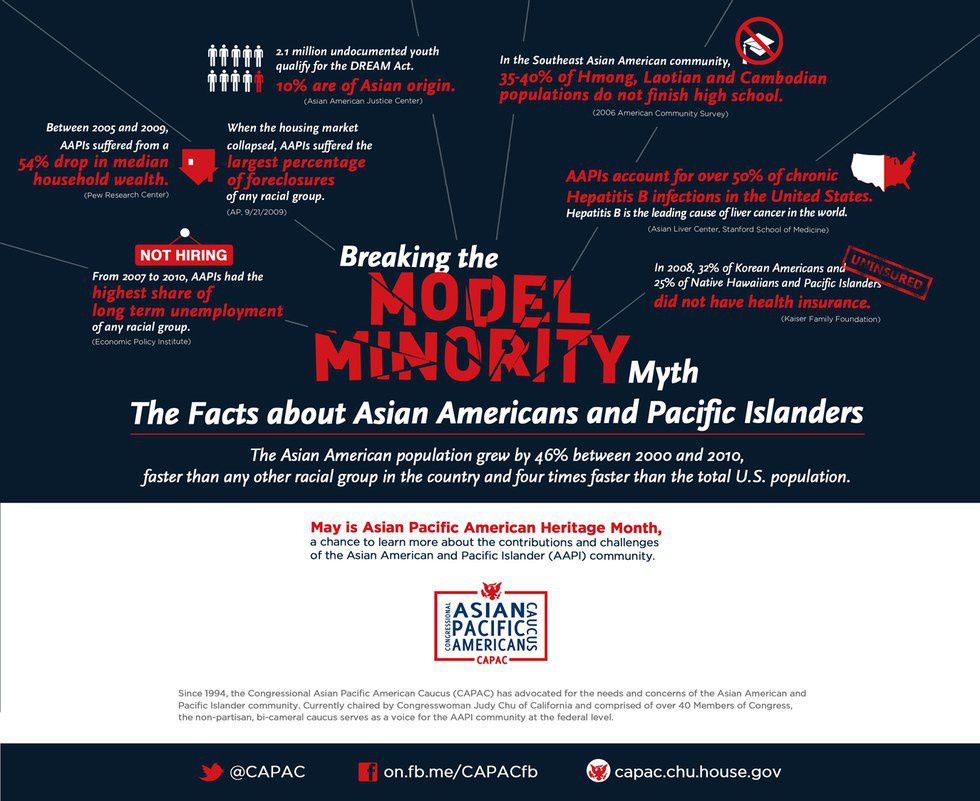
The model minority myth also homogenizes Asian-Americans. Low-income Asian families of all ethnicities are ignored and erased when people assume all Asian families are well-off. Immigrants who came from Southeast Asian countries like Laos and Cambodia escaped political turmoil and violence in their home countries, incongruent with the idea that Asian immigrants were lucky in their home countries and came here for jobs.
The myth also erases the racism that Asian-Americans faced in the past and the historical struggle they underwent: Asian immigrants faced quotas, laws against obtaining citizenship that came straight from the Supreme Court, labor abuses and indentured servitude, and racist violence.
The myth also distracts from the problems faced by Asians today. Language barriers cause problems for immigrants in accessing information in a number of areas, such as voting or getting health insurance. Asians are still often times portrayed as the butt of a joke in the media, most recently coming in the form of an insensitive quip about child labor from Chris Rock at the Oscars. Asians are also still victims of hate crimes, violence and murder.
The Myth as a Tool Against Solidarity
The most significant implication of the model minority myth is that it is used against other minority groups. While holding Asian-Americans up as the model, other minority groups, like Black and Latino people, are held down. By saying Asians have "reached the top" through hard work, these other traditionally marginalized groups are questioned why they haven't reached the same level of success. As we all know, stereotypes against Black and Latino people already include accusations of laziness and being in poverty.
As Asians, we need to make sure that we do not buy into white supremacy by accepting the model minority myth. It is possible for Asian-Americans to benefit from white supremacy through contributing to the oppression of groups like Black and Latino people. We cannot accept this. The Asian-American community already has great issues with anti-blackness.
This shows in the case of Peter Liang. Recently, it was decided that Peter Liang, an NYPD police officer of Chinese descent, will not be going to prison for killing Akai Gurley in 2014. As many already know, the story is that Officer Liang's gun accidentally went off, hitting Gurley, a black man, and leading to his death. Liang was charged, and therefore many Chinese-Americans protested because they believed Liang was a sort of scapegoat.
While it is worthwhile to note that if a white officer had shot the young man, he may not have even been indicted, the fact of the matter is that the life of a black man was still taken and someone needed to be held accountable. Asian-American communities cannot be counterproductive to the fight for racial equality. We need to stand in solidarity with movements like Black Lives Matter, as we have done in the past with civil rights efforts, and protest causes that truly pertain to Asian America and the benefit of all in the fight against racism.

















