

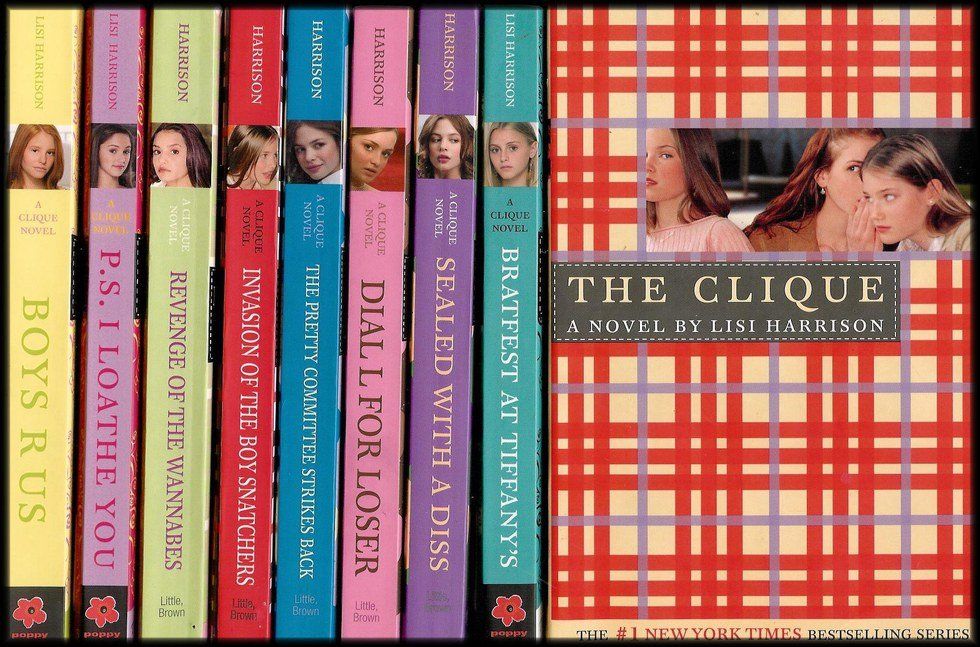
I remember being around the age of ten and regularly visiting bookstores. I would always pick up two or three books, usually from the children’s section. I had never explored any of the other sections until I saw a giant display at the front advertising a new book. It was from a series I had never heard of called The Clique. The cover was adorned with preteen girls in knee-high socks and skirts, and the title was something involving a cutesy play on words, like “Boys R Us” or “It’s Not Easy Being Mean.”
Intrigued, I picked up the book and read the back synopsis. It described in big bold letters how this clique, unapologetically called “The Pretty Committee”, would steal boyfriends, stab each other in the back, and wear the “CUH-utest clothes”. My ten year-old self wanted to read more of this immediately. Maybe because the behavior described here was unlike anything I had heard about before. Maybe because I was curious to see how middle school-aged girls acted. Either way, I convinced my mom to buy me the first three books in the set.
I now know how damaging this would become.
This series describes the lives of a group of girls who attend a private school. They are all pretty, thin, and disgustingly wealthy. Sometimes whole pages are used to describe an outfit. However, these young women (7th graders in the first few novels) spend their time relentlessly bullying other students and even adults. They base a person’s worth on how many boys they’ve kissed, how much their clothes cost, and if they’re “developed” enough. This alone is disgusting, and it’s displayed in only the first few chapters. To add on to this, the girls constantly stab each other in the back, curse, and throw wild parties.
Being young and impressionable, I assumed this was how all middle school aged girls behaved. The books never explicitly pointed out the girls in the Pretty Committee were, to put it blatantly, spoiled brats, so I didn’t question it. I craved their extravagant lifestyle and popularity. I constantly worried about my appearance and weight. I was only ten and thinking about dieting. I continued to read these books into the beginning of middle school.
According to The Clique series, and every other middle school fiction book, in order to be “cool” I had to beat out all the other girls to climb to the top of the social ladder. I tried desperately to form my own “clique” and become the most popular girl in school. All I cared about was popularity. I bullied other girls, convinced they were all out to get me. In reality, I was trying to create a situation that wasn’t there to fit my narrative of becoming the most popular girl in school. The books described every school and friend group having a rigid hierarchy, which was not the case where I went. I had not been able to separate a silly fiction book series from real life.
The twisted mindset I attained from reading said books caused my peers to despise me. No one wanted to be around me. My quest for popularity made my delusion of everyone being against me into a reality. This carried into seventh grade year, causing me to be too scared to make friends and annoying everyone by constantly talking about how I “had to destroy” people to get my “reputation” back. I was miserable. Deep down I knew I was doing something wrong, but I could not pinpoint it. It got to the point where in eighth grade year I needed to see a therapist once a week and was put on antidepressants. By this point I had stopped reading the books as I had outgrown them, but the mentality stayed behind. However, the therapy gave me the confidence I had been lacking for so long to talk to new people, and my problems minimized.
It has been five years since I first picked up that set of books and began my “quest” for popularity. The endless collection of middle school fiction still sits on my shelf. I’m still remembered as the girl who tried to pit everyone against each other by fitting them into a box, a Caste system, just to fit my twisted view of what I believed middle school to be like. Book series like The Clique, and even teen books such as Pretty Little Liars, convey that the only way to be truly popular is to bully other girls, get a boyfriend, and fit societal standards of beauty.
Thousands of young, impressionable girls buy these books each year and believe this is how they should be. The authors should realize how much influence they have over their audience and appropriately alter the content and morals of their future books. I would never want someone as young as I was while reading these novels feeling like they need to act a certain way to gain friends or recognition.
So the next time you see a bratty teen novel displayed at Barns & Noble, let's just say it won't end "pretty".















