I have spent many hours sitting at my computer -- typing, deleting and editing the words on my screen. I have been debating with myself whether or not to write this in fear of not doing the topic justice. However, I've decided to give it a go, with the hope that it turns out okay. I figured it is better to continue the discussion rather than ignore it as numerous others have. I want to thank my roommate for inviting me to the 2016 Posse Plus Retreat (PPR) and to the students, faculty, and event staff who made it so memorable.

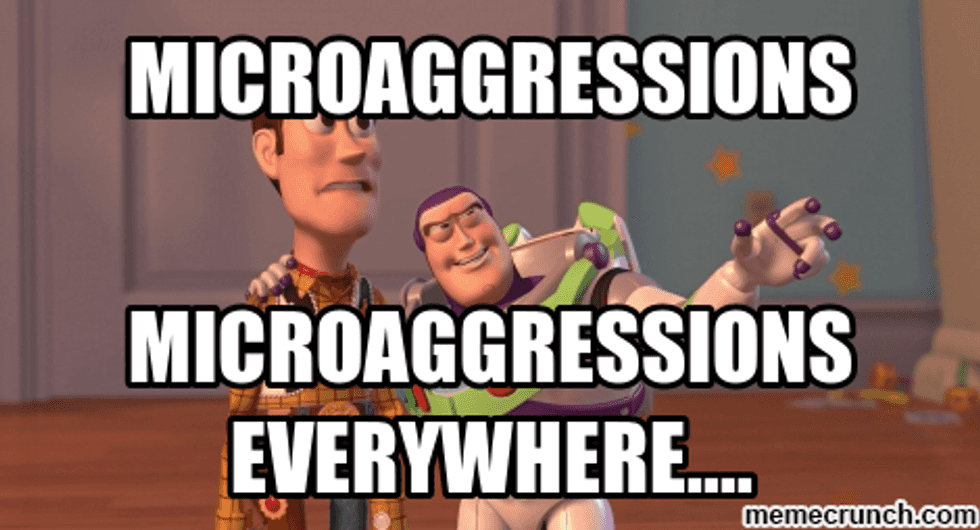
When the term, "microaggression," was first mentioned at the PPR, I was puzzled as to what it meant, and confused as to why I had not come across it before. After learning about what it means and discussing some examples, I've realized that I had been desensitized to microaggression because it is everywhere -- casual conversation, televised news, and especially social media. Now that I understand the gravity of microaggression, I hope to better myself by being more conscious of my thoughts, words, and actions. I hope that this article informs people of this social force and highlights its impact on our society.

Below I have provided the PPR definition and some examples of microaggression.
"Microaggressions are the everyday verbal, nonverbal, and environmental slights, snubs, or insults, whether intentional or unintentional, that communicate hostile, derogatory, or negative messages to target persons based solely upon their marginalized group membership."
Verbal examples:
"You're really pretty for a black girl."
"What are you?"
"I'm not racist. I have a few black friends."
"You are a credit to your race."
"As a woman, I know what you go through as a racial minority."

Non-verbal microaggressions include the following:
Someone is not willing to learn or pronounce non-Engilsh names even though they've been corrected more than once.
Locking the car doors when a person of color walks by on the street.
Denying the experiences of students by questioning the credibility or validity of their stories.

In high school, a few of my peers (not just one) mentioned that I have big eyes for an Asian. Back then, I simply took it as an odd compliment and went about my day, my own ignorance shielding me from realizing the underlying message. After PPR, I have thought back to this statement and realized that its qualifier ("...for an Asian") generalizes an entire race by implying that "all Asians have small eyes."

An example of microaggression that is not based on something as observable as eye shape, would be the phrase, "Wow, you're so articulate," directed towards a person of color. As Keyla Ynoa mentions in her article, this phrase can imply one's own disbelief in a person of color's ability to read, write and speak properly. Although the phrase is, technically, a compliment, the underlying message is negative. It implies that they believe that people of color are not articulate or well spoken as white people. Some may argue that this phrase is just a compliment and does not actually hold any deeper implications, but if you think about it this way, do people question a white person's ability to read and write properly?

Microaggression can also be found in the way people classify each other based on material objects. For instance, some people classify African-Americans who wear Jordans (as in the brand of shoe) as "ghetto," or of lower economic status. If someone were to say, "Well [that person] wears Jordans..." he or she is implying a derogatory message and stereotype towards a group of people. In this case, the microaggression is less explicit since it's masked by coded language. By mentioning Jordans, the perpetrator hides what he or she actually means by using "Jordans" as a code word for "ghetto." This exemplifies how microaggression can also be an adopted way of thinking as well as hidden within coded language.

Obviously, some people can be innocent and not realize how offensive their words can be. We can easily combat this naiveté with communication. Asking genuine questions about what may be considered offensive shows one's awareness of others' feelings and experiences as well as an honest effort to understand the issue. Some people think that words can never be taken back after they have been said, but it is never too late to apologize and clear the air instead of letting the hostile, derogatory, or negative message(s) linger. Remember that it is OK to acknowledge your own ignorance. In order to grow as individuals and as a society we need to realize, identify, and inform each other about microaggresion, as it prevents inclusiveness and leads to segregations and disparity within our society.
Photos used in this piece were taken by photographer Kiyun, who asked her friends at Fordham University’s Lincoln Center campus to “write down an instance of racial microaggression they have faced.”