

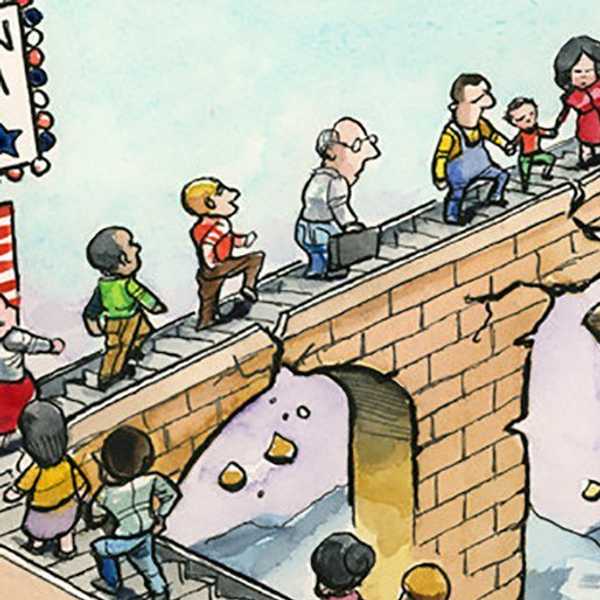

Webster dictionary defines Meritocracy as "a system in which the talented are chosen and moved ahead on the basis of their achievement." Simply put: anyone with the necessary effort and ability to succeed will achieve success. The idea of meritocracy appeals to many Americans because it reinforces autonomy, work ethic, and the promise of social mobility if it is 'earned.' For instance, a student who is held back a grade is condemned as being unmotivated (lazy), or incapable. A person convicted of a crime is usually perceived as having had justice handed to them. Capitalists, or folks with the wealth of labor, are commonly characterized by the greater American society as headstrong, assertive, and hard-working.
On the surface, the student, the convict, and the capitalist are all seemingly deserving of their positions. The student may have missed some homework, failed some assessments, or performed low enough by school standards to fail. The convict could actually have made an unlawful infraction. Likewise, the capitalist could have worked diligently in school and in the market. However, no meritocratic ideal explains the gray areas wherein many well-capable and industrious students achieve at lower rates than other students. Neither do any meritocratic ideals explain why crimes such as drug usage are severely punishable in some communities and are grounds for rehabilitation in other communities. The primary issue is the assumption that we are all on an even playing field. Furthermore, the negated paraphrasing of meritocracy usually sounds a lot like 'if you don't work hard, you won't get far. This meritocratic ideal is not a general rule in that it does not consider the many American families who have had wealth for generations.
My overall critique of the American value of meritocracy is that it does not consider social context. Meritocracy has been the fabric of American society since the establishment of universal education. School became known as the "great equalizer," despite the fact that American public schools ( & public anything for that matter) were segregated on the basis of race until the 1960's and on the basis of class even to this day (public schools are funded by the property tax of their respective school district, which varies contingently upon the income of that district). It is of my opinion that meritocracy has only been used as a sweet excuse for American inequality and social immobility. As stated earlier, meritocracy disregards social context. The particular fallacy that meritocracy makes is called post hoc, ergo propter hoc, which simply translates into since this followed that, that must be the cause of this. This unintelligent reasoning is used to justify systemic sexism and racism. By this logic, women work 3/4 as hard as men in the workplace and Black people are more prone to criminality. I know -- sounds stupid, but let's be honest, so have been the ideas that this country has been expanded upon. Meritocracy is merely a contemporary reincarnation of Manifest Destiny, which loosely translates to "I'm white, so I deserve anything I want."
After centuries of reform, America is still a very much stratified nation. The only difference now is that we convince people that they are deserving of their positions in life, no matter where those may be. We got politically correct about how we value some lives more than others. Today's conservative protest is one against that political correctness. However, this protest is in no way a means to eliminate that stratification, they just want to go back to the "great" ol' days when the non-male, the non-white, and those that identify with unconventional sexualities were disempowered enough to be repressed without creating a mainstream uproar.
















