
I must begin by saying a huge thank you to all who read, shared, or commented on my first article. The positive responses that I received began to make me second-guess promising a part two for fear it would not live up to the first! I even cleaned my keyboard in procrastination, which was long overdue. So here I am, sitting in front of a clean computer, ready for God to move my fingers and somehow make sense of my disorganized thoughts.
Let's "get our feet wet," shall we?
1. Foot Washing
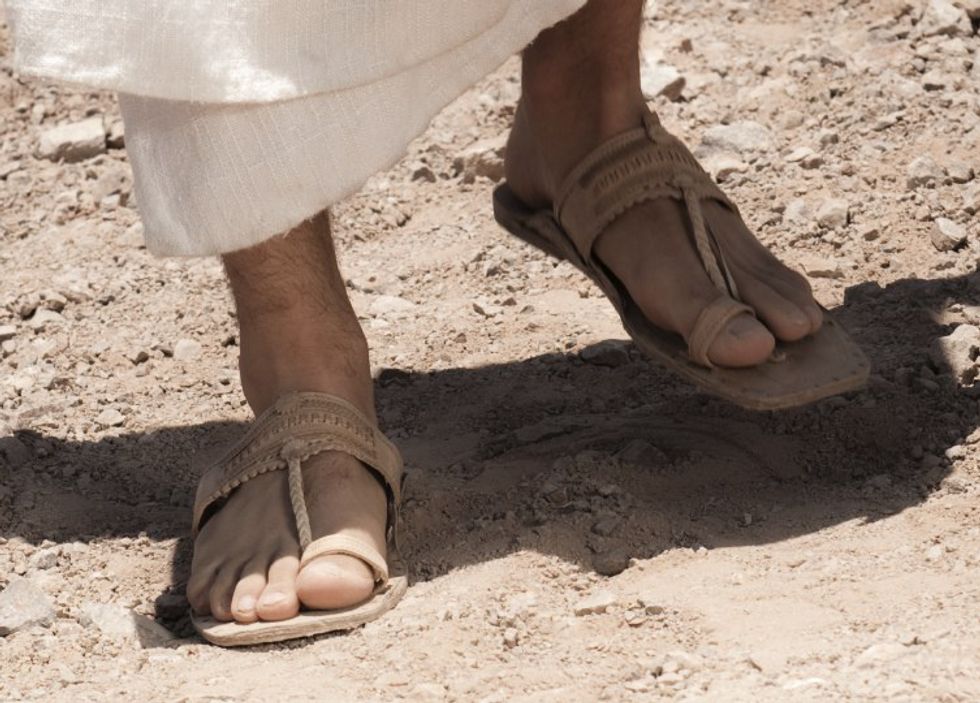
I have a friend who is absolutely terrified of feet. When I found this out, I proceeded to stick my feet inside her personal bubble as often as I could just to watch her squirm. Feet are seen as dirty, smelly, and "something to be covered" in our society. I have met quite a few people who are self-conscious of the way their feet look and are genuinely embarrassed when other people look at their feet. By revealing that covered and smelly part of the body during foot washing, we reveal to each other that we are not perfect, and remind ourselves we need cleansing from time to time.
In biblical times, people didn't wash each other's feet for fun. They did it to show devotion and servitude to someone of higher status. Jesus totally disregarded this social norm when he washed his disciples' feet. His disciples did not understand, and one tried to refuse his service. Jesus wanted to wash their feet to show that anyone can be a servant. This practice has absolutely nothing to do with clean feet. It is about serving one another as Christ served us, no matter what shoes you have on or what social class you belong to. It shows a respect for each person involved, both getting to serve and be served.
The Mennonite Confession of Faith states that foot washing is not practiced by all churches, but is encouraged. My home congregation practiced foot washing every once and awhile but certainly not on a regular basis. I remember as kids we would wash each other's shoes and joke around. I really didn't see the point. After doing some research and giving more thought to the topic, I am excited to take it seriously the next time I get the chance.
"Will you let me be your servant, let me be as Christ to you. Pray that I may have the grace to let you be my servant too."
2. God Bless America?

Every time I hear this phrase I cringe.
It's not because I hate America, it's not because I don't want God to bless America... but I want God to bless the rest of the world, too. Saying "God Bless America" contributes to the elitist belief that our government is here to rescue other nations that haven't been quite as blessed as we have.
Article 23 of our confession of faith is devoted to our relationship with government and society. It states that the CHURCH is God's holy nation. Not America. The fact that America was founded on the basis of Christian beliefs does not in any way make our nation a Christian one. It does not make our nation better than another. Our allegiance, before anything else, should be to God and the work of his church.
To put our allegiance in a country is dangerous. Leaders will sin, empires will fall, borders will change. The church has no boundaries and needs no war to protect it. In the end, laws can only change behavior, but it is God who changes hearts.
Making more "Christian friendly" laws will not make more Christian people.
I think we have forgotten that Jesus told us Christianity would not be popular. He told us it was not supposed to be easy. We have forgotten that he said, "blessed are the persecuted."
We are to act according to God's law no matter what the laws of our country may be. For it is when we are persecuted that people will know the depth of our belief and commitment to Christ. It would be easy to be a Christian in a real "Christian nation," but that nation does not exist, and the Christian road is not meant to be easy.
We can hope and pray that our nation improves the lives of all who live there, we can pray for and respect those who hold political power, and those who bring about justice. But we cannot put our faith in them, we cannot idolize them, for our hope comes from God alone.
"A government can provide good housing, but folks can have a house without having a home. We can keep people breathing with good health care, but they still may not really be alive. The work of community, love, reconciliation, restoration is the work we cannot leave up to politicians. This is the work we are all called to do." - Shane Claiborne in Red Letter Revolution.3. Community Emphasis

"How many Mennonites does it take to change a lightbulb? 11! One to change the lightbulb and 10 to cook the food."
Growing up I did not realize the value Mennonites put on community because I thought all churches operated the way we did. When a few of my high school friends came to visit my church they would always say how different it was from other services they attended. Sure, we sang hymns in four-part harmony but it couldn't be that weird, right? It wasn't until college, as I began to branch out and find a new church, that I became aware of how important community is.
At First Mennonite, my home church, everyone knew everyone. I still feel comfortable having conversations with each person at that church because of how much time we spent together in fellowship. There was a point in the service where the microphone was passed around and anyone in the congregation who had a praise or a prayer request was encouraged to share aloud. I had heard crying, clapping, laughter, happy announcements, and heartbreaking stories this way. This is what I missed the most when visiting other churches. I could not believe that other denominations didn't do this because it was so normal to me. By sharing joys and sorrows, we got to know one another and learned how to best serve each individual.
In our church directory, after listing names, contact information, birthdays, and anniversaries, each family listed items or skills they had to share with the rest of the congregation. My dad listed all 6 seasons of LOST, others offered tents, air mattresses, plumbing or electric services, and babysitting. This was a way to show that everything we owned, and each skill we had developed was a gift from God. It may sound odd that through borrowing TV shows or fixing a toilet we can spread the kingdom of God, but that is what living in a community looks like. What belongs to one belongs to all, and each of our small individual gifts can combine to make something great.
We also held parties for every occasion such as Christmas, New Years, and the Super Bowl, because going too long without playing Rook or Dutch Blitz could have a negative impact on your health! We had a carry-in meal on the third Sunday of every month and a campout at a lake once a year. It has been great attending a new church sixteen hours away and getting to know their twist on similar Mennonite traditions.
Jesus set the prime example of community during his lifetime. He was devoted to teaching the gospel, but also to learning people's stories. He made sure people had enough to eat when he fed the 5000, and he did not reject anyone who wanted to learn more. God is relational, and we were made in his image. He built us to be drawn to others in friendship and in love so that we can grow, and be challenged and learn more about him every day
4. The Mennonite Game
This game is built upon the idea that any two Mennonites, no matter where they are from, happen to be connected in some way. Your job when meeting a fellow Mennonite is to find that connection as quickly as possible!
For example, I met a Menno from Pennsylvania and ended up being her roommate. It didn't take us long to find out that her sister was once roommates with my pastor's daughter. I attended a fish fry in Kansas one time, and through the Mennonite game found out one of the ladies sitting at my table was my great aunt's sister! I got a text later that night from my grandparents because they had heard the news of who I had met. My favorite story is when my professor introduced me to a family he knew just because he knew we were both Mennonite and our last names were similar. Turns out, our grandfathers were brothers and she had been a pen pal with my sister for years before hand!
Through Mennonite conventions, church get-togethers, summer camps, and more, we all end up being connected or related if you go back far enough. It's a Menno's favorite method of social interaction!