
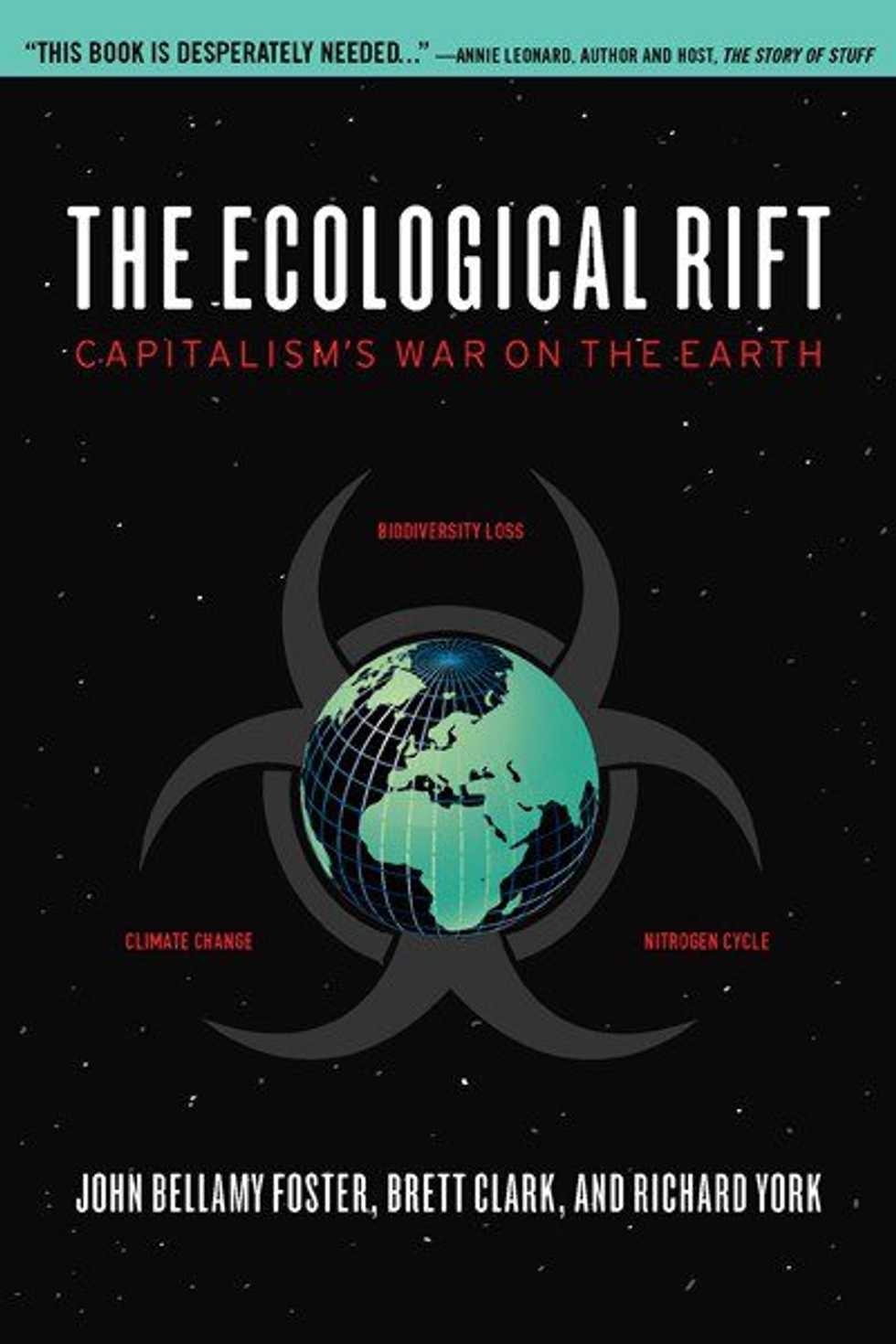
Each individual human being is equivalent to the atom of a molecule, and society is the molecule being examined under the microscope. The unfortunate entropy of society lies solely within the hands of capitalism and the unfair trade of power, goods and money. There is, however, a transition in the exchange of energy throughout the land, people and the systems. Capitalism has been “influencing human interactions with nature, shaping the particular organization of material exchange,” as quoted from "The Ecological Rift: Capitalism’s War on the Earth" by John Foster, Richard York, and Brett Clark. Due to the difference in societal changes and regulations, the exchange between material goods, natural goods, and human labor is never equivocal in terms of the economy.
Nature has fallen subject to capital and because of the shift from using the planets own substances for survival, to the overcasting our power in and onto nature. In the chapter "The Ecology of Consumption," the authors mention that “culture is an autonomous realm that has no direct relation to material productive conditions (but mainly indirectly determine the latter).” Thus, creating an imbalanced cycle between man and nature, nature and society, and even between society and man. Culture is created by man, for man. As human labor is more prevalent, the division of labor in society is biased to an extent where “mainstream economists are trained in the promotion of private profits as the singular “bottom line” of society, even at the expense of larger issues of human welfare and the environment.”
The Lauderdale paradox has come to show very evidently true throughout the last century, using the promotion of private riches through the destruction of public wealth, and thusly, human labor. In the clip, "The Story of Stuff," Annie Leonard brings up the serious lack of attention brought on the unfair pricing in market trading; the value an object, even though the processes and dissection of the item’s history is worth more than what is marketed. Under what aspect have humans changed so much that we need to find outside resources, create new things, and legitimize everything we do that slowly take away from this planet, even to the basics as recycling, even though it is making a slow impact?
What is nature? In elementary school, one is taught that nature is what surrounds you, the objects we take for granted. However, nature has always had an economic price tag that comes with it. When I look out a window, I see trees that have been planted for aesthetic appeal, leaves raked, flowers planted, and dirt that has to be pampered every couple times a tour group wants to host overnight students. Nature seems to have a big effect on the economical trade system, especially in regards to diet and marketing: fruits, veggies, and other corporate owned farms. As "The Ecological Rift" notes, “society is an organic whole, from which we abstract for purposes of investigation. Production and consumption, as elements of this unity, belong to a single metabolism.”
The reason why people feel the need to invest in the commodity of gardening and aesthetics is because we want things to be marketable. We want people to invest in our brand because we also put effort in building a community. This theoretically creates a good industrial complex and trade in man labor for pay, but that’s not the case. “Agriculture no longer finds the natural conditions of its own production within itself, naturally, arisen , spontaneous, and ready to hand but these exist as an independent industry separate from it – and, with this separateness the whole complex set of interconnections in which this industry exists is drawn into the sphere of the conditions of agricultural production.” Aldo Leopold said, “we abuse land,” and that is exactly what we are doing when we want “the production of high-quality goods [which] increases production costs and decreases sales.” If it were not for the investors of aesthetic and feel the pressure of society, there would be no sale and production in exotic flowers, and professional gardening means. There is no negative means having an appeal to the aesthetic of our surroundings, however, sustainability is always a struggle no matter where one goes.
Even though recycling can be seen as a benefit, there are only certain circumstances in which the human garbage we produce can be recycled and limitations on to how to recycle something. Recycling may help reduce the carbon footprint, however, it still takes other processes that require many other steps, tools, and restrictions in order to process fully. The millennials are slowly making a transition towards being more “green” with the environment. Wesleyan University promotes the use of the “to-go” plastic lunch box. It’s helpful, takes up some space, but also promotes the means of being out and about during the day and makes the impression that lunch is even a hassle.
Even though it has been a good movement, the issues “of social metabolic reproduction, has some of the most penetrating and prescient analysis of the ecological problem.” It makes me almost question another area of capitalism: industrialization. This form of commodity creates new sources of power where power is desired to fuel the machines that are allowed for production to take place on a growing scale. I thoroughly understand that having had friends’ parents’ jobs replaced by robots. Everything now is based on the ideals of convenience, money, and power. However, if we were in an environment that promoted the positive things in the world rather than focus on the increasingly prevalent Canada Goose jackets on campus and complaining about tuition, the mentality of Wesleyan students would all be better off.