

We know you’ve thought about your wedding. If even in the most abstract sense, we know you’ve thought about it at least once. If you’re like us, you might have thought about it a lot. And you may have over 800 pins on your Pinterest wedding board of everything from mermaid wedding gowns to engagement rings to the wedding emergency kit tackle box. This dreaming about my one-day wedding has happened in one form or another pretty much our entire lives, but as we have grown older and rooted ourselves firmly in feminist thought, we have grown to question this fantasy. Where did this originate? From within ourselves? Or was society telling us this was what we should want?
Suffice to say, marriage is a contentious topic. So, we’ve outlined both halves of the continuum — the traditional and the nontraditional — in the hopes of broadening your perspective on what marriage was, where marriage is now, and where marriage is going. And maybe, if we're lucky, you’ll come away with a greater understanding of what your views are on marriage now and where those views come from.

What Marriage Was
For centuries, marriage did not look like what it is today. Couples did not have the luxury of love as the main reason for marriage. Marriage was a serious matter, and love was considered a “fragile emotion” that could potentially ruin arrangements. Families married off their children to gain economic and political powers, often viewing women as currency in an exchange rather than as humans with agency. Daughters were forced to marry upward in society in order to increase their family’s social standing, while the son’s main concern was producing a male heir. A vestige of this practice can still be seen in today’s traditions where the bride’s family pays for the wedding (the social ceremony), while the groom’s family pays for the honeymoon (the sex).
So, stop for a moment. Let it sink in.
Marriage originated as a pairing ritual in the Stone Age and really took off as a social practice in ancient Mesopotamia. In ancient Greece, marriage was an institution that existed solely for procreation, while in ancient Rome, it was a civil affair until the Catholic church turned it into a “holy union” and one of the seven sacraments — public expressions of faith such as baptism and confirmation.
Religions around the world codified the subjugation of women into their holy scriptures through patriarchal marriage (marriage with a man in charge). As the Catholic Church has risen to power, sexual conservatives successfully confined sex to marriage, defining extramarital sex as shameful. This was especially concerning for women, whose sexual escapades could become visible through pregnancy and thus would have gender-specific, life-changing consequences.
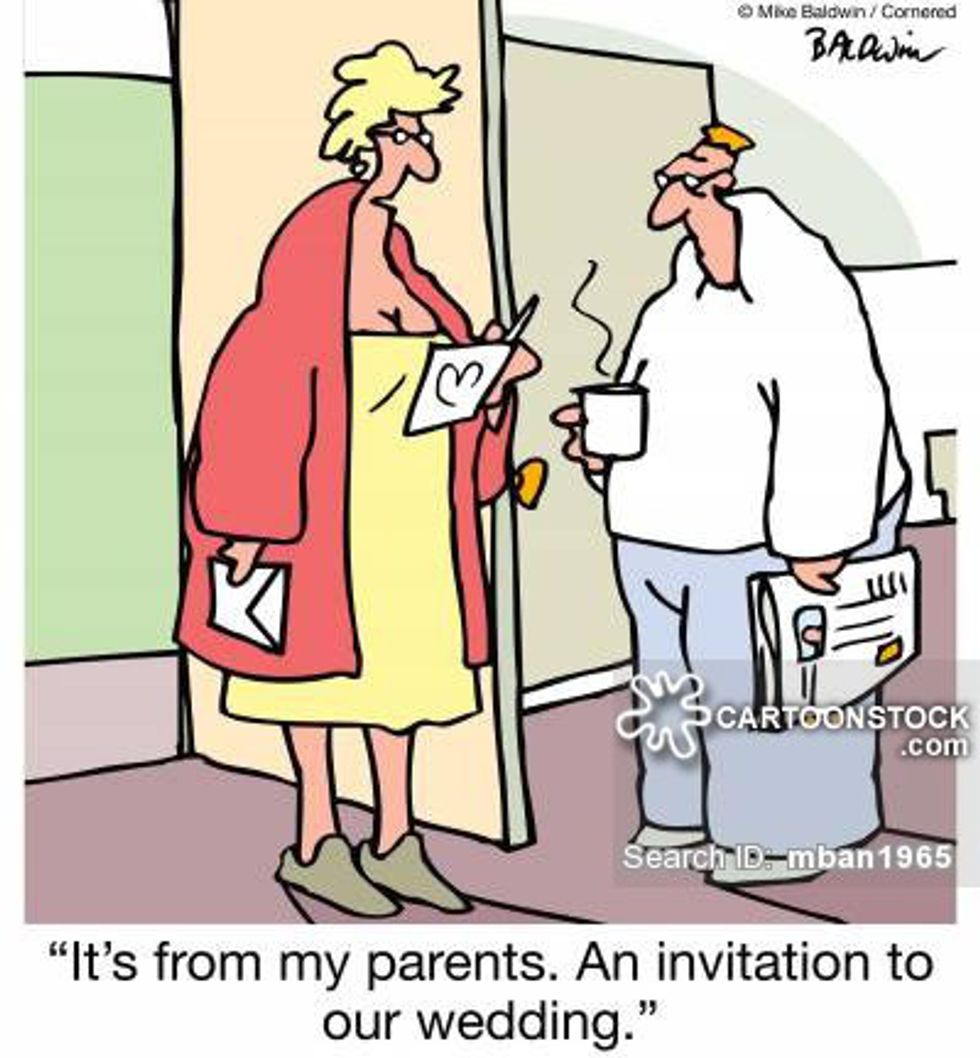
It wasn’t until the enlightenment and the growth of the middle class in the 19th century that marrying for love became more common. Despite this shift toward love, however, marriage was still based on religion, procreation, and the necessity to fulfill certain societal expectations. Throughout the 20th century, gender roles dominated marital relationships; men were seen as the breadwinners and women were largely confined to the domestic sphere. The worth of a woman was equal to her potential for being good wife material. Unmarried women were evaluated on their purity, their physical beauty, and their social standing. Good wives were expected to be less educated (than their husbands), take care of domestic chores, defer to their husbands, raise children, and provide sexual pleasure. Up until the mid-1900s, it was even legal for a husband to rape his wife.
Where Marriage Is Now
Thankfully, we live in 2016, folks. Gay marriage is now legal, people marry for love, and spouses live in equality... right?
As much as we’d all like to close our eyes and pretend, that’s simply not the case. Sociocultural gender norms still hold strong within today’s romantic relationships. Nowadays the norm is still for women to take their husband’s last name; men are still expected to pay for dates; paternity leave is virtually nonexistent, and stay-at-home dads are a rarity. Women are still expected to be passive players in romantic relationships: They’re not supposed to ask guys out, they’re not supposed to initiate sexual encounters, and they’re not supposed to propose. All of these actions would potentially bring subtle, unwelcome judgments from others. Even within same-sex couples, partners often align themselves with a gendered role in an effort to meet societal expectations.

On top of these gendered inequalities within our relationships, marriage is still a social requirement. People in their late 20s and early 30s start to feel an unseen pressure to get married. The search for a lifelong best friend turns into a desperate, almost frantic hunt for a spouse. Everyone has been a “third wheel” at some point in their life, so what happens when all your friends start getting married and that third-wheel discomfort grows? What happens when you’re the only single person at parties? How do you feel being the only single person at friend’s kid’s birthday party? At this point are you still looking for a best friend, someone to love and support you for life? Or are you just trying to fit in? Or not get left behind?
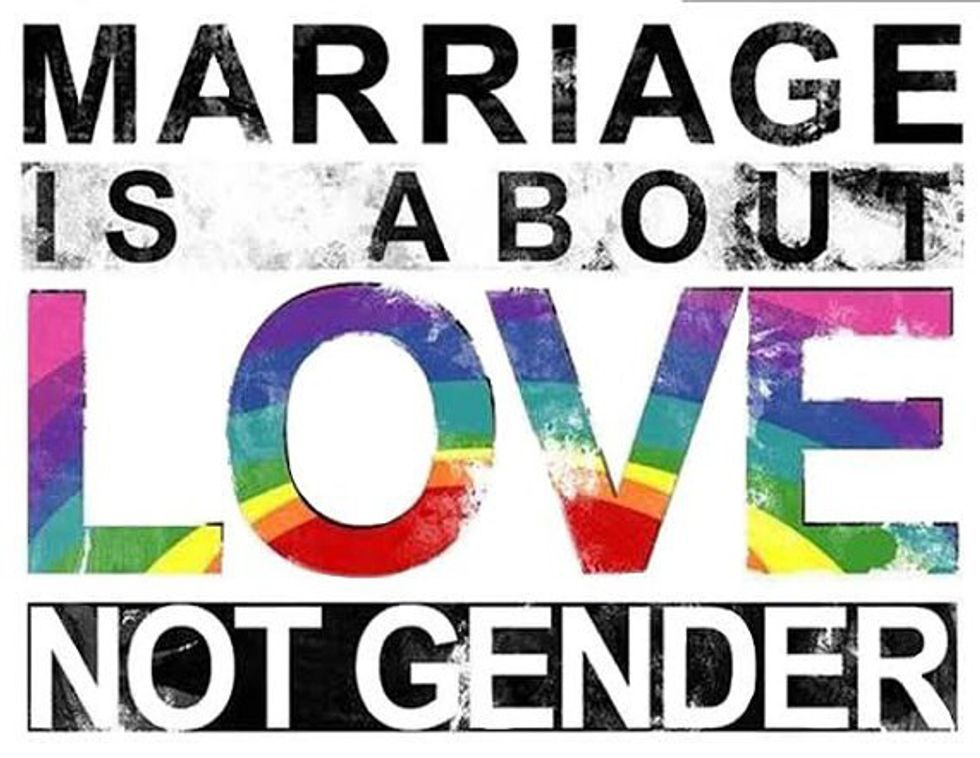
In American society today, it is believed to be the norm for couples to marry for love. There’s a reason the slogan “Love wins” rose to prominence after Obergefell v. Hodges, the ruling that legalized gay marriage. With that verdict, most of the legal issues pertaining to marriage in a modern context were conquered. Yet as a society, are we really getting married for love? If that’s the case, why is every other married couple getting a divorce?
Where “Marriage” is Going
So, if you’ve gotten this far in this article, you now know that marriage has evolved from a rigid view to a looser one. It was a political and economic contract between a man and a woman, and now is seen as a partnership based on love and so much more. That’s pretty cool, but is the idea of marriage still changing? Religion has always played a huge part, but it’s fading fast from millennial minds. Will religion still play a part in future marriages, or will it fade, leaving its best teachings behind? Where is marriage going? When we ask ourselves this question, we think about the things that matter to me: life-long companionship, raising a family in a loving home, and passing on nuggets of wisdom to a new generation.
We live in the 21st century — where there are single parents, where it is not uncommon for people to get divorced. We are in an age where men and women have sex outside of marriage, single parents raise children, and gay people can marry and have families. The typical nuclear family is not so typical anymore. We aren't sure where the idea of marriage is going, but we do know that we live in a progressive society that values love more than it does institutions and traditions.
So, what do you think of marriage now?
This article was written by myself and two other Rice University students (Michael Armstrong & Alexandra Franklin) for a gender and sexuality studies class at Rice University entitled: Sexual Debates in the United States: Social and Cultural Contexts of Supreme Court Decisions.
















