
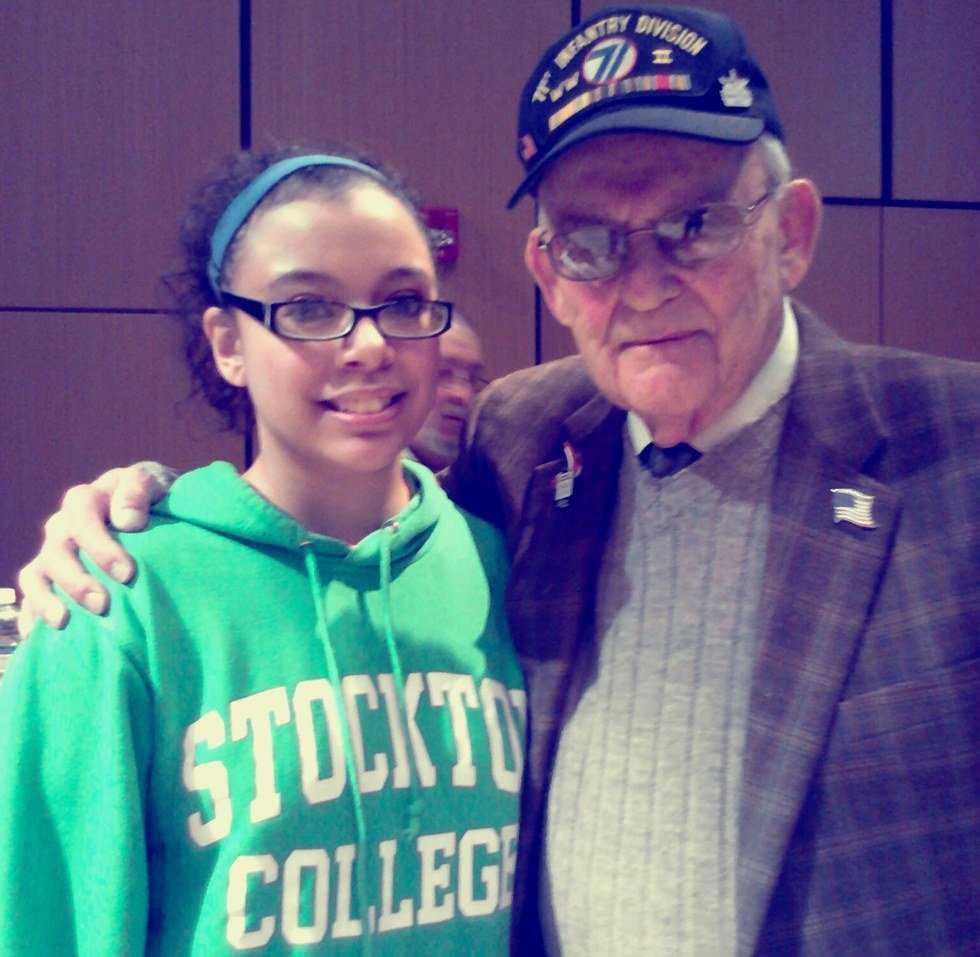
Eighty-eight-year old veteran, Alan Moskin, served in the Army during World War II from September 1944 to 1946. He was a member of the 66th infantry, 71st Division, and part of General George Patton’s 3rd Army. On May 4, 1945, Moskin's company participated in the Liberation of the Gunskirchen Concentration Camp, a subcamp in Mauthausen.
In a rather emotional talk given on April 8, 2015, Moskin recounted his life in vivid detail, from his early life to the horrors of World War II.
Moskin’s early life was spent in Englewood, New Jersey, a town he describes as being the epicenter of ethnicity and culture. A place where everyone knew everyone, and racial and religious tensions didn't seem to matter. In fact, one of his best friends, Georgie, was African-American. Moskin led a very happy and simple life in those days, and felt that equality was attainable.
Moskin excelled in his studies, skipping the fourth grade and later going on to attended Syracuse University at the age of 17. A year later, Moskin was drafted at 18. His simple and happy life would soon be turned upside down in the wake of World War II.
For three months, Moskin received basic training in Florida where the notion was “kill or be killed.” Before this training, he had never held a gun in his hands. He had also never encountered racism. Moskin was criticized for being Jewish, and for having a black man as a friend. He described southern intolerance as "garbage" and was disgusted by the rampant bigotry. Numerous scuffles broke out, but he defended his beliefs.
During the war, Moskin was proud to fight amongst good men and unfortunately lost many friends - one died in his arms. "There is nothing romantic or macho about being in combat," he said. Moskin considers himself lucky to be here today and admits to being afraid for his life everyday. “If you claimed that you were not, you were lying,” he said.
Moskin never enjoyed killing. In fact, it made him feel terrible. When he killed his first Nazi soldier, he found a picture of the boy’s family in his helmet that filled him with sorrow. In a time of war, however, “he did what he had to do and was a good solider.”
On the day of the liberation, our soldiers saw things they would have never anticipated. It was a dismal and horrific scene. All Moskin wanted to do was help, but he could not speak to or feed the victims. A man of about 60-70 pounds kissed Moskin's dirty boots. No man had ever done this in front of him and he wasn’t going to let it happen now. Despite the stench that permeated from the man’s body he picked him up, with tears in his eyes. People in the surrounding area were pleading, and Moskin felt helpless, failing to understand how people could do such terrible and cruel things to others.
Moskin now travels the country sharing his story as a concentration camp liberator. His goal in life is to see an end to genocide and hate groups. He believes that indifference lends itself to consent, and it is our job as young Americans to ensure that nothing like this will ever happen again. We owe it to the victims, and to the brave soldiers like Moskin.