

You might have heard the internet abuzz with the recent revelations about the discovery of "gravitational waves." This is in itself a tremendous discovery, and a testament to our ability to take a more in depth look at our place in the universe.
No wait, a little to the left. A little more. Next to that bright dot.
Unfortunately, the deeper meaning of this accomplishment, as well as its true significance can be lost in a haze of technical terms and misunderstanding. To do this, we need to get down to the core of our most recent scientific realization, and bring what was previously unknown to light.
The first question to answer is also the most obvious. Just what the heck are gravitational waves in the first place? The good news is that we already know a phenomenon that acts in nearly the exact same way. I'm talking about light, as well as the rest of the electromagnetic spectrum. The radiation given off from objects in the universe, taking form from radio to gamma waves, travels away from its source at the speed of light, carrying information across the cosmos. Until now, this has been the only way for us to perceive the world around us. Gravitational waves carry information in a similar way, rippling across space at the speed of light.
Of course, I wouldn't have brought up how gravitational waves are similar to light if I wasn't planning on turning everything right back around. As nice as it would be for the two phenomena to match, it's simply not the case. The primary difference is one of scale. Electromagnetic wavelengths are exceptionally small, with some types of radiation being measured in the realm of micrometers. Gravitational waves, on the other hand, can be measured in millions of kilometers. This makes observation difficult, as most signs of gravitational waves pass right by without leaving leaving any sign of their existence.
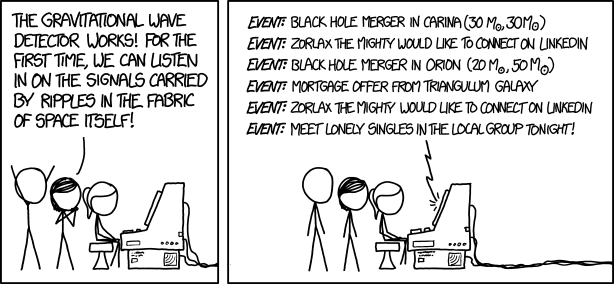
Sometimes signs of existence aren't the most impressive
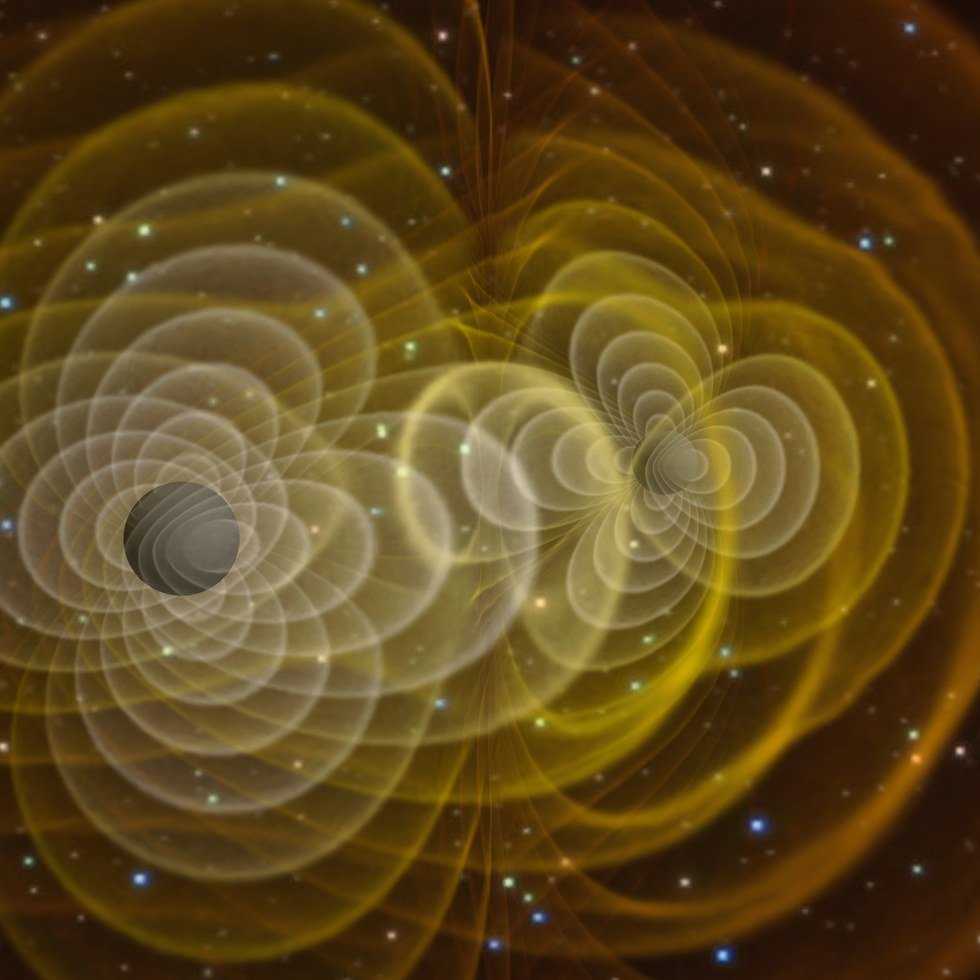
Now that we have a better understanding of what gravitational waves are and aren't, we need to know where exactly they come from in the first place. The answer is simultaneously simple to explain, but difficult to prove. The simple answer is that every object gives off gravitational waves, since every object in the universe has mass. This is purely theoretical however, as the only observed instances of gravitational waves come from the orbit of two compact objects around each other, such as neutron stars or black holes.
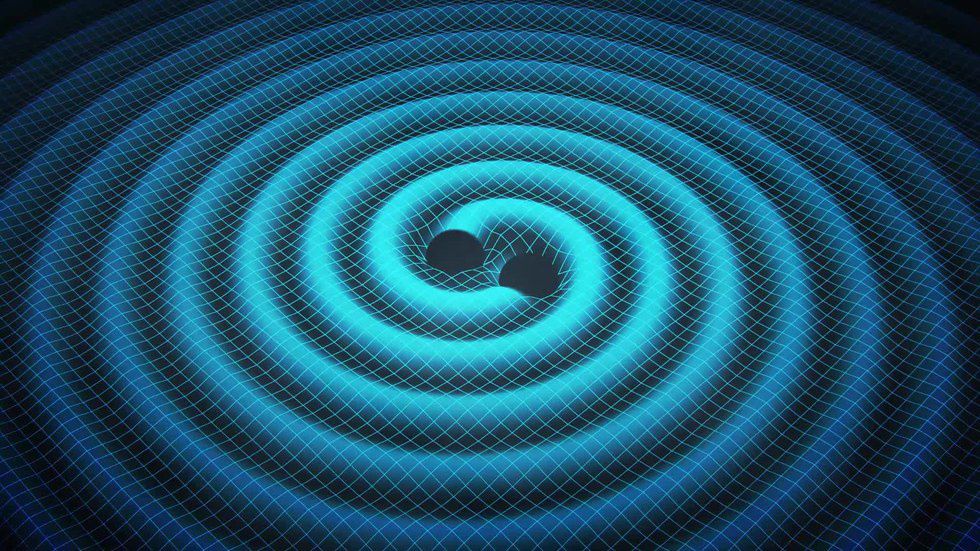
Seen in this diagram. (Giant glowing space net not included)
The objects cause massive disturbances in space-time, with the waves carrying a truly incredible amount of energy. The wave we recently detected was caused by the merging of two black holes, one with a mass of 36 suns, the other with a mass of 29 suns. The resulting black hole however, is only 62 solar masses. This means that three solar masses worth of energy was given off in the merge. The energy represented in that mass is staggering, eclipsing the total annual energy output of the entire world by a factor of 100 quintillion, a number recently described by math majors as completely and unnecessarily large.
Finally, we must ask exactly how we even detect these waves in the first place. We cannot see these waves, like we can see light, or feel them, as we can feel heat from infrared radiation. Rather, we must turn to much more precise measurements. The device used to detect these waves is not built to detect the waves directly, but rather the effects caused by the waves as they pass by. When a gravitational wave passes, space is actually compressed and stretched, ever so slightly, but just enough that a laser can recognize the difference. The difference is incredibly small, with the lasers being able to detect variance in distance 10,000 times smaller than a proton. The data is collected constantly, with scientists waiting for the time that their patience would pay off.
The virtue of patience clearly has its merits, as the scientists now have concrete evidence of how gravity itself travels across the universe. With this discovery in place, many people begin to ask about practical application of such a discovery. This attitude is completely fair, but it can lead to a dangerous lack of interest when practical purposes are not exactly known at the time. This discovery is so much more than something we can make of it. We have gained a new way of looking at the universe. By studying gravitational waves, we can detect dim objects in the cosmos, including the ver elusive black holes. It is as though we were looking at space with one eye closed, and with the addition of this new viewpoint, our breadth of comprehension has the chance to soar further than we could have ever imagined.

















