

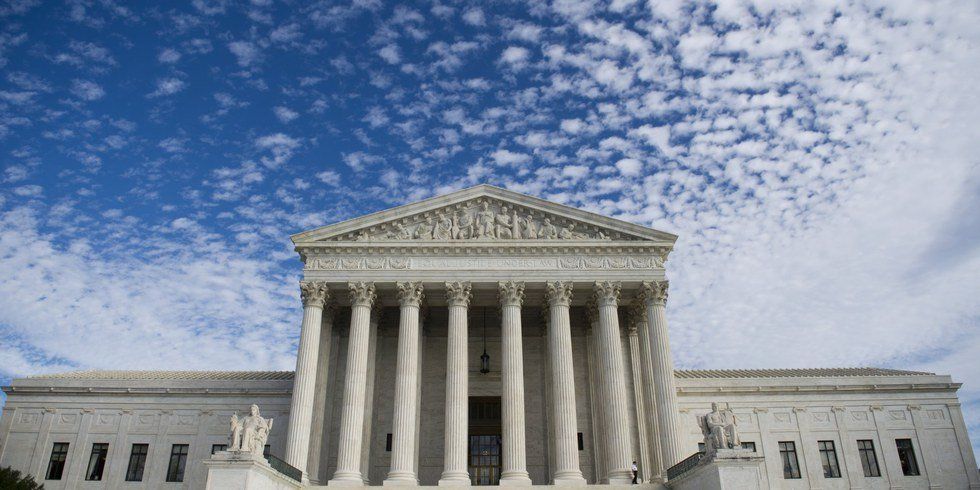
The Supreme Court is the final interpreter of the laws of the Constitution of the United States…hence, it is important. Here are the main things you should know about the Supreme Court: there are nine justices on the Court, eight regular justices and one chief justice, and once you are confirmed, you serve for life (as long as you behave). In theory, the courts are supposed to be unbiased, meaning they should not be choosing specific verdicts due to a particular ideology, but their politics beliefs should be kept “out of the courtroom.”
Frankly, that is impossible because there are two distinct ways of interpreting the constitution that happen to correlate to one party or the other. There is a strict constructionism, which restricts judicial interpretation. The thought behind it is, “what were the founding fathers trying to get across in this particular section of the constitution?” Conservatives on the court use this interpretation often. Then, there is a loose interpretation, which is the ability to use circumstance to create a new meaning to the specific constitutional laws. For people who interpret the constitution loosely, they feel something does need to be explicitly written for it to be done. Liberals tend to favor this interpretation.
The Supreme Court is usually more or less divided, often there being five conservatives and four liberals. One of the Conservatives, Justice Kennedy, is seen as being a moderate, so he often acts as a swing vote in cases. But currently, due to the recent death of a Justice, there are only eight judges, making the court completely, and evenly, divided: 4 to 4. This is not an ideal situation; deciding outcomes of cases are going to get difficult this spring.
1. An Introduction to the Players
If you want to get a full, comprehensive lesson on SCOTUS, it is necessary to know the players in the game.
First up is Justice Anthony Kennedy. He was appointed by Ronald Reagan in 1988 and has served 28 years. As mentioned previously, he is considered a swing vote, as he is a moderate, but unsurprisingly he more often than not sides with the other Republican justices.
Next up is Justice Clarence Thomas. He was appointed by George H. W. Bush in 1991 and has served for 24 ½ years. He is famous for barely speaking during court cases and he is a staunch conservative.
Next up is fan favorite Justice Ruth Bader Ginsburg, the cutie who was appointed by Bill Clinton in 1993. She has served for close to 23 years and is a liberal who never fails to side with the other liberals on the court. (Squad)
Up next we have Justice Stephen Breyer who was also appointed by Bill Clinton but in 1994 and has served close to 22 years. Just like the president who nominated him, he is a liberal who always sides with the squad.
Next is VIP Chief Justice John Roberts who was appointed by George W. Bush in 2005 and has served for 10 ½ years. He is a conservative and the Chief Justice of the court, which basically gives him the option to write the majority opinion whenever he wants, which is a big deal.
Next up we have Justice Samuel Alito who was appointed by George W. Bush in 2005 and has served for 10 years at this point. He is also part of the conservative squad on the bench.
Up Next is Justice Sonia Sotomayor, who was appointed by Barack Obama in 2009. She has served for almost 7 years and is a part of the liberal squad. (They always stick together.)
Finally, we have Justice Elena Kagan who is the newest member of the Supreme Court. She was appointed by Barack Obama in 2010 and has served for nearly 6 years. Just like the president who appointed her, she is a liberal.
And of course, lets not forget the late Justice Antonin Scalia who served for 29 years before he died in February of this year. He was another staunch republican and was appointed by Ronald Reagan in 1986. He served over 29 years on the bench.
2. The Vacancy
Now, an even number of justices on the “court that rules over all courts” just simply isn’t going to fly. But, like always in this country, there is a fight over ideologies, and it seems like it’s going to be extremely hard for another justice to take Scalia’s spot anytime soon. Due to his death, we have a rare situation in which a Democratic president has the ability to appoint a nominee while we have a Senate controlled by Republicans. In other words, it’s a sticky situation.
Of course, it does not just take POTUS to sign off on a Supreme Court Justice. The president chooses a nominee, someone that he or she feels is qualified enough to be on the bench. Then, the Senate must confirm this nomination, after vetting the candidate and holding a hearing, to appoint a justice into office.
The current senate is not about nominating anyone Obama chooses, claiming that they are going to wait until the next president comes into office.
Keep in mind that the Supreme Court is not “supposed” to be biased toward one particular party or ideology. Because of this, the Senate is not supposed to confirm based on the beliefs of the nominee, but on the qualification of the nominee.
In March of this year, Obama nominated Merrick Garland as his choice of candidate to fill the vacancy in the court. Here is some background on this chill nominee: After graduating from Harvard and then Harvard Law, he became a law clerk for Supreme Court Justice William Brennan. In 1997 he was appointed to the U.S. Court of Appeals for the DC Circuit. Point is, this guy is extremely qualified for this job but the Senate refuses to confirm him because he has previously ruled in a liberal fashion.
The Senate’s refusal to confirm is a problem.
3. Current Predicament
Spring is a time when the Supreme Court hears a lot of cases and a time when opinions are drawn up. It’s also the time of year when a vacancy in the highest court in the country begins to be a problem.
One specific example deals with Obama’s immigration reform. Remember that? In November of 2014, he tried to pass a series of executive orders that would protect a significant amount of undocumented immigrants in this country from deportation. While Republicans in Congress threatened to sue Obama claiming he didn't have the power to do this, the Democrats claimed he was well within his power.
An executive order is a legally binding order by a president. An EO does not have to go through Congress, yet it has the same legal weight as laws passed by Congress.
Anyway, after Obama’s failed attempt at passing immigration legislation through Congress, he passes this series of Executive Orders on immigration, but Republicans do not feel this is constitutional (this mainly has to do with the fact that Republicans would not benefit from these orders). The Supreme Court has taken this case, which, again, challenges the legality of the President’s EO’s.
Of course, with the lack of an odd number on the bench, when the Supreme Court looked at this case on April 18, the score looked 4 to 4. The Supreme Court “seemed sharply divided.” Without a ruling from the Supreme Court, the Court of Appeals ruling on the case would stand, which denies the President’s plan.
What I am trying to say by utilizing this “tie” in the Supreme Court is that there SHOULD NOT BE a tie in the Supreme Court! That is why there are nine judges! There should not be a vacancy in the court. Merrick Garland is a qualified nominee, and he should be confirmed.

















