The Seine River in France has risen to the highest it’s been in 35 years, and it is continuing to rise as torrential rains pelt Paris. The river is expected to rise to about 21 feet, which is twice its usual height.
A rising river is not always cause for alarm, but since many of Paris’s iconic landmarks and tourist attractions are located near the Seine, a flood is a major emergency. The Louvre, the Musee d’Orsay, the Eiffel Tower, the Notre Dame cathedral, and the Jardin des Plantes are near the river’s edge and are potentially in danger if the river rises high enough.
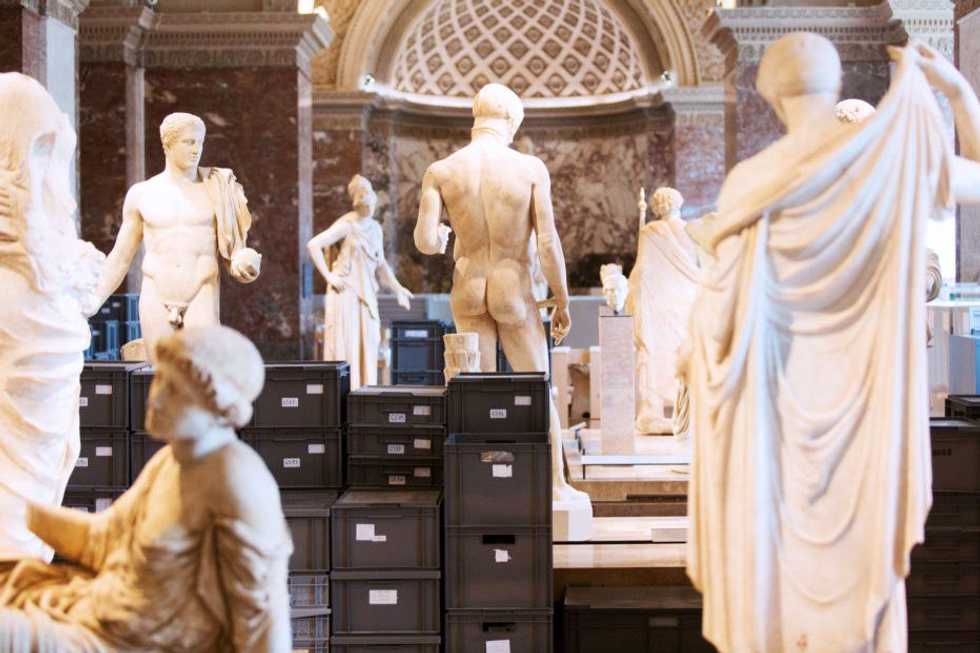
As of now, though, the Louvre and the Musee d’Orsay are of most concern to Parisian officials. Even though the water is not expected to near the museums’ doors in the immediate future, museum staff members are taking precautions to protect the priceless objects. The Louvre has been closed to the public, allowing staff members to pack up and move as much of the immense collections as possible.
Images of art being hastily packed up and shipped out of Paris ring with historical resonance: during WWII, as Nazi forces advanced on Paris, French museum officials smuggled as many works of art as they could, including the Mona Lisa, out of the Louvre and out of Paris to safety. When Hitler arrived in Paris, he expected to appropriate the cultural significance of the Louvre as a symbol of his victory over Europe and a jewel in his hypothetical crown. One can only imagine his disappointment when he found the Louvre nearly empty.
The thought of an empty museum is eerie any day, but is especially so today given the historical parallels. Googling "Louvre evacuation" brings up news briefs about the present situation, but also hundreds of black-and-white pictures from the 40's of art in crates and bare museum walls.
Of course, the present crisis is hardly comparable to the horrors of WWII. Flooding across Europe has caused at least 15 deaths, according to BBC News, the majority of them in Germany, and thousands of residents have been displaced and their property destroyed by water, but, like the efficient effort being made to protect the art within the Louvre, emergency forces across Europe are taking action to manage the crisis.
French President Francois Hollande said the flooding is “a serious climate phenomenon and a global challenge,” according to the New York Times. Many people have cited global warming as the cause of recent extreme weather in Europe, and President Hollande seems to be in agreement. Meteorologists have explained that the heavy rains and thunderstorms in central Europe were caused by a dip in the jet stream (a fast and narrow air current) that flows across the continent, which has trapped low-pressure air over much of France and Germany. The air is then warmed by the sun, and rises to meet cold air at higher altitudes, resulting in thunderstorms and rainfall.
Unlike the previous evacuation of art from the Louvre, this one does not involve any crimes or evil-doing. It should, however, cause the citizens of the world to think seriously about climate change. We seem to be willing to put off thinking about global warming when the image in our heads is just a smaller polar ice cap. Images of priceless works of art (and thousands of people) being evacuated from Paris because the river is flooding the city are much more proximate, and more striking. The cultural significance of the Louvre and the objects it contains should cause law-makers and citizens to question how much they are willing to sacrifice to keep ignoring climate change.