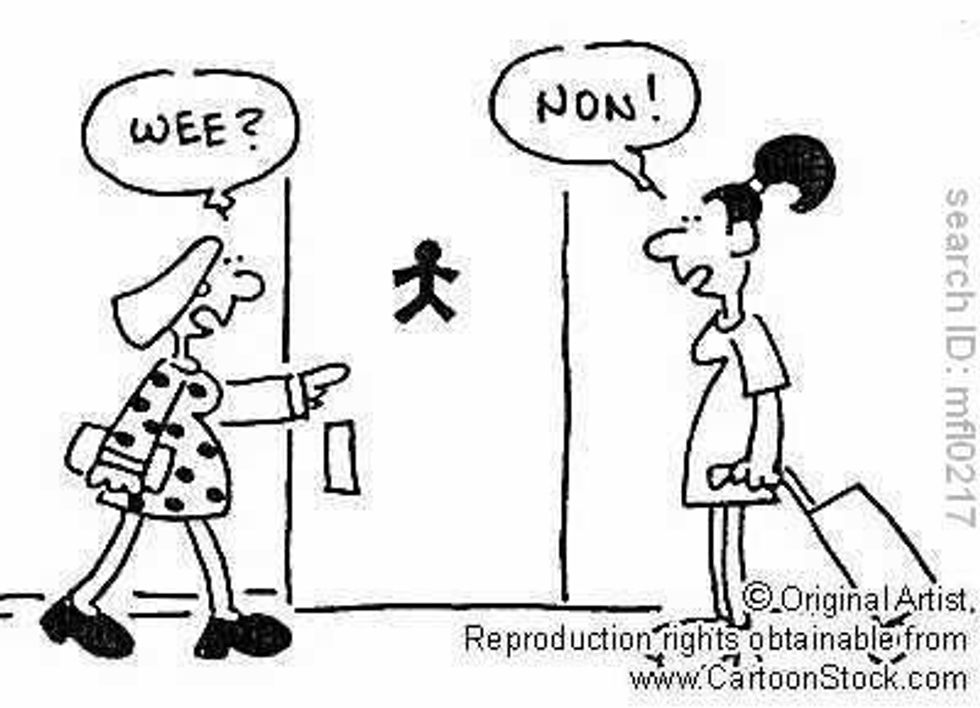
Ever hear a foreigner say something and you just think to yourself, "WHAT?" Like, "Let's go to the beach," comes out sounding like "Let's go to the b***h," and you have to think for a minute.
I've come to sympathize with foreigners here in the states during my time abroad in France because some words just sound too much alike. Here are some of my favorites that I learned:
La paix/le pet: pronounced exactly the same except for the little pesky article in front. Thought articles didn’t matter? Okay, well la paix is peace. Le pet is fart. So you wanted to say you dreamed of world peace? Well, you just said you dreamed of world fart because you forgot your article and those French are giggling at you – look at that American!
La guerre/la gare: Pronounced similarly, but mouth formation is different. You have to smile for la guerre (war) and open wide for la gare (train station). How to remember? Gotta open your mouth wide to let the train pass! This one, I accidentally misused and ended up saying “I bought a war coloring book,” instead of “a coloring book from the train station.” Very different things. You could be saying, “I’m off to the war” instead of “I’m off to the train station,” and make some people very concerned for you!
Nickel/Niquer: Again pronounced similar with just one little nuance – with Nickel you’ve got to pronounce that "l" and with Niquer you’ve got that "a" sound at the end. Really excited about something? Nickel! Super! Awesome! Think, it’s French and you don’t ever pronounce that end l, so it’s an a sound at the end? Niquer! F**k! Yep, again, very different things.
J’ai chaud/je suis chaud(e): Okay, so this is one of those famous ones that I have known ever since I started taking French, but still I continue to make a mistake, because sometimes it’s hard to stop thinking in English. Here’s one of those times you just have to stop thinking in English, though, and memorize the rule. In English we say, "I am hot" or "Je suis chaud(e)," so I wasn’t paying attention and I said to someone, “Je suis toujours chaud(e)”. WOW, that’s quite personal…I just said I am always horny instead of always hot. The French use the verb “to have” instead of “to be” when talking about being hot, so you would use here “j’ai chaud”
Similarly, J’ai froid/je suis froid(e): So, this one is very similar and needs little explanation. The only difference being froid is cold. So, if you try to direct translate and say “I am cold” you end up telling someone you are a cold-hearted person instead of being actually cold, which hey maybe that’s what you meant…
Je me couche a 22 h00/Je couche a 22 h00: This one, my French professor said he receives often and gets a little surprised at first. So, if you want to say you go to bed at 10:00 p.m. or 22 h 00, you would have to remember that it is a reflexive verb and thus you say, "Je me couche a 22 h 00." If you forget that little ME, you change the whole sense. "Je couche a 22 h 00," literally means, "I have sex at 22 h 00." Very interesting, you’re on a schedule…
Faim/femme: Again, pronounced very similarly with a slight nuance, but you’ve got to remember that nuance because one means hungry and one means woman. So if you say "J’ai [une] femme," instead of, "J’ai faim," you’re telling the world you’ve got a woman instead of hunger, but hey, whatever floats your boat!
Coucou/cul-cul: Coucou is one of those cutesy ways of saying hello to those you know, but be wary when using this expression, because if you pronounce it wrong you could be saying cul-cul, which means ridiculous/ludicrous/idiotic (take your pick)!
Always, always, always, always, be on the lookout for those false friends “faux amis” too!
Some examples:
Assister a: does not mean to assist, but rather to attend.
Attendre: I got this one, it must mean to assist right? Because assister means to attend? Not quite, rather it means to wait. J’attends mon ami. I am waiting for my friend.
Bras: Someone tells you you have something on your “bras”? Hey! How can you see my bra?! Is my shirt really that see through? Nope, bras just means arm in French, no need to get defensive.
Preservatif: you like preservatives in your jam? Well, don’t use this word then, because if you did you just told that French person, you like condoms in your jam… Interesting…
Entree: We use this word to mean the main course in English, but the French use it as a starter plate, while the plat principal is your main course. So don’t be surprised when your entree is only a small plate.
Un bouton: Yes, this one can mean button, but it also means pimple or bumps on your skin in general. So you hear that person complaining about their bouton, it’s not necessarily their pesky buttons, but probably their pimples. Watch out for context clues!
Travailler: I can’t wait to travel! Be careful if you want to say this phrase because travailler is not the word you want. If you do use this verb, you end up saying, “I can’t wait to work!” instead. And great for you if you’re that passionate about work!
Librairie: Don’t walk in here with no money, expecting to rent a book. When you get up to the cash register with your book, you are going to have to pay, because you have indeed stumbled into a book store, not a library.
Coin: Ugh I have so many “coins” in my purse. Really? What is the shape of your purse? Because you just told someone you have a lot of corners in your purse.
Prune: When your host family offers you prunes, do not expect to spend all night in the bathroom after. Don’t worry, they’re not trying to help you digest, they’re just offering you a plum.
Also, remember, when telling someone something that your culture might be different then theirs…
So how do you avoid making all of these mistakes? Well, first of if someone says something to you and it seems odd, don’t hesitate to ask for an explanation or for the word so you can put it into your dictionary. But make sure you have a good dictionary, because if you put it into Google Translate, you might be even more confused afterward! Also, if you’re not sure if the word you’re using is French or your own made-up English-French word, try to find another word that means the same thing because you might just end up saying you have condoms in your jam instead of preservatives.
Got anything you want to add - English, French, Spanish, Japanese, Chinese - any common errors you see? Comment below!