



If you or someone you know is experiencing suicidal thoughts or behaviors, call the National Suicide Prevention Hotline at 1-800-273-8255 or visit its website here.
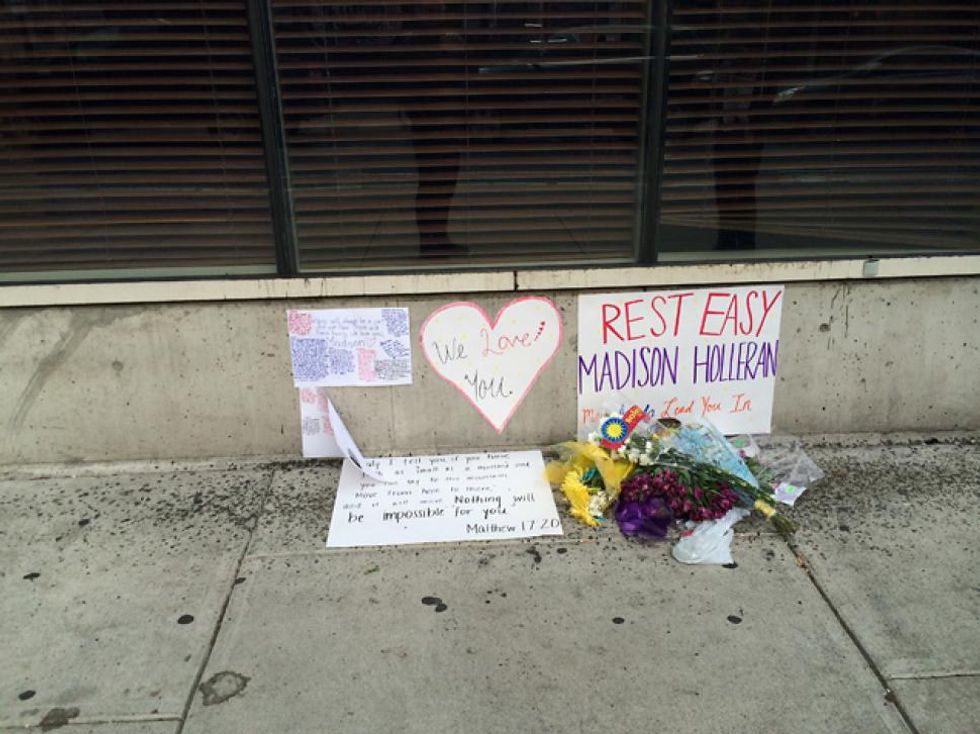
On the evening of January 17, 2014 University of Pennsylvania student Madison Holleran leapt to her death from the ninth level of a Philadelphia parking garage.
This is just one of the many college suicides that constantly make the news. It’s a well-known fact that suicide on college campuses is unfortunately apparent. Because of this, many studies and analyses have been conducted to answer the burning question of what can be done to stop college suicide. The peculiar part of Madison Holleran’s story is that to the world, her life appeared to be impeccable.

Death by suicide is prevalent — almost 35,000 people commit suicide each year. On college campuses, 6 percent of undergraduates and 4 percent of graduates have seriously considered suicide. There are about 1,100 suicides on college campuses in a given year.
Stress in classes, competition among students on campus and struggles with mental health has been said to be the biggest cause for on-campus suicide. However, these stress factors are not specific to college campuses — in general, competition among others and mental health problems are primary causes for suicide across the country. Nevertheless, in March 2015 the Boston Globe asked several schools to release student suicide data. Only a few responded, but it was found that MIT and Harvard University had above-average suicide rates, with MIT being the highest.
Although rankings for most stressful colleges vary (and the legitimacy of such ranking systems are questionable), the schools that appeared the most on various ranking lists are, in no particular order, Massachusetts Institute of Technology, Columbia University, University of Pennsylvania, Harvard University, Stanford University and Cornell University. In contrast, Princeton Review’s 2015-2016 ranking of colleges with the happiest students places Vanderbilt University, Virginia Tech, Claremont McKenna College and Kansas State University in the lead. So what differentiates the most stressful schools from those with the happiest students?

One thing the stressful schools all have in common is extremely low acceptance rates ranging from 4.7 percent at Stanford to 14 percent at Cornell, with incoming class average GPA’s of at least 3.6 and reaching as high as 4.18 at Stanford. However, Vanderbilt University boasts an 11.7 percent acceptance rate and Claremont Mckenna with a low 9.8 percent. Which is lower than Cornell’s, yet Vanderbilt remains on Princeton Review’s happy student list. Why the discrepancy?
According to reviews on Niche, a ranking and review site, Vanderbilt’s surrounding Nashville area earned an “A-” review with shining comments referencing the abundance of things to do and the beauty of Nashville. Cornell’s Ithaca surrounding area earned a “B+” with mixed reviews, particularly with several comments noting a small size and not much to do. Nevertheless, Columbia and MIT earned an “A+” surrounding area score but Stanford earned a “C” with many people stating a lack of things to do compared to other California areas. Stanford did earn an “A+” for campus quality, and so did MIT, Harvard, Cornell and the University of Pennsylvania. Columbia earned a “B+” for campus quality but high scores for most of the other ranking categories. Ranking methods are questionable, because reviews on Niche are all individual user reviews. No strong patterns in campus and surrounding area environments seem to arise between stressful and non-stressful schools, so the question as to what makes certain schools "happier" still remains.

MIT, University of Pennsylvania, Harvard and the other “stressful” schools have populations of 10,000+, but the “happy” schools have the same high populations, excluding Claremont McKenna’s 1,349. School size seems to have no correlation with suicides on campus.
According to the Center for Collegiate Mental Health at Penn State, anxiety and depression are the most common disorders among college students. Less than half seek help for their conditions.
Madison Holleran made it known to her parents that she was stressed about grades, despite her 3.5 GPA. She even talked to a therapist about her concerns.
There may be no clear answer as to what can be done to prevent suicides. Talking to a mental health professional, friends or family has been shown to improve quality of life, but much more can be done. Unfortunately, incidents like Madison Holleran’s do happen, and whether you attend Harvard or community college, suicide is a threat that faces everyone.
















