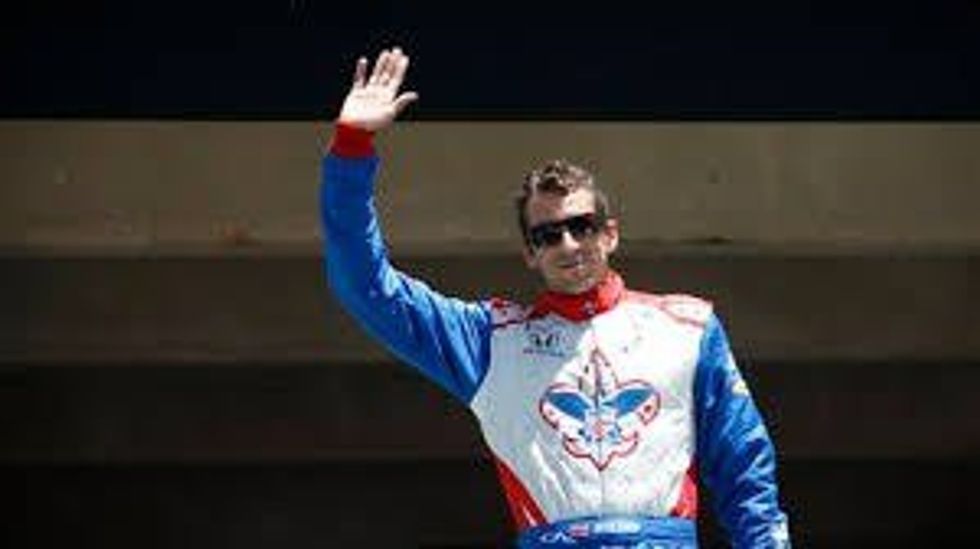
On August 24th, 37-year-old IndyCar driver Justin Wilson died in the Lehigh Valley Hospital in Allentown, Pennsylvania after suffering a massive head injury in the ABC Supply 500 at Pocono Raceway.
The fatal accident occurred when race leader Sage Karam spun into a wall late in the race, sending debris flying through the air. Most of the cars following him were able to successfully avoid being struck by any of it.
Justin Wilson, did not however. Wilson's car, the twelfth to pass through Karam's crash scene, began to drift towards the inside of the track immediately after passing Karam. It ran directly into a barrier and ground to a halt against the track's interior wall. Emergency crews swarmed Wilson's car, eventually extricating him from the wreckage and placing him onto a medevac helicopter.
Replay of the aftermath of Karam's crash revealed that a large chunk of the nose of his car had bounced down the track and into the path of an oncoming car—namely, Justin Wilson's. The projectile slammed into Wilson's helmet, the force of which sent the debris arcing high into the air above his car, now veering uncontrollably toward the inner wall.
Some perspective: in 2009, F1 driver Felipe Massa underwent life-saving surgery to insert a titanium plate in his skull after being struck in the helmet by a single spring flying off of a crashed car. A single spring.
The image of Wilson sitting in his car, head leaning motionless to one side, is a sight all to familiar to the sport of open-cockpit car racing. In one of the better-known fatal accidents in F1 history, beloved Brazilian driver Ayrton Senna died during the 1994 San Marino Grand Prix in Italy, a day after fellow driver Roland Ratzenberger, an Austrian, fatally crashed during a qualifying lap.
The cause of Senna's death was revealed to be threefold: after his car collided with a wall, the right front wheel and its suspension broke off and flew into the cockpit, striking Senna in the head and causing fatal skull fractures; a piece of the suspension pierced Senna's visor, causing significant head trauma; and a jagged piece of the car's jagged upright assembly likewise pierced his visor (he was wearing a new, thinner Bell visor) and lodged itself above his right eye. It is generally accepted that any one of the three injuries would have killed him.
I had heard of Senna well before the recent passing of Wilson, but the significant circumstantial resemblance between the two made led me to do a little digging online. I was introduced to a debate that has been going on in racing circles for years: the closed-cockpit debate.
There are myriad articles on the subject all over the web, but I'll give a quick synopsis of it here: on one side, drivers and fans alike defend the open cockpit, citing the sport's storied past and traditions. Their opponents, proponents of a closed cockpit (one very similar to those on fighter jets, for reference), look at the hundreds of fatal crashes in F1 and IndyCar history and see a way to prevent deaths in the future.
Senna, Wilson, and Ratzenberger were young men, and they died because they compete in a sport that involves racing around intricately shaped tracks at eye-popping speeds while their heads, protected essentially by a fancy motorcycle helmet, are exposed to whatever 200-mile-per-hour projectiles hurtle their way.
Judging by the tone in which I've written most of this article, it's probably not hard to see with which side of the debate I agree. Granted, I understand a few—very few—of the reasons detractors oppose closed cockpits. They are concerned about drivers being unable to open a damaged canopy in the event of a crash and/or a fire, impaired driver visibility, and uncertain canopy durability.
The problem with those concerns, though, is their uncertainty. The driver might not be able to open their canopy, or their vision might be impaired, or the canopy might not be durable (although, looking once again at fighter jets, which travel at speeds that trounce the fastest F1 cars, I'm confident that canopy durability technology is pretty good).
But I see very little of that uncertainty when a driver is struck by a piece of debris. I struggled through physics junior year, but I know enough to be able to say unequivocally that a hundred-pound shard of reinforced metal flying through the air at speeds faster than my car would ever dream of going will do horrific things to a helmet around a human skull.
Look, I don't know a whole lot about racing. I drive a Ford F-150 and am a horrendous go-kart driver, and I'm honestly better suited to talk politics or music.
I just hate seeing dead drivers.