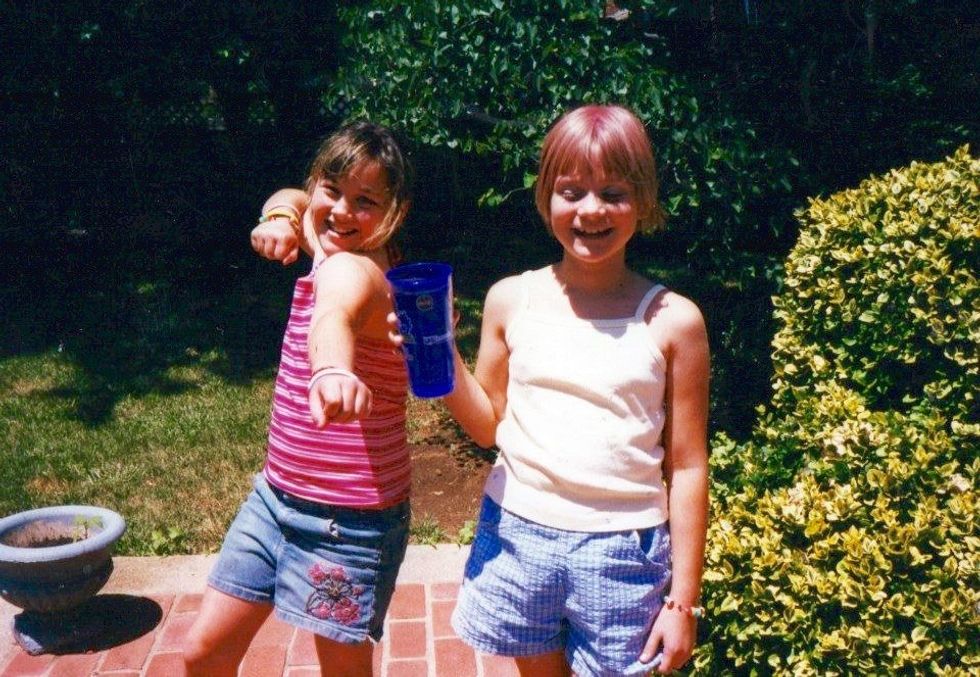
When I was in elementary school, my friend Kansa and I shared an obsession with Hilary Duff. I deemed myself a collector of Hilary Duff paraphernalia, sang along to her CDs and was an avid viewer of "Lizzie McGuire," who taught me how to be a dramatic teenager while I was still in the second grade. I’m not sure if this obsession is what led to my dream of becoming a singer or if that dream came straight from the mind of a typical American child immersed in pop culture. I give some of that credit to Ms. Duff just because, I mean, it’s Hilary Duff.
During this time, I had a really cool notebook (maybe this was the beginning of my infatuation with office supplies). It was soft and covered in fake denim made to look like jeans with a real pocket on the cover. I thought it was pretty cool, kind of “edgy” to match the awesome pink hair Kansa so graciously gave me during one of her visits after she moved away. This notebook became the birthplace of many songs. If I was going to be a successful singer, I obviously had to have my own arsenal of personal repertoire to present to my die hard fans. All of the songs were extremely short and random. One song was inspired by a pair of jeans I owned, and one was a medley of Hilary Duff songs. Another one of my personal favorites was inspired by the words emblazoned on a t-shirt I owned. (I must have had a thing for clothes). I still have the lyrics of the catchy tune memorized to this day:
“In the summertime, I can’t believe my eyes, I don’t know why I go, summer seventy-eight-oh. I don’t know why I, go go, go go go go go go, summer seventy-eight-oh.”
Since the song seemed a little short, I added a second verse:
“Red, yellow and blue, they’re the colors you use to explain feeling oh-ee-oh.”
I was pretty much Phoebe Buffay, am I right?
Unfortunately, at some point between my impeccable songwriting, crafting an image of pink hair and trying to form a band with a friend of mine, I decided that becoming a worldwide sensational singer was no longer a cool aspiration, or at least not one I could claim out loud. Not long after that, I discarded my precious denim notebook, along with all of my spectacular songs. (RIP Summer 78-0.)
Fast forward to my freshman year of college. I had long ago thrown out my “childish” dream of becoming the next Hilary Duff, and as I had grown up, even more, I decided that I was not fit to write songs of any kind.
I had tried to write songs to appease the assignments of my guitar teacher a few times, but all that I came up with was unsatisfying and cheesy. However, I began to spend a good chunk of time with two friends, Robby, and Jake, who were excellent musicians and impressive songwriters. I looked up to Robby and Jake as older brothers. I admired who they were, their talent and how they lived their lives, and I still do. I was semi-jealous of their pursuits, but because I can be extremely stubborn, every time they tried to include me in their songwriting processes my insides went crazy. My fear of inadequacy would not be tamed by their kind words of encouragement and gentle composure. It was in these moments of random guitar playing and chatting that the words, "You’ve just go to go for it, you’ve just got to try,” were spoken to me by Robby, Jake and our campus chaplain Patrick. The three of them continuously cheered me on, telling me to just start singing, just start speaking. Unfortunately, the words never took hold of me in the moment. Being afraid of what would spew out if I just “went for it” and fear of looking like a fool gripped my heart 99.9 percent of the time.
But one day it kind of clicked.
After babysitting for a little boy who fearlessly made up songs, had me record them and watched them on my phone on repeat, I heard little me. The little me who wouldn’t be afraid of watching and listening to videos of herself sing because she knew that it was her. It was what she enjoyed doing, regardless of talent or success.
So I sat in my room, half desperate to write a song, knowing how helpful it had been for my heart to write alongside my brothers, one-fourth obliged to write one because I had pretty much been told that I had to and one-fourth ready to actually do so.
And I “just went for it.”
And somehow it worked.
I emerged, after a few days of revisiting and revising, with a song I was proud to share with my two brothers and other people who had been pouring into my life. One of my friends secretly recorded part of the song on her phone, a video I later acquired and admired greatly, much like the little boy I had watched a few days earlier. This became a mark of my nudging away from the terror of watching myself and a movement closer to the freedom of little me.
Is this song a masterpiece full of theological truth and meaningful lyrics for the entire world to hear? Absolutely not. But it came from inside of me, a declaration from the little girl with the denim notebook. It was the outpouring of feelings and thoughts and desires that she had longed to proclaim and finally had.
After the first song, I went on to attempt others, only one coming out alive and whole, but I don’t think that’s wrong. Just because a song doesn’t get finished or sounds a lot like another or plain doesn’t fit together, doesn’t mean that it is bad. It just means that the little girl with the denim notebook is still here. She is still hanging around in my heart, waiting to proclaim her existence, even if only a few people hear her.
There’s a child inside of everybody who wants to have a say in how they're older, maybe not wiser, counterpart lives their life. I think a lot of who we are when we are little gets suppressed as we grow, sometimes by peers, family or the culture around us. But one of the most beautiful things that can happen is that kiddo being unearthed and brought back into life. What a better person to learn how to live and thrive from than yourself? The work comes in allowing that little one to be rediscovered by yourself and by others, by taking chances and trying things, pushing back the fear of failure. And it doesn’t happen in just one shot. We have opportunities every day that we can choose to own ourselves, or hand over to be owned by our fears.
My favorite author, songwriter, speaker, person extraordinaire, Christa Black Gifford, proclaims in her song “The Grass is Always Greener,” “I forget I can sing when I don’t make a sound.” When I am quiet, when I don’t “just go for it” and sing, I forget about my own voice. I forget that I have valid thoughts and ideas. But once the little me fights her way to the top, I open my mouth and I speak, I sing and I become more of who I used to be, who I long to be. That little girl who is obsessed with Hilary Duff has a lot to teach me, and I have a lot to learn.