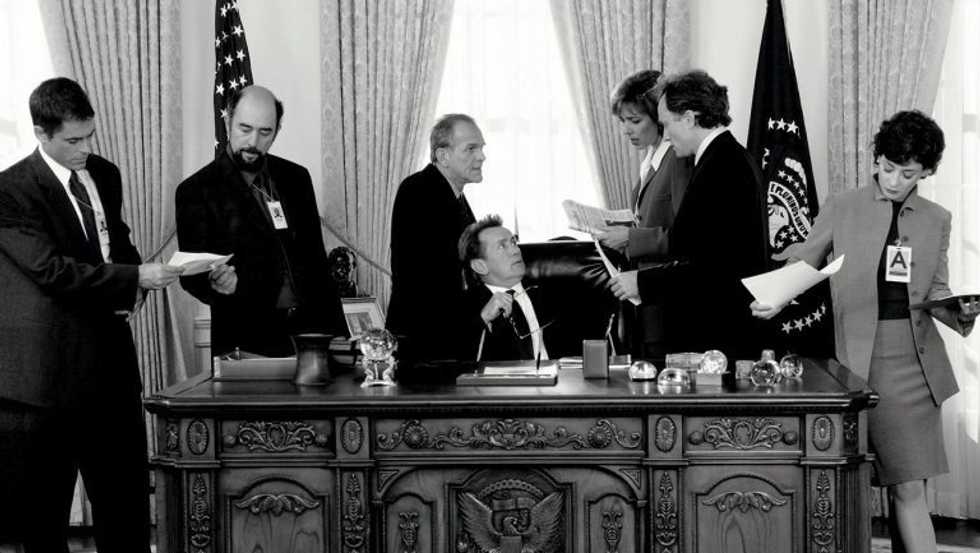
"The West Wing" is a drama about an American President and his staff that aired on NBC from 1999 to 2006. This means that for most of its run on TV, George Bush was the President. It’s thought by many that this brilliant program evolved into a sort of liberal’s fantasy to combat the frustration felt by our kind during W’s reign. I didn’t start watching until 2010 when we were blessedly in the capable arms of Barack Obama, but still I’ve loved the idealism displayed by the show’s main characters. Now that the country is rapidly dissolving into a mass of uncertainty and disjointedness thanks to the coming election, I find myself longing more and more for the world of The West Wing. Yes, I watch it to distract myself from the current state of affairs, and yes, I realize this is escapism. Still, dream with me while I describe one of the reasons that this show is not only the greatest show that was ever on television, but also how it taught us a timely lesson in political compromise.
In Season 5, there’s an episode called The Supremes, in which the death of a Supreme Court justice (Owen Brady) sparks huge discussion and debate within the liberal Bartlet administration. President Bartlet recognizes that nominating a new judge will be a political minefield because he faces a Republican Senate. In a calculated move, his staff meets with an extremely liberal judge (Evelyn Lang), which they hope will satiate Democrats, scare Republicans and ultimately create a smoother confirmation process for a more moderate judge. Though the meeting was supposed to be just for show, Bartlet’s staff falls in love with the idea of getting her on the court. However, everyone knows she will never make it through the Senate because of her far-left politics, and they start to settle on a more moderate contender.
In a show of brilliant and idealistic spirit, Bartlet staffer Josh Lyman (forever the light of my life) approaches the sitting Chief Justice with a wild idea. The Chief Justice is a liberal giant, but he’s aging and perhaps physically past the point at which he should have resigned. He has always refused to step down because he doesn’t believe that President Bartlet will appoint a strong enough liberal to replace him. Josh’s idea is to replace the Chief Justice with mega-liberal Evelyn Lang, and allow the Republicans on the Senate Judiciary Committee to pick a replacement for judge Brady (the one who died). On the show, the plan works beautifully — the Democrats get a new Chief Justice and the Republicans also get to place a powerful conservative on the bench.
In my favorite scene of the episode, Evelyn Lang and the Republican’s choice judge (Christopher Mulready) encounter each other in the White House while they’re both there for interviews. The two of them strike up a conversation, and end up in an amiable but powerful debate about issues. The sentiment of this scene, and of the episode as a whole, is that meaningful and educated conversation about the problems facing America is always more productive than one side or the other getting its way. It’s this spirit of listening and compromise that I wish would carry into America’s politics today.
I realize that America’s situation in the wake of Justice Scalia’s death is much different than the situation facing President Bartlet and his staff on the show. I also realize that "The West Wing" presents an idealized version of liberal American politics. Still, why can’t we learn from it? Even though the exact happenings of Bartlet’s presidency may be impossible in real-life America, why can’t we strive for the kind of compromise and respect demonstrated on the show? The fact that Republicans on today’s Senate Judiciary Committee have flat-out refused to consider any nomination made by President Obama is an unbelievably frustrating display of stubbornness and short-sightedness, and I’m ashamed to think that many Democrats would probably do the same thing. The mutual hostility and hatred displayed by both parties is causing the implosion of American politics, and I hope Washington figures that out before it’s too late. Let’s take a hint from "The West Wing" and get back to some real discussions.