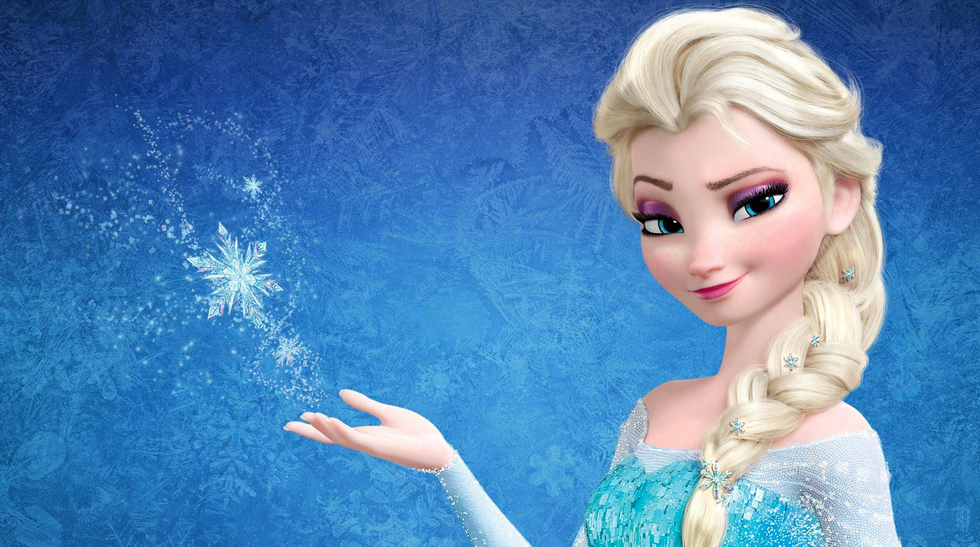
Lately, there has been a lot of talk about the possibility of Elsa being a lesbian in the second movie, both in that some people really like the idea, and others are prepared to boycott Disney should it happen. In response to a video of Idina Menzel (the voice of Elsa) and Miley Cyrus discussing the possibility, one person left this comment:

This stood out to me as the exact reason that we need a lesbian princess: lack of representation. I love the idea of children, especially young girls, having role models whose lives don’t revolve around finding a partner. It’s absolutely important to teach children that people don’t need to have a partner in order to be happy. However, it’s equally important to teach children that being gay is fine.
“A character like Elsa probably would've helped me quite a bit back in the day. That’s why we should give them [children] characters they can see themselves in, but not characters that only 25% of our youth can identify with”, in other words, “I want representation for myself, but not others.” Growing up LGBTQ is confusing. Even in a household where being queer is accepted, the media, especially for children, is so exclusively hetero that it still felt as though I should grow up, marry a man, and have kids in order to be happy. Barbie had Ken, Minnie had Mickey, etc. Having even one character who was gay and happy could have made a big difference in realizing that being gay is something that exists.
It’s not even that we don't have enough positive representation—it’s that there’s little to none that exist for children. Depending on the people in a child’s life, they may not have ever knowingly interacted with a gay person or really recognized it as an identity. The first time I saw two women kiss, I thought it had to have been fake. I knew that I liked girls more than boys, and I still couldn’t wrap my head around the idea of two women wanting to kiss just because they liked each other.
I recognize that there are characters which “hint at being gay," but children don’t pick up on subtleties. If a child can’t look at a character and say “they are gay," it doesn’t help the cause. I’ve found two gay characters in all of children’s media, and they are in a relationship with each other. In July of 2016, ’Loud House’ became the first show to feature a gay couple in the history of Nickelodeon and it is the only example I could find of an explicitly gay character in children’s media.
LGBTQ relationships shouldn’t feel awkward for people any more than straight ones. The reason a lot of people feel that way has a lot to do with the fact that LGBTQ relationships, especially lesbian relationships, are constantly sexualized. There’s nothing inherently inappropriate about two women kissing or holding hands any more than a man and a woman doing the same. Cinderella kisses the prince and nobody has any issue with it because it’s an innocent and romantic interaction which is in no way sexual.
I promise that if your child is “having those [gay] thoughts," it’s not because they saw another gay person. Growing up in the early 2000’s, I promise there were plenty of young girls with crushes on Lizzie McGuire, Kim Possible, and Zoey Brooks: three characters who crushed on boys and for whom there were no implications of homosexuality. The difference is that many of these kids (myself included) didn’t know what to make of these crushes. Maybe it’d go away, or maybe everybody thought girls were prettier than boys and grew into being straight. I didn’t know that and didn’t really figure out that it was just because I was gay until middle school.
The fact that you “can’t imagine Elsa, one of Disney’s greatest characters of the 21st century, would fall for a woman” means nothing because gay people are like everybody else. There’s no such thing as “she wouldn’t fall for a woman” because nothing makes people fall for women except for their sexuality. They don’t have to wear flannel or Birkenstocks and love cats to be a lesbian. We’re just ladies who happen to like other ladies.
The last point I’m going to bring up is also the most concerning in my opinion—being gay does not mean that you’re in any way interested in incest. The fact that I like ladies does not mean that I’m attracted to all ladies. I’m perfectly capable of looking at a woman and not wanting to have sex with her. Lesbians aren’t attracted to their sisters any more than I am to my brother. Incest is disgusting, and not something that comes of being gay. Again, this belief comes from people sexualizing lesbianism and thinking that gay people are attracted to everybody.
I don’t think that Elsa specifically has to be “the one” who ends up being gay because, like I said, having characters whose plots don’t revolve around romance is also important. However, I think it would send a really good message that LGBTQ people are the same as everything else. Hopefully, if a parent were to ban Frozen from the house because of this, then the process of explaining that “you can’t watch Frozen because it’s inappropriate” would be a bit of a wake-up call. How do you convince your child that a character whom they love and idolize is suddenly a bad person and they’re not allowed to like them anymore?
Overall, representation is important, especially for those who can’t find somebody to connect with in pop culture. Representation validates that who you are is okay and giving that to queer children rarely happens, but should.