
"I'm walking down the street – well back when I could walk down the street – and I trip over a large rock. Now, I’m a nice looking old lady, so everyone rushes to help me stand up. Everyone is worried if I’m okay. No one goes to remove the rock."
A lifelong Human Rights Activist Shulamith Koenig was wheeled over to my lunch table during Northeastern University’s annual PHRGE Institute. PHRGE, the Program on Human Rights and the Global Economy, put on this two-day conference with a focus on the Emergence of Human Rights Cities. Shulamith Koenig, who was referred to as “Shula,” sat with me, Vickie Casanova Willis, Noel Didla, and Dorotea Manuela. We represented three generations of women at various stages of our Human Rights activist work in various locations across the country. Me, in the earliest stages, the three aforementioned women in the middle of it, and Shula coming to the end of it.
Shula insisted we take this metaphor with us. She was this living, breathing embodiment of years of fighting the good fight. When someone in the conference used the term “basic human rights,” she corrected them by saying we should not use that term. All human rights are basic. Take a look for yourself right here.
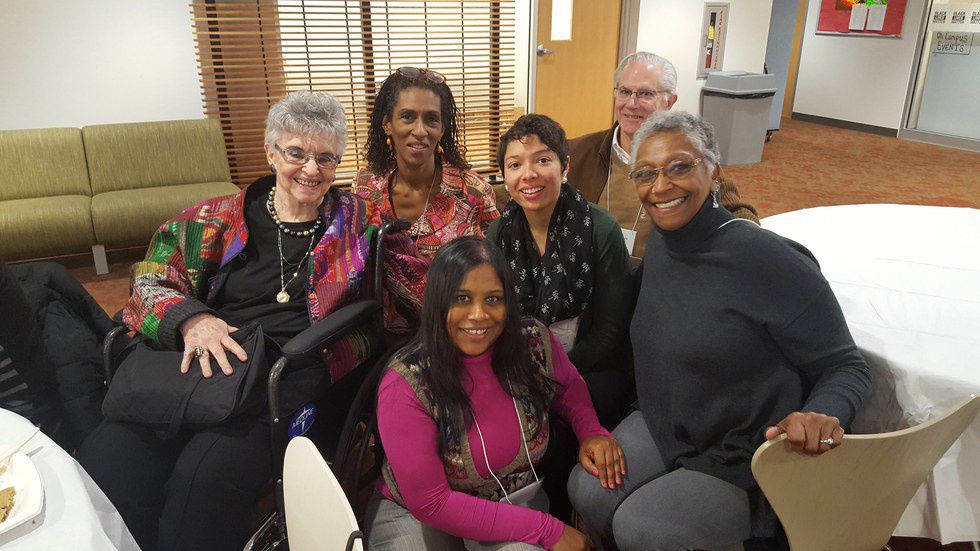
So we conference-goers are gathered here on the eve of International Human Rights Day (December 10), talking about human rights and how it relates to the current post-election climate. We talked about Rosario, Argentina, which became the first Human Rights City back in 1997. What that meant was a community came together to sign a proclamation in City Hall which committed the people of the community to promoting respect for human rights, and equity and peace. The government of Argentina complied with this obligation. It was similar to these sanctuary campuses and cities that are emerging in the wake of Trump’s elections. These sanctuaries are being created to protect the human rights of people targeted by Trump and his administration.
When it comes to work revolving around social justice and human rights, we as a society are often reactive instead of proactive. Either that or we create temporary fixes for problems instead of getting at the root of the problem. Shula’s metaphor really speaks to this. The rock is the institution, or the system we are existing under, that is creating a constant disproportional amount of problems for minorities in comparison to our white counterparts.
We are constantly falling, and because we are resilient people, we always get up. We allow our communities to help us get back up. But removing the rock would prevent others from falling. Part of this is recognizing that this isn’t new.
One of the largest takeaways from the conference was the importance of these cross-generational conversations and individual testimonies. We don’t put enough emphasis on the stories of individuals, particularly those of the older generations. We don't look at how those individuals comprise this community that needs to work together. If we did, we would find that none of this is new at all.
Oppression has not lessened, it has only changed face and form. We must recognize now is the time to act, as individuals and as a larger community. The people who followed Malcolm X or Martin Luther King Jr., they did not know the impact they would make in history. History is only recognized in hindsight. But we need to see this moment in time for what it is. We are making history, right now. And we have a lot of work to do.