


I walked into a packed lecture hall; there were already students deciding to sit on the floor and stairs and professors scrambling to get people into seats. Luckily, I found a single seat and waited for the lecture to begin.
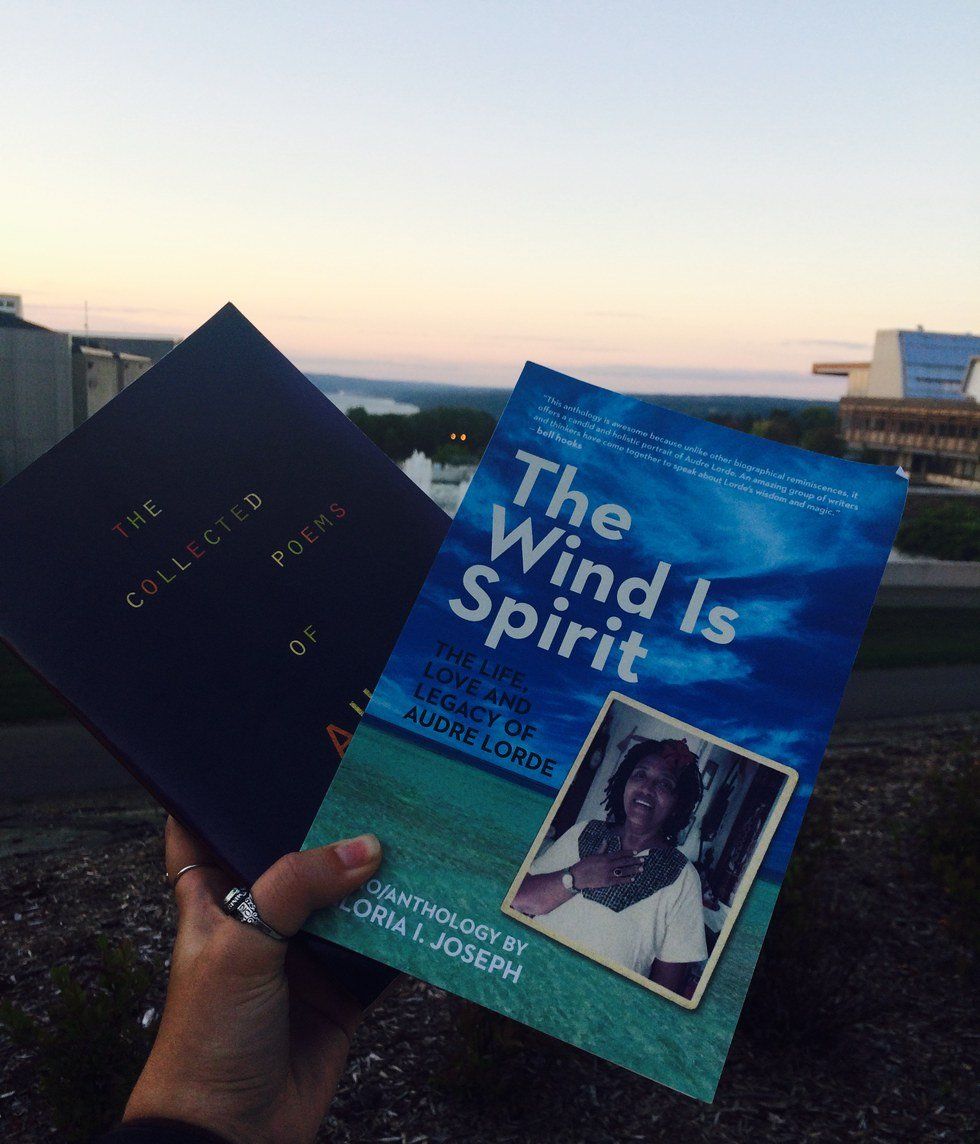
No, I was not in a class. I was going to an Ithaca College Women and Gender Studies lecture given by the remarkable woman, Gloria Joseph, PhD. Dr. Joseph was in town to talk to students about her new book, which she calls an "bio/anthology" of her friend and partner, Audre Lorde's life. Why is she so remarkable? Well, I think that attributes to her long history of being a radical Black feminist - and she even introduces herself as a Black feminist because she "wants people to know we aren't going anywhere" until the job is done.
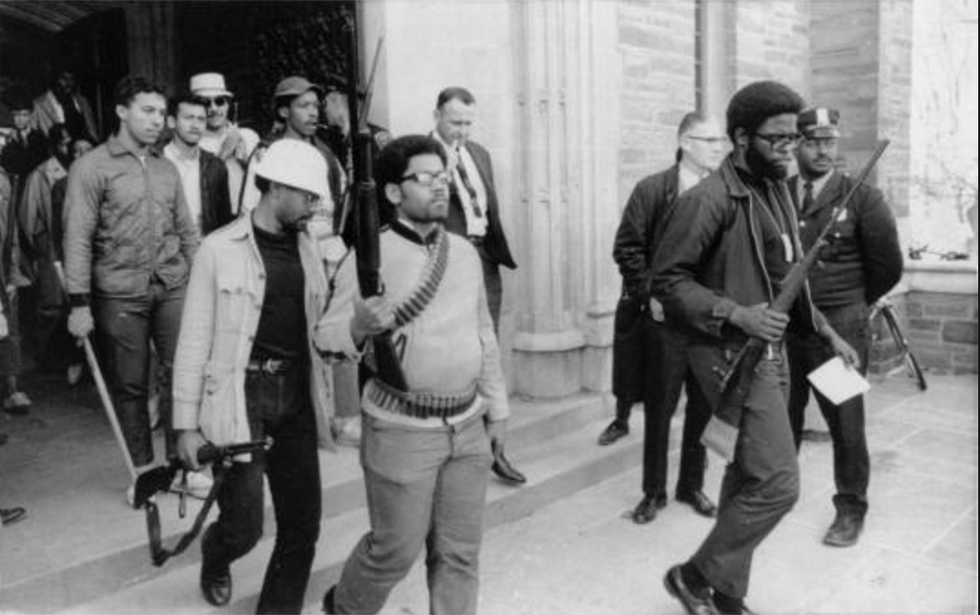
What has Dr. Joseph done to be dubbed a "radical black feminist"? Well, I only knew a little bit about her before walking into the lecture hall (because Google doesn't have that much on her), but Professor Carla Golden gave so much information on Dr. Joseph I thought she may have been Google. Professor Golden professed that Dr. Joseph attended Cornell for an MFA program and then began a teaching career there. This was during the time in our country when college campuses were conducting many protests - some were for the Vietnam War and others were for racism.
Cornell had a protest of its African American students taking over Willard hall for 36 hours in protest of the campus's racism. Dr. Joseph was with the students for the entire time and this is the famous photo that came out of the stand:
Professor Golden also remarked on Dr. Joseph's, and Audre Lorde's, creation of an organization to help women in South Africa during the Apartheid period as well as writing numerous books on feminism and activism.
When Dr. Joseph took the mic, she said, "It's easy to get involved in things" you just have to be willing to get up and do it. "People think activism is marching, protesting, or holding a sign. But you can be an activist and just write." And this is how Dr. Joseph viewed Audre Lorde.
For those who don't know who Audre Lorde is: she was a poet and an essayist and someone who helped the word "intersectionality" come to life in the women and gender studies world. Intersectionality is the intersections of social identities such as race, gender, and sexual orientation. Lorde described herself as a African American, Female, Lesbian, and mother all at once because that was who she was.
When she was dying, Lorde made Joseph promise to write about her life because she "wanted to inspire black women - all people in actuality. I'm telling my story and you have to tell the rest of it." And therefore the book The Wind is Spirit: The Life, Love and Legacy of Audre Lorde came to be almost twenty two years later. When I asked Dr. Joseph why she decided to have the book published now, she explained that her conscious just told her the time was right, that the energy was there and ready.
But Dr. Joseph didn't want to write this on her own; instead, knowing that so many lives have been touched by Audre, she asked about fifty writers and family members and friends to write pieces about Audre and how she brought light into this world that was so dark. When the papers were all submitted, Dr. Joseph saw that Audre was beginning to form a profile and gave herself the position of "griot, a storyteller who keeps the flow of the book while making connections between stories." Dr. Joseph felt this was necessary due to the idea that "hundreds of women could also identify under that profile and Audre was different."
Dr. Joseph began to compare Audre to Martin Luther King, Mahatma Gandhi, the Dalai Lama and Malcom X. Why? "Because her words are known world wide and have moved masses, too."
Here are some quotes of Audre's:
"Your silence will not protect you."
"There is no hierarchy to oppression."
Dr. Joseph then decided to analyze this quote because all of Audre's quotes and poems have a deep meaning to them. Dr. Joseph said, "think of all the wives of the slave holders that went on and created 'malto' children (half white and half black children). They must of had a tough time. Their husbands were cheating on them with a race that was supposed to be 'below' them. I have always wondered why no one has tired to analyze them or something. But you cannot compare their oppression to the slaves because it was not on the same plane.. Look at oppression; women have it, overweight people have it, disabled people have it. If we put them all in a room and had them talk it out and then had a poor man who lived in a inhabitable place come in and say that he had it worse them all and then added a woman of a domestic abusive relationship" - it wouldn't create a caste system or no oppression would "win" at being the worst. "You cannot sit and judge someone on their oppression because you haven't walked in their shoes. And you can't divide and conquer. Band together and take down the oppressor."
Instead of reading any parts from the book or a poem of Audre's, Dr. Joseph decided to tell us little bits about Audre in her own words, not written down, those personal words that you save. "She used to wear this red t-shirt that said, 'if I can't dance, I don't want to be a part of the revolution,'" Dr. Joseph laughed at the memory. "And when she accepted the poet laureate award in New York City, the governor had to change his speech on stage because Audre's made him nervous. She said in her acceptance speech, 'Its nice to get an award from a country that is ..' and she listed off all the wrong in the country." And then Dr. Joseph began to talk about the two's travels around the world and how Audre influenced Black German women to be prideful of themselves - "I can't say she 'empowered them' because you have to empower yourself."
Then came time for the Q&A section. There were many questions, all were very thought provoking and deep and emotional, Dr. Joseph took her time to answer them and to give some really strong answers. I couldn't write down them all, but here are just some:
Q- "How do you understand your writing to be activism?"
A- "Well, first, today, I wouldn't last half an hour marching or holding a sign for so long. But I believe the battleground of your activism is where you are. Political consciousness is knowing which side you are on. Political analysis is knowing who is there with you. Because we know that not everyone can 'walk the talk and talk the walk'... But the role of the artist is to 'keep civilization from destroying itself' (an Albert Camus quote) and just a few words can do it."
Q- "What do you believe to be the best way to fight oppression?"
A- "Besides sex? (small laugh) No matter the oppression you face, you must understand it and have a goal/mission/theory on the best ways to attack the opposition. Change takes place not through meditation, but through action" - whether it be words or marching or holding a sign.
And lastly, one of the quotes that stuck with me for the rest of the night that Dr. Joseph said was, "One hand cannot clap." She claimed that this was her guide when she wrote and I believe that even when she was out protesting and organizing groups of support for women she had never met before, she believed this quote too.
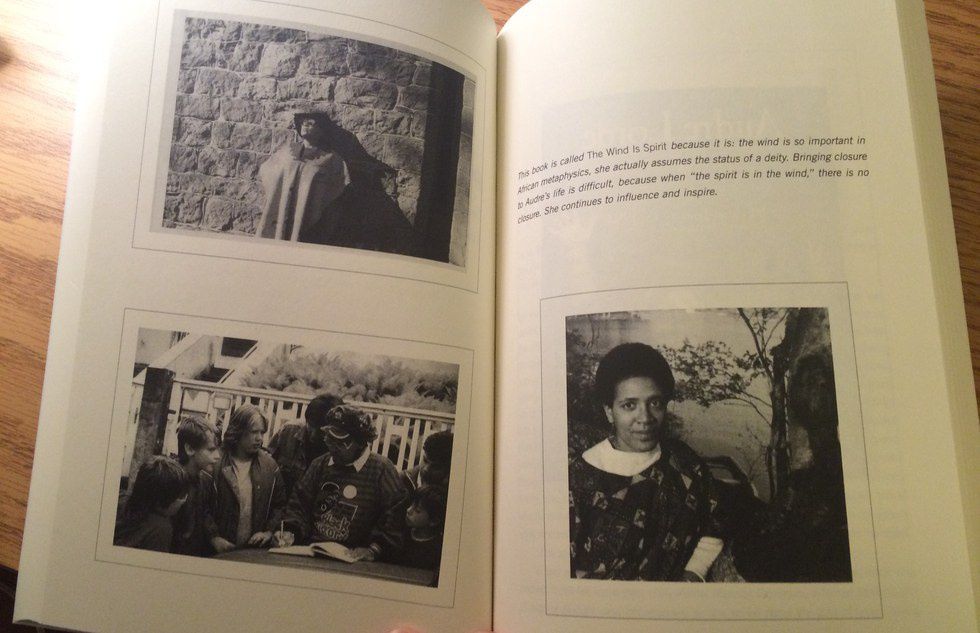
And I hope you all think about the quote because in our country right now, we need to help each other instead of tear each other down. We need to know that we are one and we shall walk hand in hand no matter race, gender, sexuality, identity. So let this all sink in and then find some Audre Lorde poems online and read them, too, and think about their meanings. They have a lot to say.

















