

Last week, in news that shouldn't have been news, actress Blake Lively received criticism for captioning one of her Instagram photos with Sir Mix-A-Lot lyrics. The Cannes veteran wrote "L.A. face with an Oakland booty" under a split image that showcased both her flawless face and plump behind. This chosen quote caused rampant controversy on both Twitter and Instagram, somehow making it newsworthy. People were outraged with Lively.
Now, forget the fact that the caption was a jesting reference to "Baby Got Back" and not a statement by Lively. Forget the fact that we all recently celebrated Body Positivity Week in order to promote self-love, so all bets are apparently off when a professional pretty person chooses to love her body also. Forget the fact that there are other matters in the world to become outraged over, and this is literally the minutia's minutia. Do I have to quote Kourtney K on this? "Kim, there's people that are dying!"

But forget all this and focus on the underlying problem at hand. Every small argument is just an indication to a larger one, and the result of Lively's quote unquote miscaption is no exception.
In her caption, the actress never claims to have a big behind, but this is obviously the connotation. So the Internet, and specifically my fellow African-Americans, grew enraged. How dare Lively claim to possess something that another culture boasts? How dare she, a wealthy, blonde, Caucasian woman, go around flaunting a big behind knowing full well that this is appropriating black culture? HOW. DARE. SHE?
Sorry, but if you can't tell I'm being overly sarcastic.
For those of you who may not know what cultural appropriation is, it's defined by Wikipedia (a credible source obviously) as the following: "The adoption or use of elements of one culture by members of a different culture."
Cultural appropriation is seen as racism or a form of oppression. And while there have been serious cases of cultural appropriation throughout the years, society today has transformed this problem into another groaner. How so? By finding fault in every form of expression, which is a practice our country is fortunate enough to partake in.
Think about Justin Bieber and his recently sheared dreadlocks. People were quick to point out his cultural appropriation in regards to the hairstyle. However, the singer simply commented in response to all the controversy: "It's just my hair."

Or think about the case of the white student at San Francisco State University who suffered verbal and physical harassment from a black woman, who is also attending the school. The woman interrogated the young man, questioned whether he had a pair of scissors to cut the dreads he sported and subsequently threatened him. Her inappropriate behavior was filmed and uploaded, resulting in the video's "virality."
When I watched the video, I grew disgusted by the woman's actions and tried to conceive an excuse for her harassment, coming up with none. It's more than unfortunate that our society, and my race in this matter, is quick to accuse others of cultural appropriation these days. But that's how the matter has become a groaner, as mentioned before, growing as tiresome as the boy who cried wolf.
Now, in regards to the aforementioned examples, I do not care about another person's hairstyle for the following reasons. One: it is not my hair, and two: people are free to express themselves in whatever way they feel. So accusing someone of racism because he or she has decided to style his or her hair in a manner that may or may not have originated with your people is something close to pettiness.
But by this logic, flip the coin on the other side. Do black celebrities receive backlash for styling their hair bone straight? I have never heard someone accuse Jada Pinkett-Smith of cultural appropriation for doing so. But let me follow Kermit's lead and sip my tea.

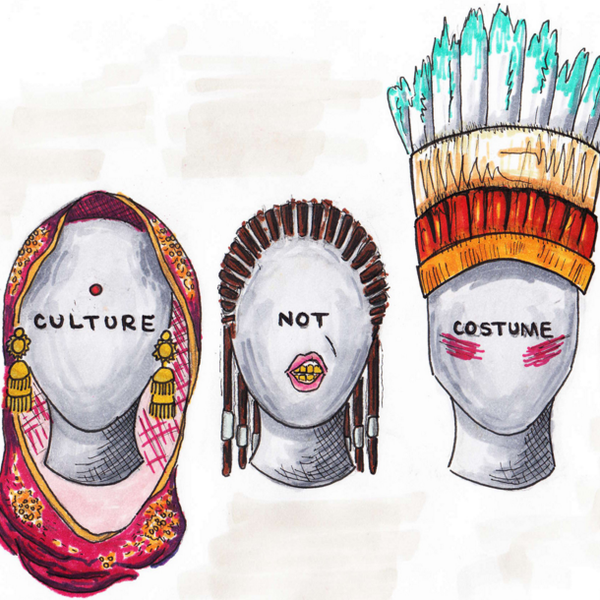
Society has grown misinformed about what qualifies an act as cultural appropriation. So if you'd like to share some pointers with your friends, here are a few acts that are considerably racist. One, donning a mustache and getting hammered as a way to celebrate Cinco de Mayo is appropriation. Two, placing a bindi or a vermillion mark on your forehead while attending Coachella is appropriation. Three, wearing black face for any reason is appropriation.
There are certainly gray areas when it comes to cultural appropriation, but that's where intellect and a brain filter get involved. But the way someone styles his or her hair should not qualify as appropriation since no culture has ever had any set claim on a hairstyle. And the fact that God blessed Miss Lively with a back to brag about is not a form of cultural appropriation either. Get it with your bad self, Blake!
In conclusion, a hairstyle and buttocks should not be the end-all-be-all definition of one's culture. So, my fellow African-Americans, think about aspects other than physicality that make our culture unique and come back to me.