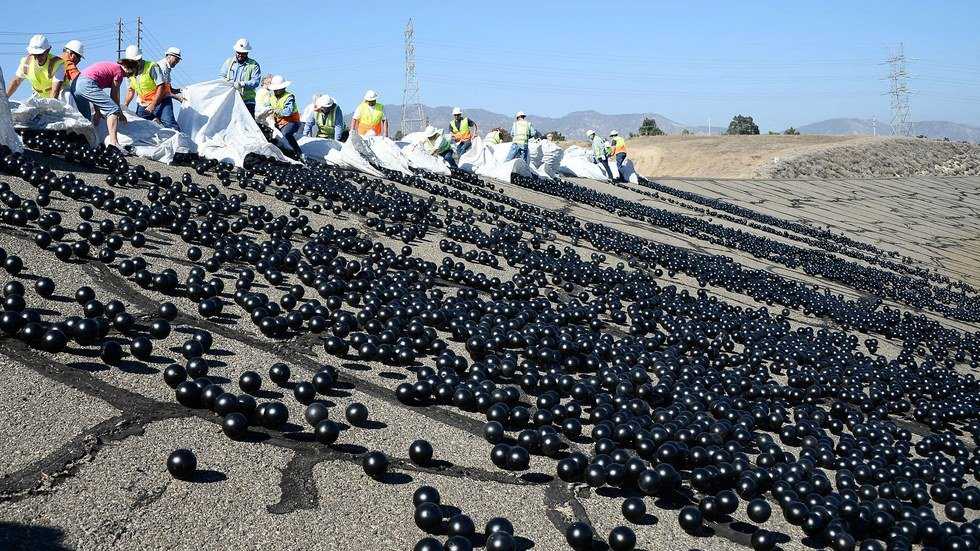
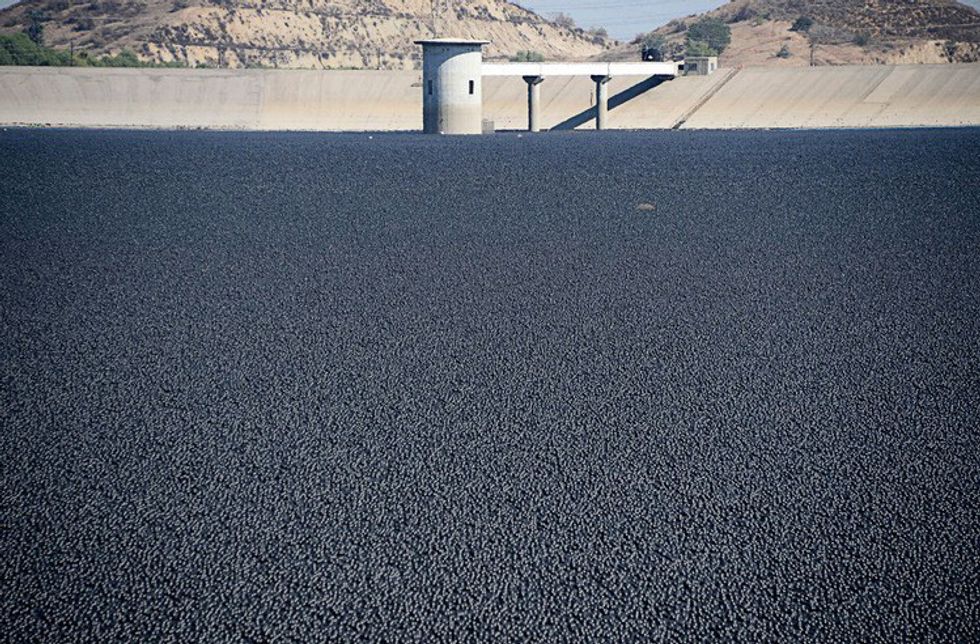
Last week, 20,000 plastic balls were released into the Los Angeles Reservoir to finalize a massive effort California has taken to combat its severe drought. There are now are a grand total of 96 million plastic balls — coined “shade balls” — floating on top of the reservoir. While it’s impossible to deny how cool the pouring of these shade balls into the reservoir appeared, the balls actually serve a much greater purpose.

After four years of drought in California, the Los Angeles Reservoir is in need of protection as it holds most of the city’s water supply. Containing 3.3 billion gallons, the reservoir can supply the entire city of LA with water for up to three weeks. This is the largest basin of its kind — at a whopping 175 acres — and it is owned and managed by the Los Angeles Department of Water and Power (LADWP). According to Mayor Garcetti's office, the LADWP is the first utility company to use shade balls as a means of water protection.
These plastic shade balls have the potential to protect LA’s water supply as the terrible drought wages on. Their purpose is to reflect sunlight away from the water with their black sheen, thus preventing more water from evaporating. Annually, evaporation removes around 300 million gallons of water from the reservoir, and shade balls will combat this. Additionally, the balls will block harmful UV rays from reaching the water and causing massive algal blooms and toxic chemical reactions. If too many algae were to grow in the reservoir, the drinking water could be rendered too dangerous to consume. The balls will also deter wildlife from contaminating the water and act as a shield against falling and wind-blown debris.
At only four inches in diameter, the balls cost 36 cents a pop and
are actually a cost-effective means for protecting the city’s water supply. The
total cost of this initiative was $34.5 million, much less than other proposed
methods of protecting the water supply. To install a floating cover that would
act in the same manner as the shade balls over the expansive reservoir would
cost upwards of $300 million dollars. Additionally,
the balls are designed to last at least 25 years, so they prove to be a wise
investment for LA.
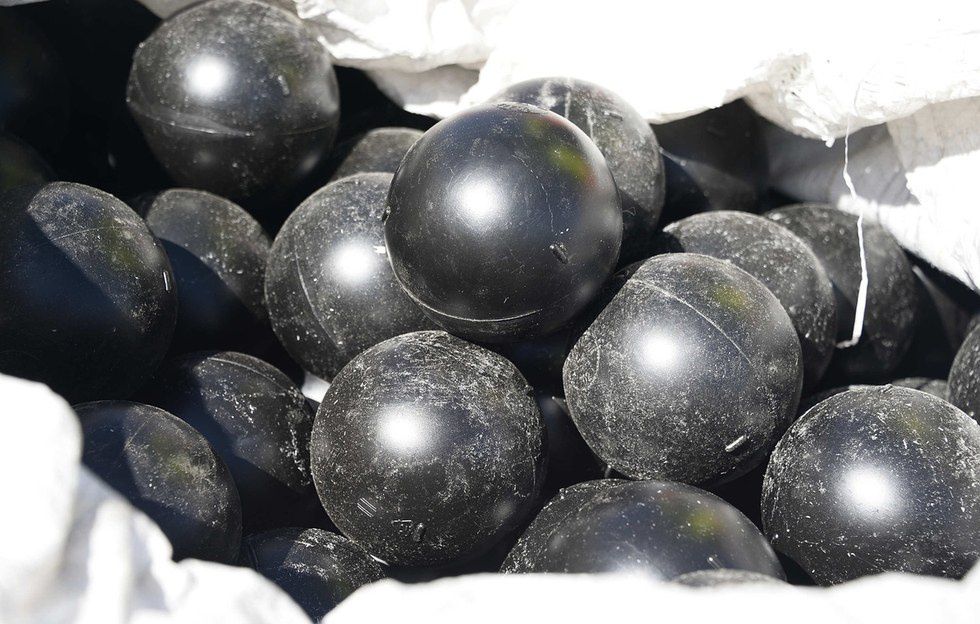
The shade the plastic balls are providing to the reservoir could be the key to protecting LA’s water supply. This innovative solution is easy to maintain — the balls will only need occasional rotating — cost effective, and will last for a long time. Under the cover of 96 million shade balls, the city’s water is shielded from extreme evaporation, UV rays that could cause chemical reactions and algae growth, and tons of other debris. And if anyone is wondering why the balls are dark, heat-absorbing black rather than less heat-absorbing white, according the the LA Times, it is because the balls are manufactured with carbon black that allows them to resist strong UV rays without degenerating quickly.