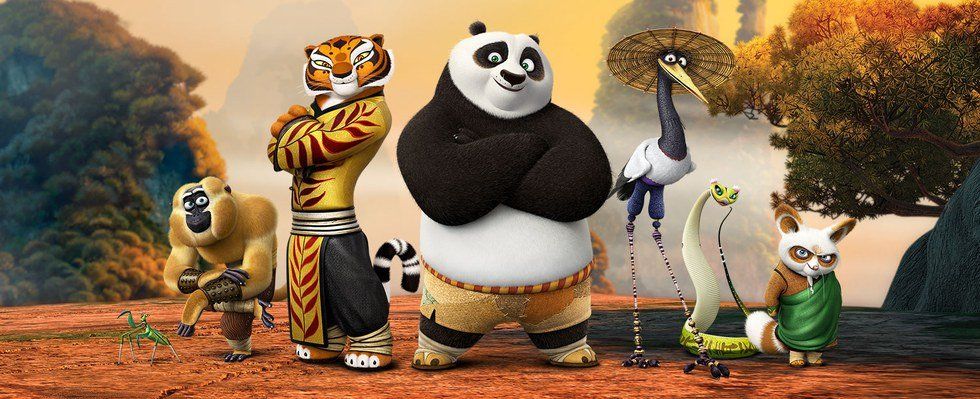
I feel incredibly conflicted about “Kung Fu Panda 3." I greatly enjoyed it while watching, but after it finished my mind dove into hyperactive overanalysis and I began to see all the missed opportunities, unfinished plot threads and flat characterization. The thing was, I really wanted to be able to say it was a great film, because the original “Kung Fu Panda” is my favorite from Dreamworks Animation, and the sequel is also pretty amazing, but the more I thought about it, the more I realized I had to concede that “Kung Fu Panda 3” is only a good film.
“Kung Fu Panda 3” (2016) is the latest installment in Po’s growth as the Dragon Warrior. This one continues the plotline from the sequel about Po’s family history, when a panda named Li Shan (Bryan Cranston: “Breaking Bad”) comes to the Valley of Peace in search of his long-lost son. It’s quickly surmised that Po is indeed Li’s son, but they have little time to become reacquainted, as the vengeful bull Kai (J.K. Simmons: “Whiplash”) returns from the spirit realm to destroy Oogway’s legacy. Li and Po, along with Po’s suspicious/jealous adoptive father Mr. Ping, head for a secret panda village in order to learn the power of chi, an inner energy force buried deep within their souls.
What I was really missing from “Kung Fu Panda 3” is a sense of solemnity. There were moments where I could feel the film was trying to take a step back from the fast-paced dialogue and witty jokes—Kai fighting the Furious Five at the Jade Palace or Mr. Ping giving advice on parenthood to Li—but it never struck that emotional cord that I experienced with the previous two films. I believe the reason is because Kai is by far the weakest of the three villains. From a pure kung fu standpoint, Tai Lung in the first film has scene after scene of showcasing his amazing abilities: the epic prison break, the rope bridge against the Furious Five, and his showdown against Shifu. Lord Shen in the sequel has a captivating, elegant style to his fighting that’s supplemented with his use of gunpowder. In contrast, Kai actually does very little fighting himself. Instead, he controls jade statues of the captured spirits of other kung fu masters, which robs the audience to see what makes him such a formidable opponent.
On a more important level, Kai has absolutely no depth to his character. What makes Tai Lung and Lord Shen so powerfully passionate is that both are direct comparisons to Po’s situation. Both villains are troubled by who their identities are in relation to their parents, and are trying to prove themselves worthy of distinction. With Kai, all of his motivations are based on revenge and the audience has no grounding to understand who he actually is outside of that.
So what happened with “Kung Fu Panda 3” is that I don’t feel the same urgency or the same poignancy. There isn’t a strong enough foreboding of the consequences that could happen if Kai actually does succeed because I didn’t see Kai himself as a serious threat.
Now, like I mentioned earlier, I greatly enjoyed the experience despite some of its downfalls. The humor is as sharp as always, leaning on misdirection, undercutting characters with puns and wordplay, and Po’s lovable personality. The artwork and animation is absolutely beautiful, and like the previous two in the series, integrates its own style of 2-D animation that is clever and enthralling. The design of the spirit world is ethereal and immense, a world that offers peace and tranquility to elderly kung fu masters like Oogway. My final rating is perhaps a half-letter, half-star high, but I’m willing to cut everyone’s favorite panda a little slack.
Rating: B | 3 stars