As students go away to school, they’re are thrown into a pit full of diversity, new opportunities, raging hormones, and overall freedom which can sometimes be an opportunity for the sexually repressed or curious to explore their true thoughts without as much pressure from their authority figures to fit a certain sexual role. In college, the lines between gay and straight definitely seem to blur. Here, people often can come to terms with themselves regarding their sexually.
Gay or Straight. That’s it, right? Wrong. One of the fundamental problems we have when perceiving new or unfamiliar concepts is the tendency to look for a black and white or yes-or-no answer. Things aren’t always this way. In fact, many of us would be surprised to know our normal thoughts and desires could be classified as not gay or straight, but instead a percentage of both.
This idea of people not being gay or straight isn’t necessarily a new concept. It has only recently come to a greater light given the higher acceptance of the subject in today’s society. Many of us would indeed be surprised to learn this idea actually came about in the late 1940’s. This theory called The Heterosexual-Homosexual Rating Scale or The Kinsey Scale; was developed by Alfred Kinsey and his colleagues Wardell Pomeroy and Clyde Martin. (credit: The Kinsey Institute)
So what is The Kinsey Scale exactly? According to The Kinsey Institute, “The Heterosexual-Homosexual Rating Scale”, or “Kinsey Scale,” was developed, “...in order to account for research findings that showed people did not fit into neat and exclusive heterosexual or homosexual categories.” Once I read about this, I was very eager to take some sort of test in order to participate in the study. However, The Kinsey Institute answers the very question of can one take a test to be rated using The Kinsey Scale?”
Unfortunately, you can’t actually take a test. In fact, the original researchers rated people based on their sexual history says The Kinsey Institute. The Kinsey Scale is actually rated as follows, “The scale ranges from 0, for exclusively heterosexual with no experience with or desire for sexual activity with their same sex, to 6, for exclusively homosexual with no experience with or desire for sexual activity with those of the opposite sex, and 1-5 for varying levels of desire or sexual activity with either sex.” Here's an actual image of the scale to give you a better idea:
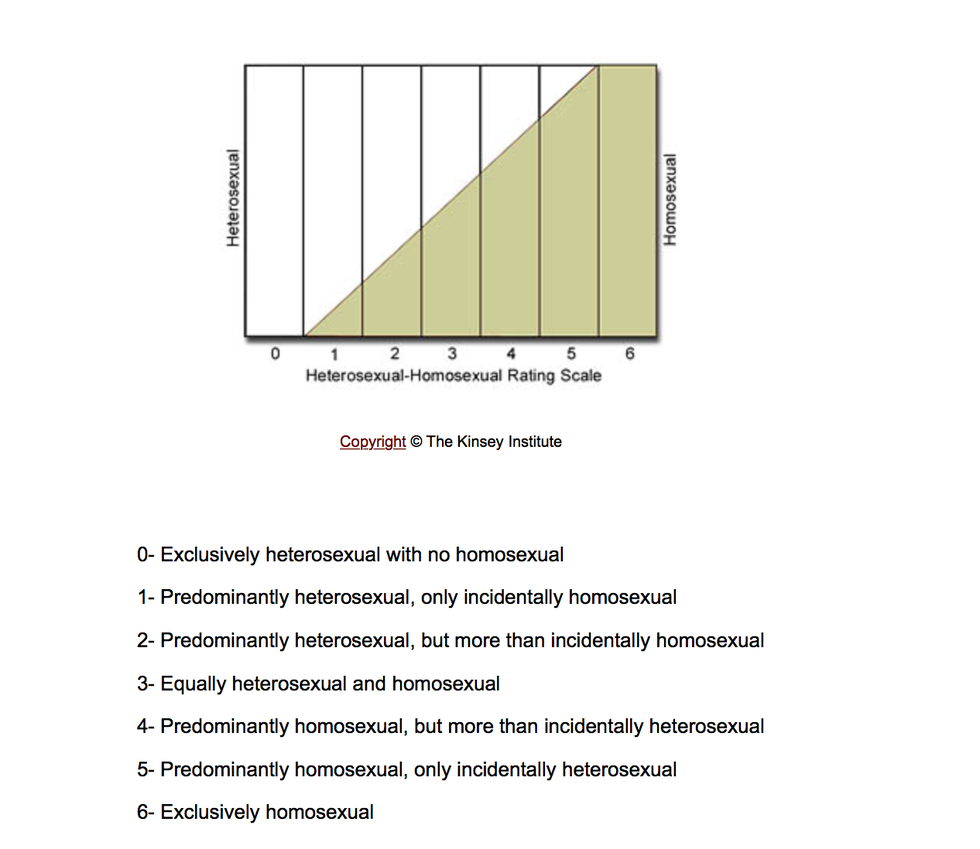
Now, on a more anecdotal note, if you split the scale in two, and every score to the left of three was simply called straight and every score to the right of three was simply called gay, this would explain many people’s explanation of their sexual orientation. For example, if you ask a self-proclaimed straight male exactly what his sexual orientation is, chances are his answer will not take into consideration any possibility he has participated or has plans to participate in non-heterosexual acts. In fact, he will most likely generalize his sexual orientation as a zero, or completely heterosexual. And the same thing can often be said for people who identify as gay. Frequently, they will not account for any sexual experiences in the past or any possible desires. One can assume that people's answers are subject to situational biases meaning some people may not yet be comfortable revealing details about their sexual orientation. The reason this anecdotal note is important is that during the original Kinsey Study, the research was not conducted on a test, but instead, it relied on an interview revolved around questioning the interviewee’s sexual history.
Alfred Kinsey is quoted as saying, “Males do not represent two discrete populations, heterosexual and homosexual. The world is not to be divided into sheep and goats…The living world is a continuum in each and every one of its aspects." (Sexual Behavior In The Human Male, 1948) This quote is powerful in its explanation of my original statement which is that often times society tries to classify things in a black or white, yes or no manner. This isn't necessarily because society is looking to believe in fiction, but instead it's often easier to accept an answer this way.
For as Kinsey explains here, there are often times deeper levels to every aspect in life. I personally believe the sooner we accept that every aspect of every life is unique and its own in every way, the sooner we can become a unified and understanding society. Often when we try to classify or fit ourselves and others into these societal, psychological, or even physiological roles, we cause significant trauma. People are meant to grow significantly in their own way from the time they're born to the time they die. If you plant something, assuming it doesn't die, it's going to grow freely. Period. If you plant something with barriers or fencing on and around it, forcing it to grow inside or through barriers, it may still grow, but keep in mind, those barriers can't be separated from the plant and its growth will be altered. The effects will be there.