
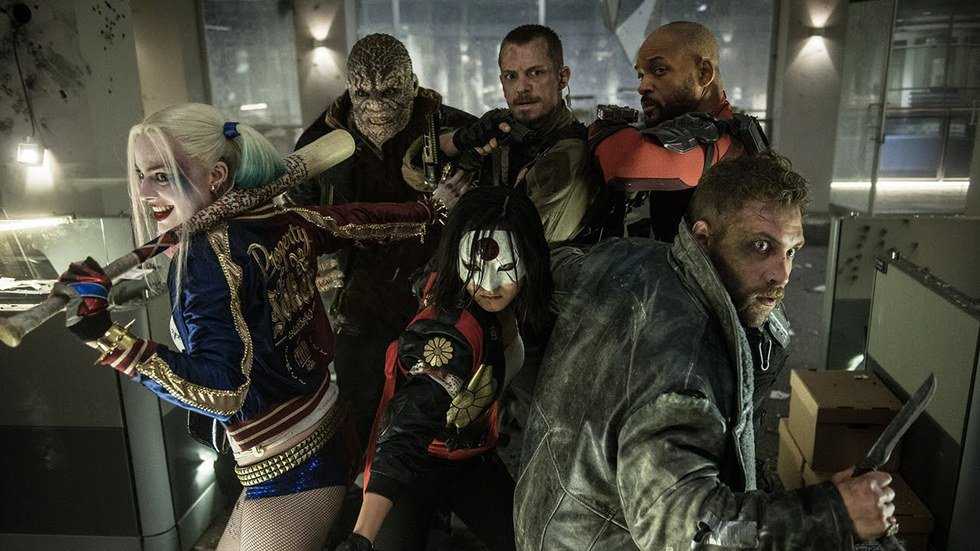
Though this year has had its share of movies focusing on valiant superheroes, this month’s “Suicide Squad” celebrates the exploits of the DC universe’s sinister supervillains. The main protagonists—criminals and loose cannons skilled at making somebody have a bad day—are ordered by a shady superior to do some dirty work and potentially serve as scapegoats. Beneath all their nastiness and infamy, writer-director David Ayer attempts to show, they’re still human and (in some twisted fashion) redeemable. The film shares a lot in common with its titular characters in that respect; there’s a lot wrong with it, but there’s something right about it too.
Given Ayer’s previous projects, most notably the crime thriller classic “Training Day” and the hard-hitting and realistic “End of Watch,” one would think “Suicide Squad” would work well as a film at least on the technical level. Unfortunately, you would only be partially right. Some scenes, especially the action sequences, are well-shot and edited, but the film as a whole feels slightly rushed and messy. Certain scenes appear as though they were cut short, dialogue seems to be missing in some areas, and there are several instances where scenes are over and done with little impact or importance in the grand scheme of things. A director’s cut of the film may shed some light on what was lost before the film hit theaters, but that doesn’t excuse the bizarre editing and pacing.
Speaking of pacing, the weak, uneven, and muddled narrative for “Suicide Squad” must be mentioned. It’s nice to get character backstory for the film’s main characters, especially for those in the audience who don’t read comics, but the movie spends too much time on this background information and not enough on actual character development. The lack of sufficient character development affects the characters Katana, Joker, and Enchantress the most, as these three don’t have enough context to be considered important or likeable. Furthermore, “Suicide Squad” falls into the nasty habit of having characters spouting exposition as opposed to letting the story develop organically through dialogue and interaction. To top it all off, we are given a main antagonist that not only fails at being a credible threat, but also is a cookie-cutter big bad for our “heroes” to punch and a cheap plot device used for shoddy, awkward drama.
Once again, though, “Suicide Squad” is a movie that straddles the line between good and bad, saved from its flaws by certain positive factors. For starters, the casting choices and acting were for the most part great. Will Smith and Margot Robbie as Deadshot and Harley Quinn, respectively, clearly are engaged in their roles. The two and their characters possess genuine heart and relatability, and almost serve as a reason to forgive the weaknesses of other characters in the film. One other standout would definitely have to be Viola Davis as the manipulative, cunning, and disturbingly cool-headed Amanda Waller, the government official responsible for bringing the film’s main characters together. Davis has an undeniable charisma that has to be commended, despite her character’s untrustworthy and uncompromising demeanor.
There are certain aspects of the jumbled narrative that somehow work. In the second and third acts, there are some rather well-done scenes of the team interacting with and learning about one another. It may sound confusing given my previous criticisms of the story and screenplay, but simply put, it seems as though Ayer corrects himself every now and again throughout the film, managing to provide a good amount of entertainment and engaging material. I found that the film had some surprisingly strong moments, such as the backstories for Harley and Deadshot or some of the aforementioned character conversations; these moments pretty much save the movie.
I find that no matter how much I complain, no matter what flaws I find upon recapping the film in my head, I can’t stay mad at “Suicide Squad” for too long. Make no mistake; it disappoints in more than a few respects. Yet, the disappointment gets shoved aside for those brief, beautiful moments when the characters are truly fleshed out or when the brawling starts. In short, “Suicide Squad” represents the one thing that I’ve wanted Warner Bros. to grasp ever since they started their DC movie universe with “Man of Steel”: have a sense of fun and adventure. Ayer’s latest work may not be at the caliber of “End of Watch” or “Training Day,” but I’d be lying if I said I didn’t enjoy watching it. It’s a sign that things are looking up for DC Comics films, and is a pretty satisfying ride in its own right.