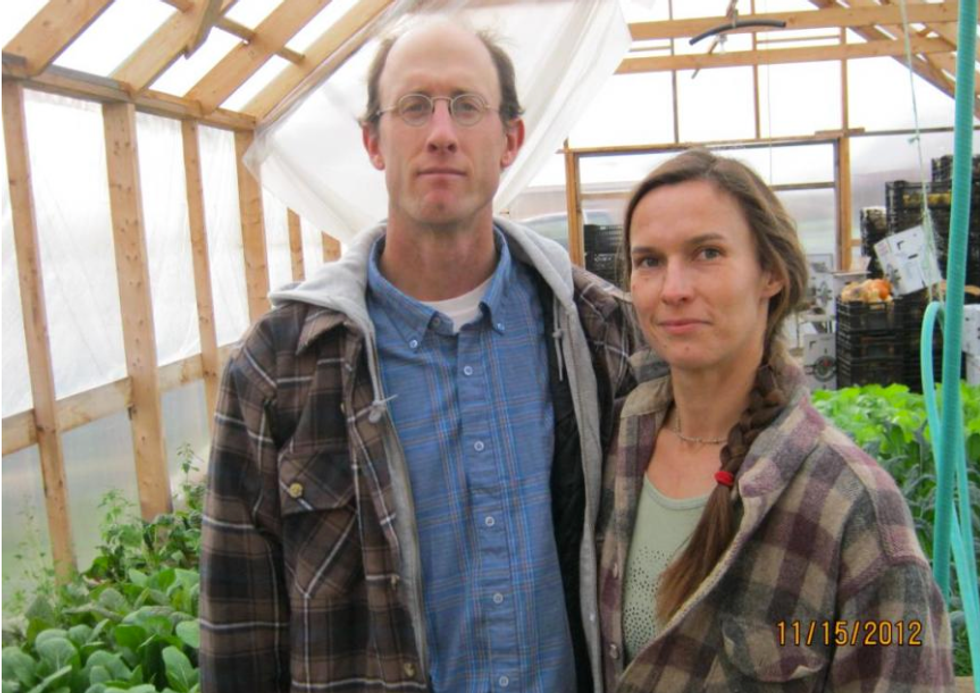
Dan and Megan Kent own Kent Family Growers, an NOFA-NY organic certified vegetable farm in Lisbon, NY. Together, the couple has spent fourteen years raising heirloom to conventional style produce. However, they didn’t always live in the North Country. Six years ago they lived further south in Heuvelton, NY. Dan had minimal experience in farming, only working as an apprentice in Maine for a year, but had a passion for the land. Megan had a bit more experience from farms in Vermont but was overall new to the project as well. To support their dream financially, Dan worked four to five jobs and ate rice with beans until he paid cash for a five-acre plot of land. Back then, the farm was fueled by a “green team”, or horse-power. Today, Dan still keeps a pair of horses, although the size of his operation has grown to 117 acres, twenty-four of which he manages: twelve are fallow and twelve are a crop.
This past spring, Dan was banking on the help of three workers from Mexico under the H2-A visa to work ten hours a day for six months. They were to spend the spring and summer prepping, planting and maintaining the forty different crops, while the autumn months would be spent primarily filling his four types of storage, cold-dry, cold-moist, frozen and room temperature, full. However, the infamous H2-A program is costing average farmers up to $300,000 as it fails for the third year in a row. Largely, the downfall is because of recent immigration reform in Congress failing to pass. While some people claim hiring out of the country takes away from the local economy, others assert finding hard honest workers locally is difficult — especially here in the North Country. Farm labor shortage is a national problem, and H2-A is one solution, but at the farmer’s expense, as they must provide room and board for the workers. It is no secret most farmers have to take on a secondary job to make an affordable living.
To help make ends meet, Megan works at the Potsdam Food Co-Op, where many of the locals buy their vegetables if they can’t access the Canton or Potsdam Farmer’s Markets. This isn’t the only place the Kent name is known, however. Approximately 30 percent of their produce is sold to a food co-op in Brooklyn. Although that seems like a lot of food miles, a food company based out of Ithaca conducts all transportation; Dan simply has to meet the driver in Potsdam for pickup. Another way customers can access Kent Family Growers is through their Community Supported Agriculture (CSA) program. For a basic twenty-two-week summer share, the cost is approximate $400. This is enough to feed two people. A full share is an additional $200. Customers access their portion of in-season produce from various pick-up spots each week. Some years are better than others, Dan said, depending on biological factors such as the amount of rain, number of pests and length of the growing season. Dan also mentioned other hardships such as weeds, which recently have increased, and the wholesale prices set by commercial agriculture.
So what is the key to his success? Diversity and timing. Having a multitude of produce, both between varieties of the same vegetable and having a plethora of different vegetable species allows for a wide range of customers. It also guarantees the Kent family will have some sort of income should a certain crop fail. Their success is also largely owed to their community. A common understanding when buying into a CSA is how the consumer becomes a stakeholder in the farming process. Some years aren’t profitable for the Kents, but the family is able to support themselves because the community has bought into their farm. The community knows when there is extra to be had the next harvest, they will be the first to receive. With this year’s workforce short, CSA members gathered a few weeks ago for an “onion planting party” to help the Kent family.
Is organic farming worth the hassle of short labor, climate change, pests and higher costs? For Dan, organic farming is more about the ethical and ecological treatment of the land rather than the profitability. He is only a few failed crops or machine breakdowns away from bankruptcy — a common risk most small-scale farmers face. His future plans, like any farmer, are to take the season by each successful crop. When asked how sustainable his farm is, Dan responded, “Not at all”. Yet, when asked what he has learned since the start of his journey, Dan replied “I don’t know any more now than year five. I just do what makes sense.” Such a simple answer reveals a lot about the motivations supporting their locally based operation. Interest compared to profit is a fine line for farmers, but I genuinely believe Dan and Megan care about their food, land and wider community in a way that strengthens the North Country.