

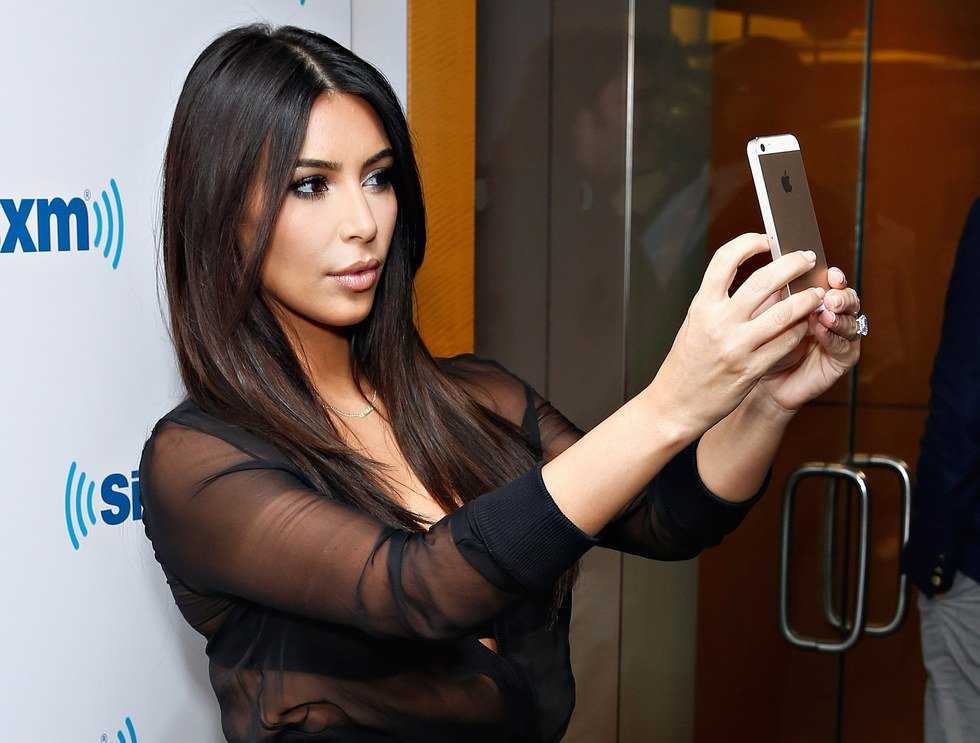
This past Sunday, I was watching “Keeping Up With the Kardashians," of course. As I watched, I simultaneously scrolled through social media apps and messages on my iPhone, because only watching one screen at a time is simply not enough. As I glanced up at the television, I was, for some reason, fascinated to see Kim Kardashian glued to her iPhone 6, just as I was.
My fascination may be a lesson in celebrity. No matter how many people know your name, most of us spend the same amount of time each day staring at our phones. However, the real root of my fascination was an interest in design. Perhaps because of my interest in the topic or the heavy amount of information about business I’ve been absorbing while studying for finals to conclude a semester of eight intensive business courses. This one product, the iPhone, was so supreme, that both myself, a college student unknown to the general public, and Kim Kardashian, one of the most talked-about and photographed human beings of our time, rely on it daily.
This definitely speaks to Steve Jobs, and why is he so highly regarded as a design genius. The iPhone is not only revolutionary in terms of pushing the boundaries of technology and redefining the capabilities of a cell phone, it is designed so well that no matter how rich or famous you are, you feel you have to have it, and so relatively accessible that you actually can have it. That is good design.
If anyone rivals Kim Kardashian in terms of fame and controversy, it’s her husband, Kanye West. While the discussion of “Kanye West” and “design" for most will conjure his self-proclaimed similarities to Steve Jobs and his award-winning, expensive shoes, West actually has a very simple, important idea about design.
In a lecture at Oxford University in March, a video of which was made public this month, West says that when he became successful and got a glimpse at how the other half (or so-called 1 percent) lives, he was shocked at the lifestyle that he had never even known existed growing up in the middle class. While Kanye worked for his success and is now able to afford a more affluent lifestyle, like, theoretically, any American can, it’s becoming apparent that you shouldn't have to be wealthy to access a certain amount of luxury.
West goes on to question why when a creative genius emerges, for example, a fashion designer, he or she is programmed from a young age to aspire to work at a fashion house like Dior, where the world’s best and most expensive fashion is tailored for the elite. He claims that the people with the skill to design $200,000 cars should be designing safe, sleek, and efficient automobiles that are affordable to the public.
The concept is as much an innovative proposition as it is an acknowledgment of a trend already occurring. Stores like Zara and H&M offer uniquely-designed clothes that imitate high fashion items at prices accessible to the general public. However, the success comes at a cost, destroying the lives of underpaid and overworked laborers in countries like Bangladesh and wreaking havoc on the environment. In terms of culinary arts, “casual dining” restaurants like Pret-A-Manger and Chipotle have seen success in offering delicious, health-conscious, and competitively priced food to the public. This business model can now be called into question due to the recent health problems seen at Chipotle’s across the nation.
Though a prime model is not yet established, the idea is worthy. People want products that are well-designed and differentiated, but also affordable, and businesses want to serve the customers and make profit. Given high millennial consciousness for the environment, and willingness to spend more for a better product (i.e. organic food), millennial entrepreneurs entering the world of business will begin to focus more and more on this concept.
Just under a century ago, automobiles and televisions were luxury items only owned by society’s most affluent. Today, a typical American family having only one of each of these items is abnormal. Gone are the days where well-designed products are only for the upper echelon. The Information Age, ought to, and is beginning to, usher in a time of sharing. If one man can design the phone owned and admired by both myself and Kim Kardashian, what can the collective minds of the millennial generation do when encouraged to collaborate and share in order to advance efficient, sustainable, well-designed, and affordable design?