


The insatiable screams for different people groups' concepts of justice is one of the most loud and uncharitable themes in the public sphere. It saturates the news, social media, and public places. Is this ugly rainbow of different ideas of justice a symptom of our modern age? I would say for at least the past century or so in America, no.
In an age that stands on or burns American flags in failed attempts to be profound, the following instance may come as a surprise. During World War I, a Christian minister named Herman Hoeksma declined to display the American flag in the sanctuary of his Michigan church. He was promptly reviled as a communist and pro-German traitor who should be shot or deported. You can read about it and other similar instances here via The Gospel Coalition.
Fast forward to a more recent example: almost every conceivable major activist group did everything in their power to fit the Duke lacrosse scandal of 2006 into their narratives. White over black, rich over poor, man over woman - each one was viciously exhorted in public humiliation of those players. Below is an actual banner displayed on Duke's campus shortly after the night in question, just to give the reader an idea of how gloves-off the reactions had become.
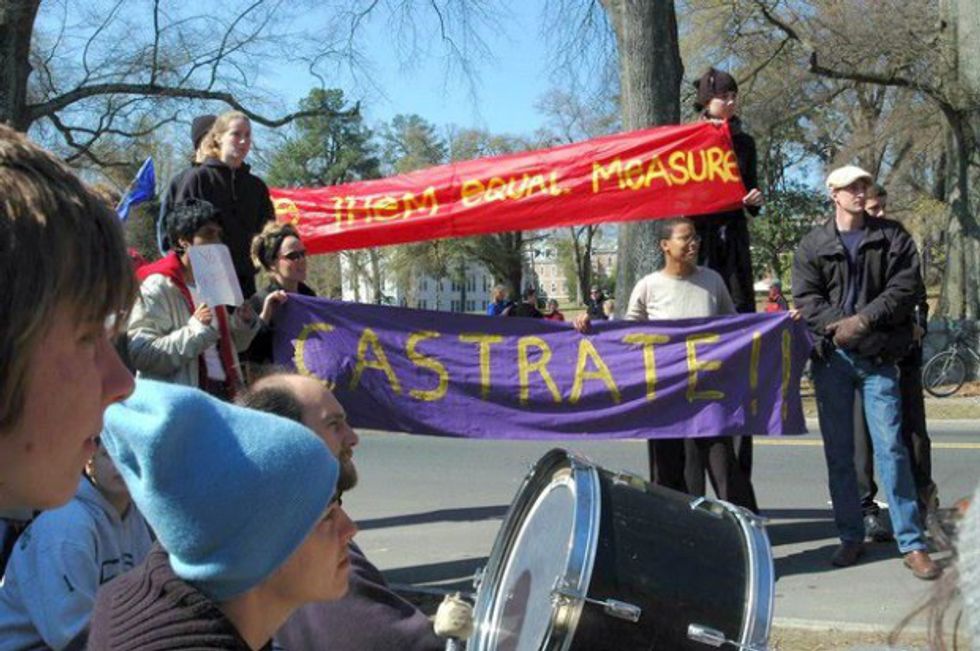
At least some of these activists and journalists (I probably shouldn't distinguish the two anymore) had the integrity to issue apologies to the Duke lacrosse team when none of the players' DNA was found anywhere on or near their accuser on the night in question and when the Durham District Attorney prosecuting them was swiftly disbarred after the proceedings.
Do not mistake me: hiring strippers for a party is reprehensible, but so is the unnecessary persecution the team took from just about everyone following that fateful night. ESPN's excellent 30 for 30 film "Fantastic Lies" documents this string of events. Guilty until proven innocent indeed.
And just last week, in the most undignified response to the Orlando shooting I've yet seen, one side of the House of Representatives basically rioted on the House floor until gun control bills were introduced (all of which eventually failed). The list of stories like these goes on and on.

So what explains this unfortunate theme of at least the last century of our country? It is a misunderstanding of God and a consequently misplaced hope. Our collective concept of God has evolved during the last century to define a God of only love and not wrath as well. The theme I have illustrated so far is one of the many sad results of this flawed understanding.
We profess to not believe in a God of both wrath and love, but yet we also profess to the contradiction that there is such a thing as justice. With only love and no wrath, there can be no such thing as justice, but that's a discussion for another time. Because we no longer believe in a God Who will eventually bring perfect justice to the world, it enslaves us to the need to bring about justice (our concept of it) right here and right now.
The bottom line is that an insatiable thirst for even a good thing like justice robs us of the peace God died for us to live by. Anyone willing to stand behind a "castrate" banner or trample on a flag that has brought as much good to the world as it has evil has definitely lost that peace. The only way to regain that peace is to ask yourself the fundamental question, "what, or whom, is my hope in?"
And by "hope," I mean the Biblical definition: life-altering assurance; as opposed to a vague, uncertain, and unlikely possible form of deliverance. Placing our hope in God and His redemptive work on the cross frees us from the need to see justice done here and now because we have been assured that one day, He will bring perfect justice to this earth.
Furthermore, it liberates our heart to ache for what makes God's heart ache (such as the Orlando shooting) and to work for restoration and justice in the aftermath without staking our entire being on those results and sacrificing our honor and dignity in efforts to achieve them.
Even when our public scorn and condemnation is accurately directed, it is still a corruption and perversion of our holy desire for justice that is inherent in the image of God that we all bear. Placing our hope in anything other than the redemptive work of Christ's death on the cross inevitably leads us to some form of prideful moral superiority.
Our only antidote is to re-fix our hearts and minds on the assurance of God's future perfect justice and love those whom we would share eternal bankruptcy absent Christ's sacrifice. The humility accompanying that revelation brings honor and respect to any quest for justice.