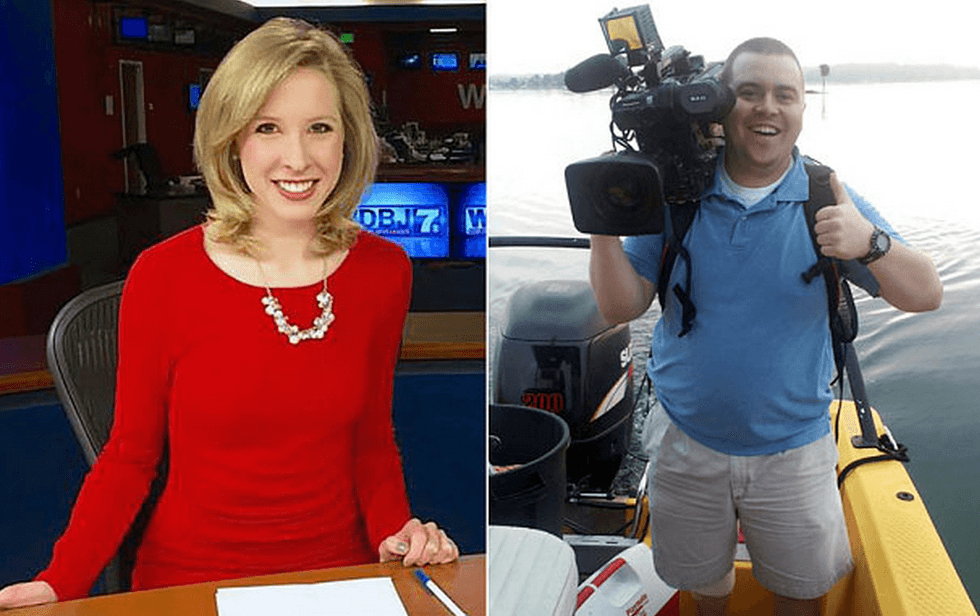
By now I’m sure everyone has heard about the two journalists that were killed in Moneta, Virginia. Alison Parker, a reporter for WBDJ7, and Adam Ward, a cameraman for the same station, were murdered while on the air for WBDJ7’s morning show by a former colleague.
When I first heard about the attack, I was shocked, as I’m sure most people were. I couldn’t believe that two journalists could die while reporting a story live, especially in Virginia. With thousands of broadcast journalists around the world reporting live stories from the field every day, some from extremely dangerous locations, I guess I shouldn’t have been as surprised as I was. It just seemed impossible. I thought that because journalists reported live from war zones and hurricanes, two journalists at a shopping center in Virginia should have been safe.
Initially, the attack reminded me of ISIS, and their habit of targeting journalists for shock value. ISIS’s main motive is to inspire fear. Journalists are often fairly high profile, reaching a lot of viewers and readers with their stories, while also being in visible, unprotected, available positions in the field. I viewed the murders of Parker and Ward in the same way—a political statement, targeting two journalists for their availability and for the shock value of killing them while on the air.
But as more details emerged about the shooter in Virginia, I realized that this wasn’t the case at all. Though the killer’s motive might be similar to ISIS in that he sought to make a name for himself by killing two innocent people in one of the most shocking ways, there was nothing political about it. No statement to be made. It wasn’t an attack on journalists; it was an attack by an enraged former employee of WDBJ7. The fact that Parker, Ward, and the shooter all happened to work for a TV station was just an unfortunate coincidence that made it possible for the murders to be committed on live television. There’s no doubt in my mind now that the killer would’ve reacted in the same way no matter where he used to work—it could have just as easily been a an office or a corporation or a small business. He’s clearly a disturbed individual. But his actions wouldn’t have gotten the same attention then, because the shock value would be diminished.
So even though the murders of Parker and Ward scared me and made me realize that reporting on even a simple feature story isn’t as safe as it may seem, it hasn’t shaken my resolve to become a journalist even a little. Journalists might be more exposed than office workers, with slightly more potential for tragedy, but there’s no telling what other people will do. There’s no way that anyone could have predicted that this would happen, and worrying about “what ifs” should never stop anyone from doing what they love. Though this incident rattled me, it hasn’t done anything to diminish my desire to become a journalist and a writer—but it does serve as a reminder that no profession is going to be completely safe, so I might as well just keep doing what I love.