

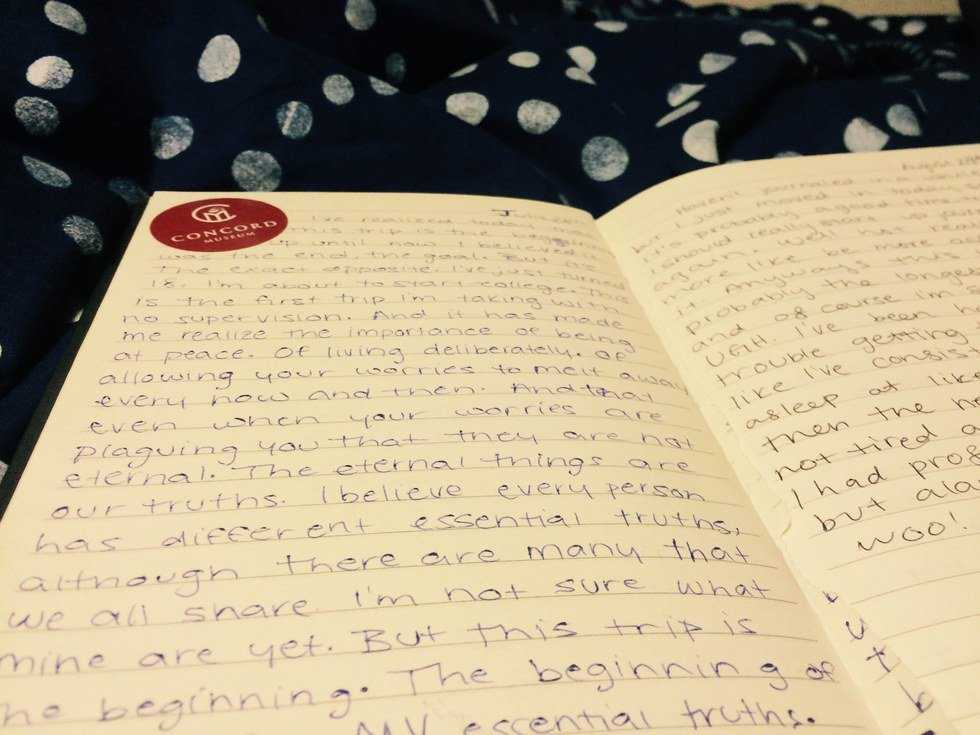
Maybe it’s because I’m an English major, or maybe it’s because I was raised by a teacher, I’m not really sure why it is, but I love journaling. Sitting down at my desk, in my bed, or even in a coffee shop with my journal, a pen, and my thoughts is one of my favorite things to do. Getting out my thoughts on paper is so refreshing and freeing. Whether I’m ranting, reflecting, recalling my day, or just killing time, journaling helps me sort out my thoughts and keep my mental health in check.
That isn’t to say that I always loved journaling. In fact, there was a period when I flat-out hated it. I created a wall between myself and the paper. For some reason, the activity and idea of journaling felt very foreign to me. I wrote essays, letters, notes, lists, and just about anything else, but not journal entries. Introspective writing, writing my feelings and personal thoughts, seemed wrong to me. Slowly, I realized all of the benefits I was missing out on and all the misconceptions I held about journaling. So, here’s what I overcame in my journaling journey. Hopefully, this inspires you to pick up the pen and let it out!
One of the biggest journaling obstacles that I overcame was the idea that what I was writing didn’t matter. I felt like what I was writing was insignificant; if no one was going to read it, what was the point? I wasn’t writing anything radical, philosophical, or even informative, so it seemed to me as if there was really no point. Funny enough, a different perspective on this same idea was what got me so invested in journaling.
No one was going to read what I was writing! It didn’t need to be deep and well-written, it didn’t need to use proper grammar or spelling, it was just me writing. I was just letting my pen be a vehicle for my thoughts, feelings, and opinions. Admittedly, I still deal with the fear of insignificance a lot of the times when I go to pull out my journal. I still ask, “is this worth writing?” Then I remember that it doesn’t matter if it’s worth writing or reading, because that’s not the point. The point of journaling is to clear your head of toxic thoughts, recall memories, figure things out, and just be yourself.
My second biggest obstacle was the pressure to journal every day. I used to feel compelled to write something meaningful every single day, like I was pressured to come up with something interesting from the day and write it down. The days when I didn’t journal, I felt like a failure. This ended up turning into me quitting on journaling entirely for a while. Then I realized that no one was telling me to journal every day. There was no one and nothing telling me that I had to write something every single day. Surely, this seems dumb now; of course there was no one telling me I had to journal. But the idea that I could just journal every so often, as much or as little as I chose, was freeing to me. Even now, I write in my journal when my thoughts are flying around a million miles per minute and when I need some stability. I no longer feel the need to write every day if I don’t want to or I can’t. Journaling is supposed to be relaxing, not worrisome.
Journaling can be hard. Your thoughts can be so jumbled that you pick up the pen and your mind can't even agree on a word to start with. But it can also be incredibly freeing and personal. Of all people in your life, you should know yourself best, and journaling is one effective and easy way to do that. So, grab a pencil and a journal (or a sheet of paper) and write away!