

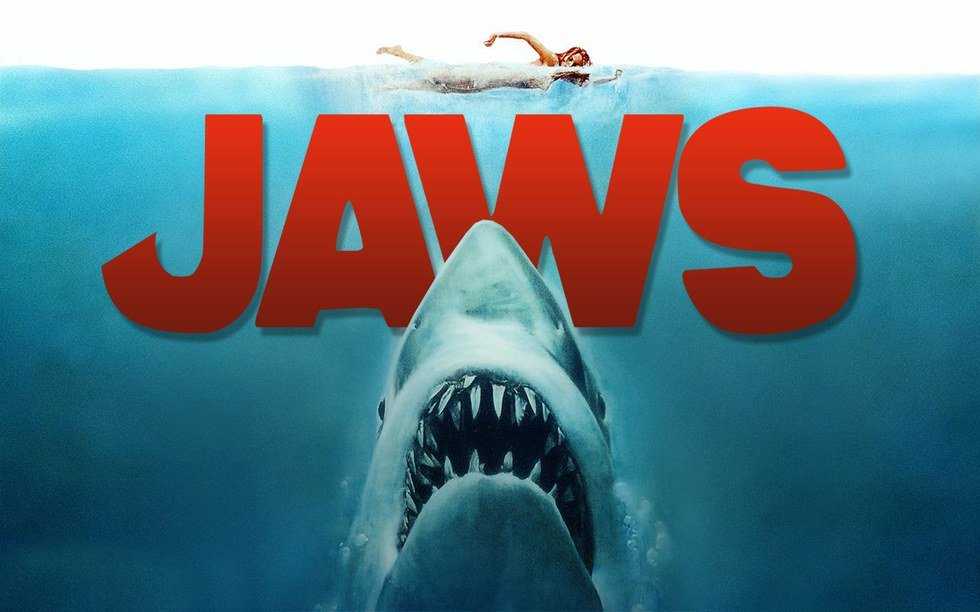
Before viewing this film, I knew Jaws was a 1970s movie about a killer shark that terrorizes the beaches of a small town, directed by the legendary Steven Spielberg. Before I started watching the movie, I was expecting cheap set designs or parts of the animatronic shark being shown in small sections. What I got instead was one of the most tense horror movies I have ever viewed. The best scenes that made me feel anxious used camera motions, shots, and, of course, the film's iconic musical score. The way these components are able to make the shark scarier than it really is makes Jaws an enjoyable film to this day.
Never have I encountered an opening scene more powerful than Jaws'. This scene is executed so well camera work that it really sets in the feeling of suddenly becoming hydrophobic. In the shark's first attack, we, the viewers, don't get to see the shark in this scene. Because the camera is placed just above the surface of the water, we can't try to peek and see a part of the shark.
All we see is the victim getting flailed about until she is dragged down to the murky depths of the water. By doing this, Spielberg is sort of toying with our minds. It leaves us guessing what the shark looks like and how big the shark is. Ethan Alter makes this clear in his book Film Firsts: The 25 Movies That Created Contemporary American Cinema, where he states that “our minds are left to fill in what our eyes can't see, which conjures up all sorts of primal terrors…(p. 3) " Indeed, Spielberg is taking advantage of using the viewer's own imagination to scare them. We may not be able to see the shark (now), but Spielberg is forcing us to create a good mental image of how menacing the shark might look like. It only gets worse (for the viewer) when Spielberg moves on to describe how violent the shark may be.
After the first attack, we see various scenes throughout the first half of the film where characters are reacting to the victim's remains. We don't get to see anything, yet again, thanks to that camera placement. The only thing we ever see, after the opening scene, is the victim's forearm sticking out from behind a pile of sand and little crabs. From there, and in later scenes, the camera focuses on the character's reactions. In these shots, we see them make faces similar to when someone is about to wretch and vomit everywhere.
This gives us a brief feeling of this nauseating fear. We don't know what the victim's body looks like now and how bad of a mess it is exactly, but we can get a good idea from the reactions displayed by the characters. Again, this is Spielberg playing the "Tell & Don't Show" game. Because of this camera work, Spielberg has given us a vague idea of just how massive this shark is. In a way, he's sort of ingrained this image of the one thing that makes every shark scary, the razor-sharp teeth, and yet, he hasn't exactly shown us anything to confirm our beliefs.
It isn't until halfway into the film that Spielberg finally gives us a small, brief look at the shark, during the Fourth of July picnic scene. When the shark is ready for his next victim, we are shown, from a bird's eye view, a man sitting in his boat. As the music gets more intense, we start to see this large, dark object swimming towards the man's boat. The shark's head raises out of the water just long enough to show the audience how massive the shark is. Spielberg is using the man's boat to compare the size of this beast and the placement of the camera does just that. The camera has to be so far away to try and fit the shark into the frame that it makes the man's boat seem about as small as a canoe when compared to the shark.
With that, Spielberg has set in this feeling of hydrophobia like concrete. After building up the suspense for over half of the movie's running time, he has created this anxiety inside the viewer of seeing other characters going into the water, feeling helpless from watching the attacks, and constantly feeling an anticipation of danger (Gordon, p. 33).
It's amazing how a film like Jaws can still be scary today, despite being forty years old. If the shark was shown earlier in the film, Jaws probably wouldn't have been as much of an impactful horror movie as it is now. Sure, the decision to not show the shark was made because of mechanical issues, mostly, but Spielberg made the right call and found the perfect alternative to making this movie just as scary as his original idea. That's why Jaws still holds up well to this day and as aged so well.
WORKS CITED
Alter, Ethan. "Jaws (1975)." Film Firsts: The 25 Movies That Created Contemporary American Cinema. Santa Barbara: Praeger, 2014. 3. Print.
Gordon, Andrew. "Jaws (1975): Hydrophobia." Empire of Dreams: The Science Fiction and Fantasy Films of Steven Spielberg. Lanham: Rowman & Littlefield, 2008. 33. Print.