
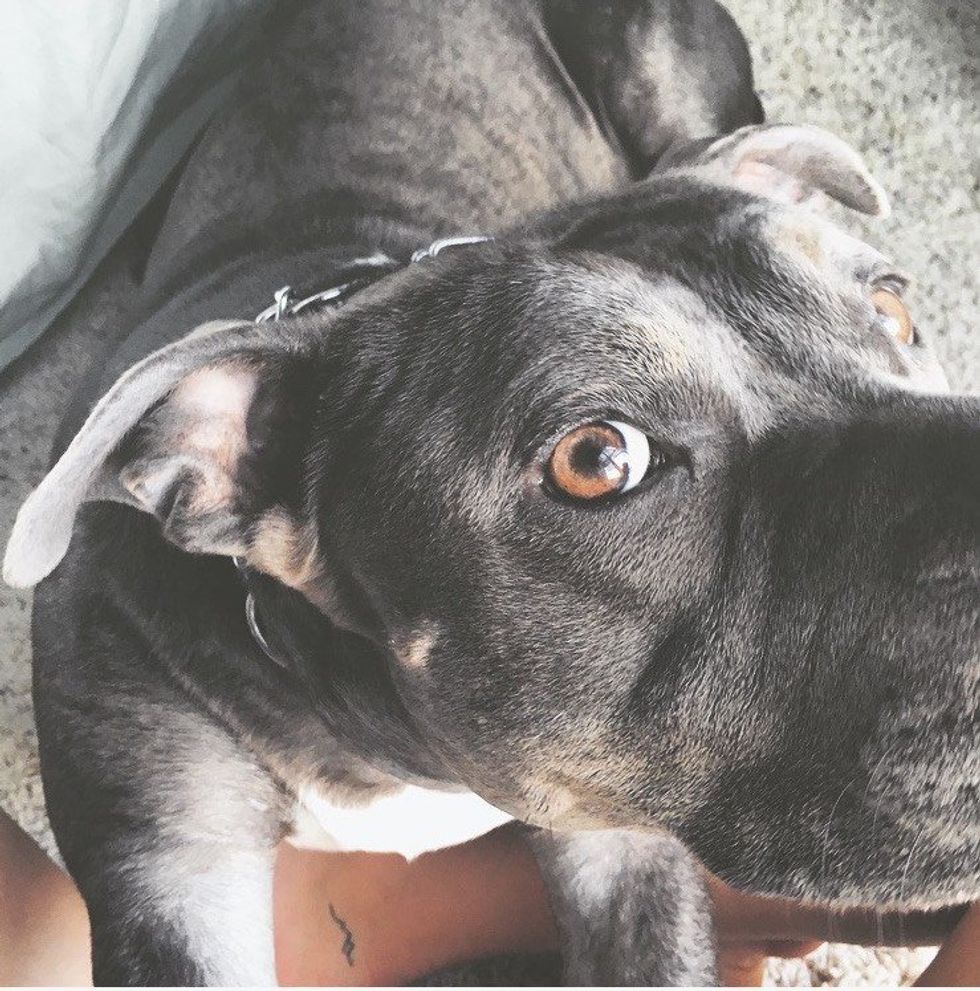
Do you cross the street when you see a pit bull coming your way? Do you roll your eyes when you hear a breaking news story about a pack of pit bulls attacking an innocent bystander?
There's a lot of gossip running the rumor mill that pit bulls are the most aggressive breed of dog in the world. A majority of people believe that if you are unfortunate enough to meet one, you should probably call a priest and receive your last rites because that dog is about to naw on you like a rawhide. There's hard facts proving that we should be afraid. Right?
Wrong.
It has been scientifically proven that pit bulls are no more aggressive than your average golden retriever and that any aggression shown in a dog is significantly more likely to be caused by how the dog was raised rather than its inborn need to hunt and kill.
I would like to begin by offering a personal experience with a pit bull that I adopted from the pound. Her descriptive card said that she "no longer had a place in the home" and was "not outwardly aggressive towards other animals." Immediately she crawled in my lap; I spent an hour with her and saw no signs of aggression towards animals or humans. S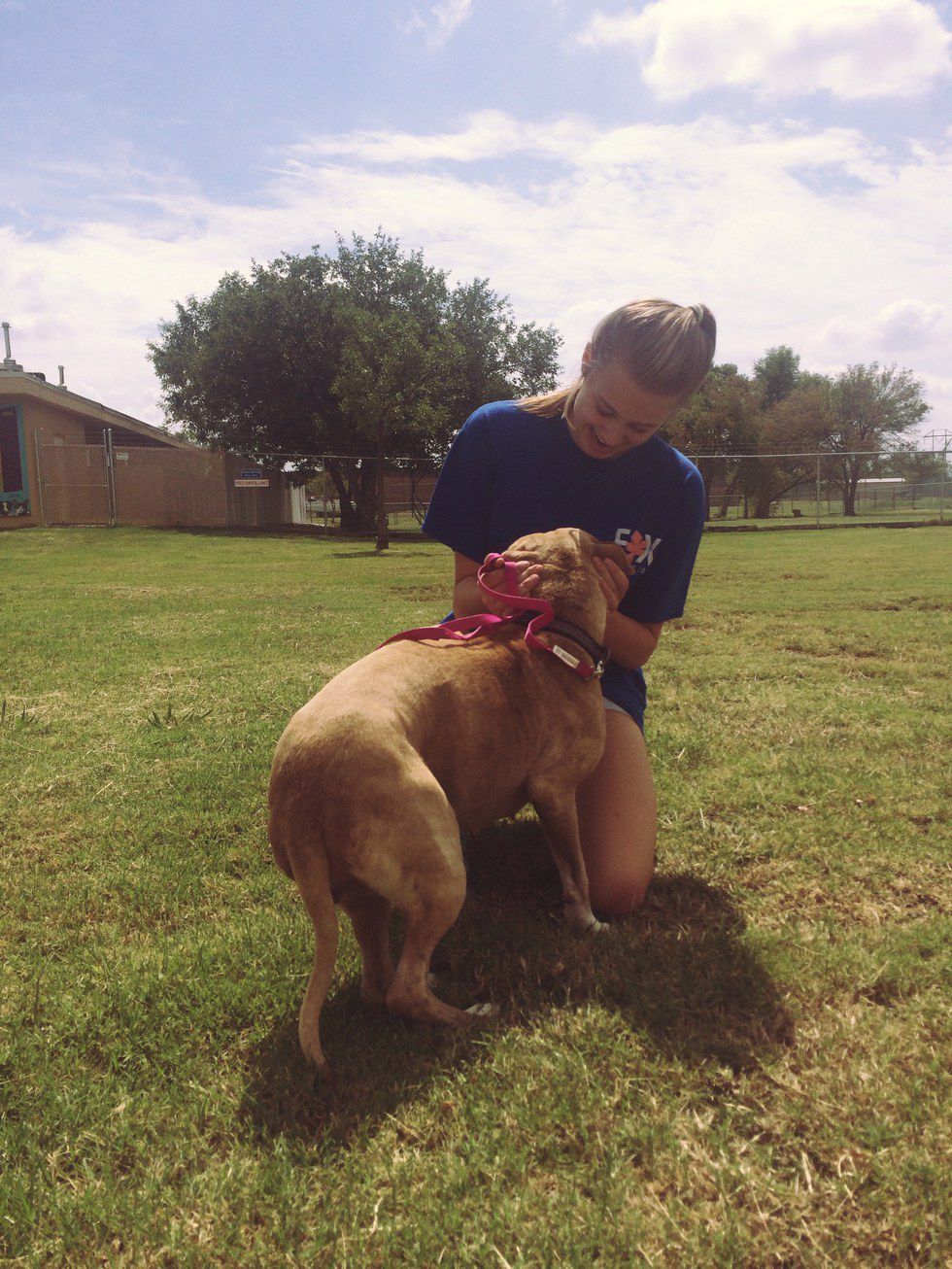 o I decided to take Ginger home. Ginger attached herself to me fairly quickly, like a lot of pit bulls do. She gave a warning growl to the people and dogs that came out of her peripheral vision, but was overall warm and inviting to the people around her. She was skiddish, jumpy, and so afraid of the noise that her food made in the bowl that I had to feed her from the palms of my hands. Besides being extremely anxious and afraid, nothing seemed wrong with Ginger at the time.
It was not until I had to leave for a friend's birthday dinner that I truly saw the dark and ugly side of aggression fostered by an unfit owner. I had put Ginger in a metal cage with a blanket over the top (to help with her anxiety) and she was separated from the rest of the house by my bedroom door. Within an hour of leaving for the party, I got a call from my roommate. Ginger had chewed her way through the metal cage and through my wooden door to get to my friend's dog, who she perceived to be a threat to my well being.
I got home as quickly as I could in order to deescalate the situation, and to make sure that both dogs were safe. It worked for a small amount of time until I was in my room with Ginger alone, and my friend's dog walked through the door outside of Ginger's view. Ginger's eyes went black, her hackles raised, and she moved with lightning speed to attack the 25 pound dog that entered my room. I've never heard a dog make a sound like Ginger did. She thought that my life was endangered by this other dog, and she was going to do whatever necessary to provide that safety to me. Thankfully, I put myself in the middle of the two, flipped Ginger over onto her back, and secured her underneath my foot while I got the other dog out of the room. Instantaneously, the Ginger that I adopted returned. Her pupils shrank back to normal size, her breathing slowed, and she sat patiently and obediently by my side. She acted as if nothing out of the ordinary had happened. And to her, she was right. Ginger lived, or had lived, in a world where it was her job to defend her owner to the death if need be. She was trained to fight and to breed. She knew nothing else, and like a tape that plays the same song over and over, Ginger would repeat this behavior for the rest of her life.
It was one of the hardest decisions that I have had to make to put Ginger down. I called everyone I knew who had knowledge about dogs and pit bulls. I did research and read as many articles as possible to find out if there was another alternative to Ginger's imprinted aggression. There was none. Because of the cruelty of her previous owner, Ginger would forever be a threat to the people around her. She had no remaining quality of life if she was not returned to the dog fighting world, and this was not an option.
For the rest of the night, Ginger spent it with one of my good friends. She sat at the foot of of the shower, snuggled close with her all through the night, and was picked up in the morning by animal control to be put down.
Ginger was my first interaction with a pit bull and it confirmed everything that I had ever heard, read, or been warned about the breed.
Yet, something still tugged on me to not give up on this breed.
I found out that the city that I lived in had a horrible reputation for dog fighting and that most of the pits that ended up in the pound here considered useless because they were overbred or overused for fighting. By the time they reached the pound, being aggressive was engrained into their minds so that nothing was left. They would attack and fight to the death anything that approached as a threat to their human.
I also found out that this was not characteristic of pit bulls in general. They are a companion and a family dog breed, and became known as "nanny dogs" because they were so gentle around children. The name "pit bull" actually refers to a multitude of breeds that include, but not limited to: American pit bull terriers, Staffordshire terriers, and the American Staffordshire terrier. While they need early socialization, this is a universal rule for all dogs.
In reading these articles, I decided to adopt again.
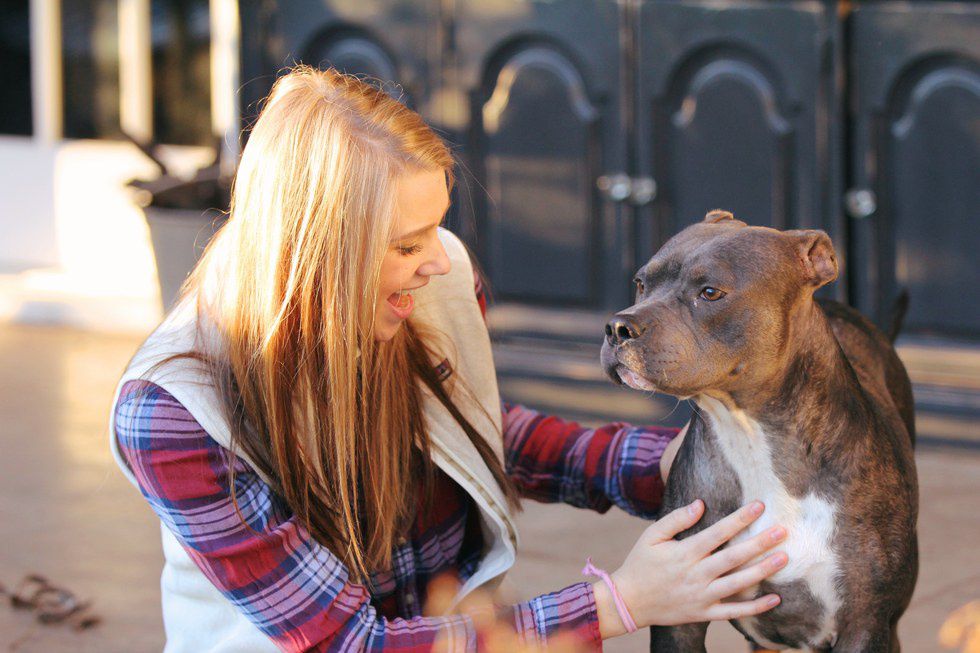
Tess is ferociously kind. She barks when she's hungry and has adopted my best friend's dog as her little sister. Tess has never bitten, acted aggressively, or attacked anything or anyone. She has alopecia, so she's balding around her middle and we put sweaters on her in the winter so she doesn't get cold. She snuggles up to me at night and watches me until I fall asleep, and then she doesn't move until I wake up. She eats leaves from the branches of trees at the dog park and looks like a baby hippo when she swims in the water. She is a trained service dog, and lays on top of me when I have panic attacks. She loves popcorn and peanut butter and takes allergy medicine when the seasons change. When I was hospitalized and in the ICU for three days, she hugged me when I came home. She is the opposite of every stereotype of pit bull I've ever heard.
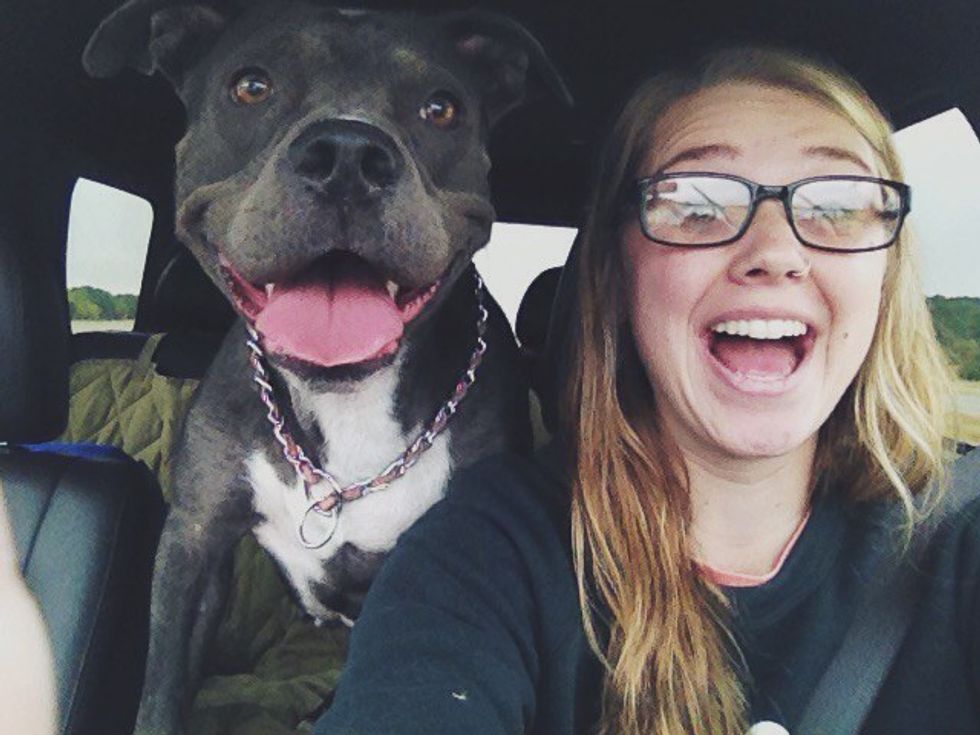
Because of this 180 degree of difference in experience with Tess, I decided to look into the science of breed aggression. I found that science debunks the myth of pit bull aggression. Three every important studies have been done that compare pit bulls to breeds like golden retrievers to determine if the breed is truly more aggressive and therefore unsafe for an owner of any kind.
A study done in 2008 by the Institute for Animal Welfare and Behavior: Is there a difference? Comparison of golden retrievers and dogs affected by breed-specific legislation regarding aggressive behavior found no significant difference between aggressiveness in golden retrievers and rottweilers, bullterriers, Staffordshire bullterriers, and dogs of the pit bull type (Ott, Schalke, von Gaertner, & Hackbarth, 2008, p. 139). The study also declared that "assuming that certain dog breeds are especially dangerous and imposing controls on them cannot be ethologically justified" (Ott, Schalke, von Gaertner, & Hackbarth, 2008, p. 140).
A second study conducted by The University of New England in Australia considered the justification of the breed-specific legislation against pit bull terriers. Their findings were as follows:
"Breed-specific laws singling out [pit bulls] cannot produce significant reductions of dog attacks...BSL directed against the group of breeds with the worst bite records with be unlikely to affect bite frequencies for long...There are many other breeds' individuals of while irresponsible owners could render dangerous" (Collier, 2006, p. 21).
In layman's terms, this article reveals that it is not the inbred aggression of a dog that creates the danger, it is the irresponsible ownership of such a dog with any breed that creates danger and increases the chances of dog bites or attacks.
What science is telling us is that there is no reason to believe that pit bulls, or dogs associated with the breed, are more aggressive or prone to attack than any other dog that you might come across on the street. Breed-specific legislation is outdated and unsupported by scientific data, and there is no study circulating that declares pit bulls as more aggressive than your average golden retriever.
I'm presenting this information to you as an owner who has experienced both kinds of dogs: aggressive and nonaggressive. One who has had to break up a fight in order to save another dog's life, and one who falls asleep being watched over by a protector and faithful friend. I encourage you to do your own research to see what you find, and to challenge the stereotype of a dog breed that does not deserve the negative misconception that it is a danger to society.

Are you interested in adopting a pit bull? Check out these local DFW adoption agencies and groups.
Love Tess? Check out Peach Pits, where I got her!
The resources can be found on Google scholar and are available to read at your leisure.
Collier, S. (2006). Breed-specific legislation and the pit bull terrier: Are the laws justified? Journal of Veterinary Behavior, 1, p. 17-22.
Ott, S. A., Schalke, E., von Gaertner, A. M., & Hackbarth, H. (2008). Is there a difference? Comparison of golden retrievers and dogs affected by breed-specific legislation regarding aggressive behavior. Journal of Veterinary Behavior, 3, p. 134-140.