

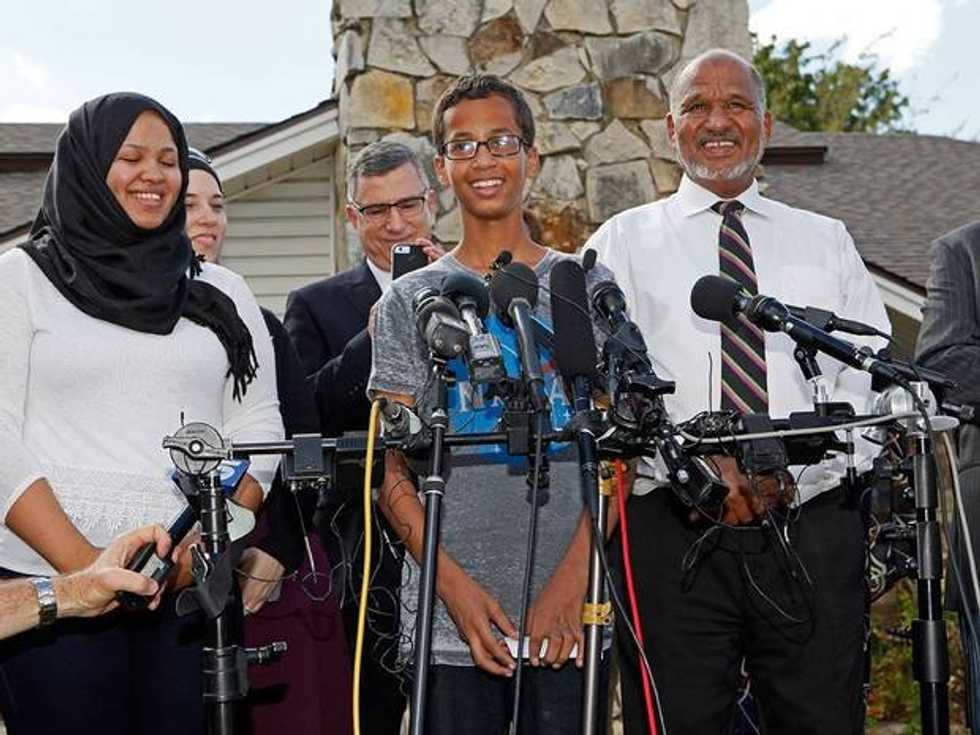
Some fourteen-year-olds are passionate about playing sports. Others feel the same way about creating art and making music. These are all talents that should be and are usually praised, supported, and celebrated by adult role-models in the child’s life. Children are taught at school to partake in something that interests them and inspire others by doing so. Unfortunately, some meaningless qualities, such as religious backgrounds, stand in the way of many children reaching their potential. In this case, it stopped fourteen-year-old Ahmed Mohamed, a Muslim student, from showing off his hard work in producing a digital clock.
Ahmed showed up for school last week, excited to show his engineering teacher his latest creation. He had assembled a digital clock all by himself. However, his teacher’s reaction wasn’t what he was expecting. The teacher told Ahmed it was nice, but he should put it away and show none of the other teachers. Discouraged, Ahmed spent the rest of the day with his invention in his book bag.
Later that day in a different class, the alarm on the clock went off and Ahmed respectfully showed the teacher what made the disruption. The teacher confiscated the clock and told the young boy that the device looked like a bomb. Not long after, the principal and police arrived, taking Ahmed away to be questioned, handcuffed, and sent to juvenile detention all without the presence of his parents.
This form of prejudice has been present in the United States of America for several years, especially after the terrorist attacks on September 11, 2001. Does this make them any more reasonable? Of course, it does not. People are frequently treated differently, belittled, and in some cases physically harmed based on religious beliefs, appearance, and even names. In Ahmed’s circumstance, he was put through a horrific and emotionally scarring experience for something that other students would be commended for.
The fact that this type of injustice is taking place in our world today is heart-breaking and extremely concerning for the progress of our country. All students should be rewarded equally for hard work, no matter what their race, gender, or religious views may be. Until we can all agree that these factors play no role in determining events in our lives, can we really argue that our country is as fair and just as we believe it to be?