
“People say, ‘well, water is a lot like air, could you charge for air?’ Of course not. [They respond] ‘Well you shouldn’t charge for water.’ Okay well watch what happens,” says entrepreneur, Boonie Pickens, when asked about the commoditization of potable drinking water. Pickens was not asked to elaborate, but I imagine he couldn’t do so in a way that would satisfy human rights advocates. Pickens is one of many people who jumped on a money train that left the station sometime in the late 20th century.
This was right around the time that corporations like Nestle discovered the profits to be made off the privatization of a public resource that everyone needs—water. After all, of all the times people have chugged bottles of Poland Spring water, how many times have those same people taken a glance at Poland Spring, Maine? If they did, they’d find that about 30 years ago, they might have gone there and turned on a tap and gotten the same exact water for which we now pay $1.29.
So exactly what are we paying for? The World Bank profits off the consumer’s belief that we pay these companies to purify the water for us. Innovators like Ashok Gadgil beg to differ. Gadgil is the primary inventor of a UV water filtration system that boasts a measly annual cost of 6 United States Dollars per person globally, to provide ten liters of fresh drinking water daily to everybody. Inventions like this, however, have not been adopted on a large scale because there is no money to be made, only lives to be spared. Meanwhile, huge companies such as Suez, are dominating the world water crisis without hesitation to scrape up every last cent. Not only are the people who can perhaps afford to pay for the luxury of convenient plastic bottles, paying unnecessarily for water, but people who can’t even afford to educate their children are being forced to do so as well.
In developing countries like Bolivia, one in ten children will die before the age of five. It isn’t AIDS or Malaria or any of the world’s most feared epidemics killing many of these children, but disease derived from insufficient water sources. We might envision the juxtaposition of an average American paying into a process that wastes and pollutes water just to have a “crisp,” personalized bottle, with a family across the world drinking from a murky, odorous creek because they don’t have the means to activate the local pump for access to some treated water that day. The most frightening part about this disturbing recognition of inequality, is that the subjects in both instances are lining the pockets of the same corporate heads.
As population grows, water availability does not. In 2008, slightly more than one-sixth of the world's population did not have access to proper drinking water. Today, roughly one percent of the water that covers about 71 percent of the Earth’s surface is potable. It is no wonder that water is starting to resemble commodities like oil a lot more closely, through a political lens, than its real-life, non-transient counterparts like oxygen. Water is now only third to oil and electricity, as financially one of the largest global industries. To put this in perspective, we are engaging in practices like Hydraulic Fracturing in order to introduce more oil to the market, while proceeding to inhibit the safety of our water supply. Once we’ve accessed enough oil to fuel every country sufficiently, and contaminated so much water that virtually no life at all can be fueled, who will be left to figure the value of oil and electricity then?
While privatization of water for resale is arguably one big marketing scheme, that isn’t to say consumers are so blind that we let this happen without any inquisition. Many people who buy bottled water, including myself, are thoroughly convinced that tap water is somehow inferior. This isn’t an unreasonable conviction considering, for example, after World War II, leftover chemicals like Fluoride were disposed of by diluting them throughout the tap water supply; then, citizens were convinced of false benefits in order to assure them that it was safe to drink.
However, the same FDA that overlooks cancerous chemicals in tap water, has a grand total of one person in charge of overseeing the health and safety of all intrastate bottled water sales in the country. That is, one woman oversees the marginal 30-40% of bottled water sales across state lines by requiring the companies to self-regulate. The rest of those bottles are sold within the state where they’re bottled, and are therefore not subject to chemical testing. Meanwhile, all drinking water that runs through public taps requires testing for specific chemicals and viruses with results published in an annual drinking water quality report for each community.
We are already seeing an increase in every disease known to man, and we can factually attribute a portion of the growth to the chemicals found in bottled water. There is no need to even regard the lab tests when we look at how our pollution of water sources is already affecting frogs and fish. Scientific observations show that runoff of these chemicals is causing biological sex changes and reproductive sterilization of aquatic animals. It's not a stretch to deduce that the same fate could soon be translated to the people drinking this stuff.
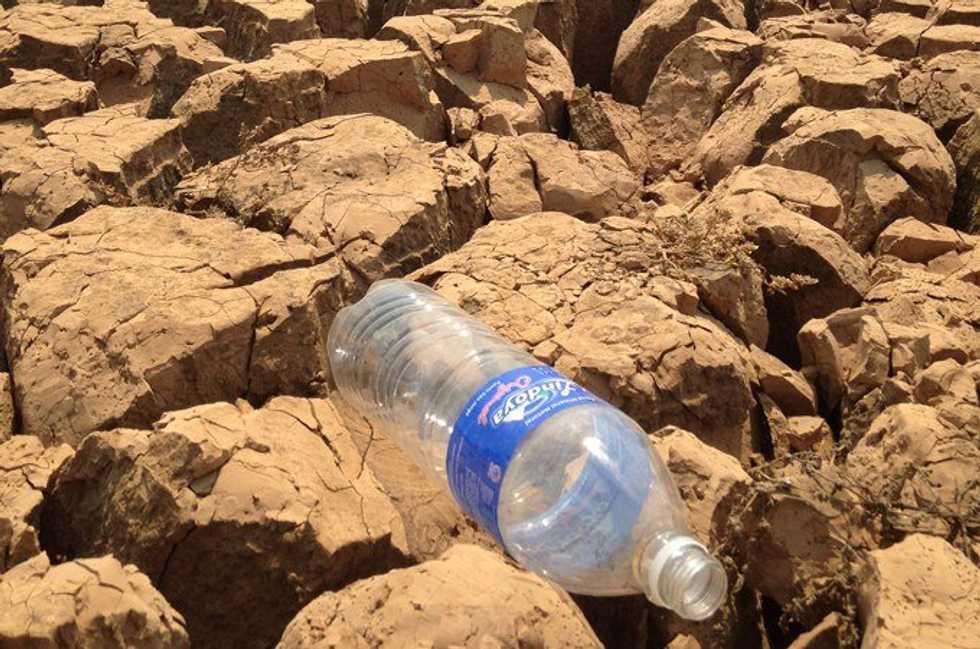
I am probably among one of the demographics responsible for a large portion of the disappointing 20 percent of plastic bottles actually recycled in the US. My peers and I are likely more aware than the average US citizen of the fact that oceans now have a higher ratio of plastic particles to water than of natural bacteria, and that fish in these areas are consuming these micro-plastics in abundance. What is unfortunate is that we still think the primary solution for taking resources like water from the planet is to attempt to minimize the waste we create as a byproduct. Instead, we ought to focus on consuming the resource in a more sustainable manner.
When I leave a sustainability class, then go buy a vegan lunch while praising the organic, local movement’s minimal water use for food production, I'm guilty of not even considering the water that I drink. Most of us don’t think about where it comes from, or where it goes when we’re done with it. Because we need to drink water to survive and because bottled water is so available to us here, we don’t immediately think of it as something we should cut back or consume more ethically. But the fact is: the same water that I buy at concession stands, I can get for free from a fountain five feet away. I can look at these wasteful, money-making bottles and consider, "Is water a human right?" To me the answer is clear, but at this point in time, water is not even a fish’s right. Fortunately for us, we have the power to change that by way of conscious consumption.