


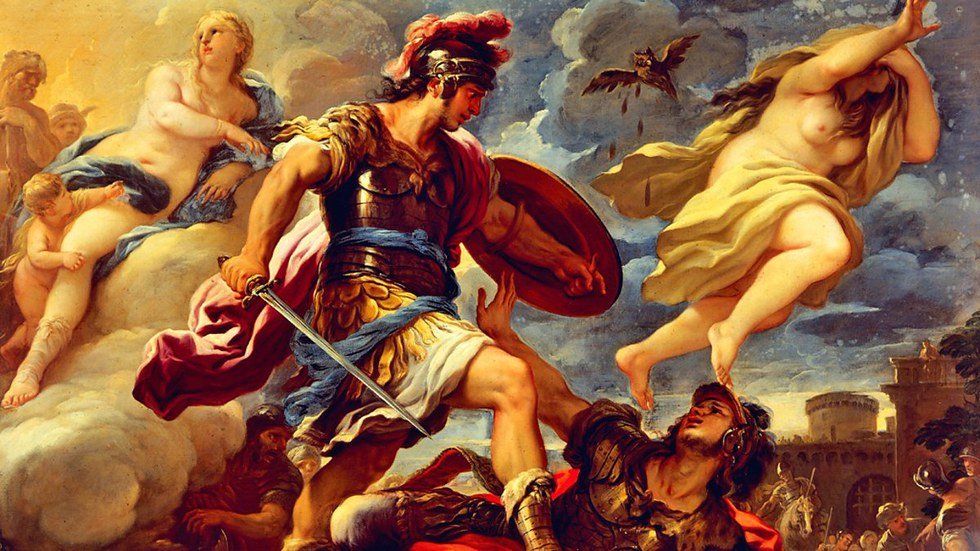
In this article I will look to answer the question of whether or not Vegio’s 13th book of the Aeneid successfully ends Vergil’s epic. Virgil left the Aeneid unfinished, but with a substantial amount of the book completed, there has long been debate as to whether or not a continuation is necessary. I will look at the values in the text to see if Vegio places the same emphasis on traditional Roman values - such as Pietas and Gravitas - that Virgil does. I will also investigate whether or not Vegio successfully finishes the character development that Virgil had put in place in his original books. Additionally, I will look at the inclusion of the gods and the supernatural in Vegio’s book compared to that of the original. Overall, I will look to conclude that while Vegio successfully imitates Virgil in several ways throughout the text, it is ultimately an unsatisfying conclusion to the compelling epic.
In Virgil’s Aeneid we see many themes throughout, but in my opinion the strongest one is that of traditional Roman values, encompassing attitudes towards the gods, family, duty, honor, loyalty, and seriousness. Throughout the epic we see Aeneas making several key decisions based on the traditional Roman values such as gravitas and pietas. We can see this in the 11th book of the Aeneid in the aftermath of the battle at the Trojan fortress, after which, Aeneas is met by Latin messengers who propose a truce to bury the dead, a truce to which he agrees. It is in the agreement where Aeneas demonstrates values such as fides and gravitas in agreeing to these terms. In fact the messengers are impressed with his piety. This is acts a sort of historical reinforcement to the importance that Roman’s placed on such characteristics, a sort of historical example for Romans to live up to (exemplum) much like Horatius Cocles at the bridge. As such this highlights one of the underlying themes that goes with the inclusion of such Roman values, this theme is that of exemplum. Throughout the original writings Aeneas is portrayed as the exemplary Roman by demonstrating these values, a feature that I believe is central to the spirit of the Aeneid, and I will look to see if Vegio continues this.
Firstly, we see Vegio continue this theme with Aeneas’ first speech in his book, “What was this vast madness that ripened in your mind….so that you futilely presumed to drive out of Italy…. the Trojans who had journeyed here at the behest of the gods...” Here we see Aeneas condemn Turnus for opposing the will of the gods, showing Aeneas upholding the Roman value of pietas. In addition to Aeneas’ speech we see several features of Pietas in the 13th book. For example, when Aeneas orders honors be placed on the alters of the gods, and Aeneas’ prayer. Thus we can see how Vegio continues with Virgil’s theme of values in his writing, and so maintains the spirit of his writings.
However this is not limited to pietas, Vegio includes all of the core Roman values. Regarding a demonstration of fides, we see this when the Rutulians are allowed to leave the city, with Turnus’ body unharmed. In fact this could also show gravitas as it shows respect for the dead, in particular respect for their dead leader Turnus. This can be seen in the quote from Aeneas “I grieve for you lying there, Turnus, a noble corpse.” We also see gravitas from Metiscus when he leads the Rutulians out of Latium. This is interesting because it highlights the importance of gravitas both in victory and defeat, what many would regard an important message for Romans at the time of the empire, but considering Vegio lived much later than the Empire it is impressive that he has taken care to continue in the style and mindset of Virgil to include such a message. This serves as evidence to show that Vegio successfully carries on the spirit of the original texts into his book.
Regarding virtus, there isn’t much in terms of physical courage, on account of the fighting being over, however we can see some examples of moral courage. Firstly, we see this value carried by Turnus’ father, Daunus, who in spite of his son’s death and the destruction of his city manages to pull himself together and act as a leader. In particular, we see this in Aeneas’ words and actions as he carries himself with such normality despite all that has happened. This is moral courage because he was able to keep a straight face and composure in front of everyone despite all that happened to him and all he had seen. Moral courage can be seen when Aeneas allows the rest of the Rutulians march out unharmed instead of finishing off the men who had so readily opposed him and killed many of his men under the leadership of Turnus. However, this is also a show of fides as he fulfills his promise from the 12th book of ending the conflict with a duel with Turnus.
Vegio uses the roman value of dignitas solely for Aeneas. This is important because he continues Virgil’s cultivation of Aeneas as the man who all Romans should look up to, and what better way than by showing Aeneas to be revered by all? We can see this in the reaction to one of Aeneas’ speeches, “The whole audience together held its gaze toward him, openly in awe of his utterance and astonished at this majestic instance of his piety.” By illustrating the amazement of the people with Aeneas, Vegio shows the idea that this man not only commands the respect of his men but also that of people who have never met him and are not held accountable to him, an idea that would awe most Romans, and is very much so in the spirit of Virgil in the Aeneid. Therefore this shows Vegio to successfully carry on the spirit of the Aeneid.
Throughout his original writings Virgil is constantly inserting these Roman values, in obeying the orders of the gods we see pietas, in keeping the truce we see fides, in leading his men to battle we see virtus, and in dealing with the dead we see gravitas. These values are key to his writings and it is not often that one does not come across them in the Aeneid. Therefore one could say that these values are central to the spirit and meaning of the Aeneid. Virgil put a lot of effort into ensuring that his writings promoted the qualities sought after by the empire and that his main character was the person that Romans should model themselves on. In fact, I contend that this is the main message of the Aeneid. Whilst the Aeneid is filled with war and love, it primarily serves as the formation of a character that possesses all the values and traits that all Romans should have.
The examples in the above paragraphs show how throughout the book Vegio continues with Vrigil’s efforts to paint Aeneas as the premier exemplum for Romans by continuing to instill Roman values in the text. In fact, we can see Aeneas embodying all these traits and thus being the exemplary Roman upon Aeneas’ entry to Latium. Thus by continuing to instill these values in Aeneas, Vegio does well to keep the meaning and message of Virgil’s original works alive in his attempt to finish the epic. In the sense of keeping the Aeneid a platform to promote Roman values through Aeneas, Vegio does well to keep the spirit of the Aeneid alive.
Another successful feature of Vegio’s book is the continuation of character development. First, we see the development of Turnus, as can be seen in the quote from Aeneas “I grieve for you lying there, Turnus, a noble corpse.” This is important not only because it is illustrating gravitas in Vegio’s book but also it follows with the evolution of how the reader perceives Turnus. He was introduced as being cocky, brash, and war hungry. Yet at the end of book 12 we see him in a vulnerable state, and also feeling responsible for the citizens of Latium as he runs back to the city to save them, and we finish with the man who killed him grieving for him. This shows how Vegio has kept the spirit of the Aeneid by continuing with the changing perspective for Turnus. We also see a continuation in the development of Aeneas. Virgil had been trying to paint Aeneas as the premier exemplum for Romans by instilling Roman values in his actions, and in Vegio’s book we see the cultivation of this as Aeneas becomes a man who can forgive his enemies, respects the gods, respects his father in law, keeps his word, and can make rousing speeches. Thus the metamorphosis of Aeneas into the exemplary Roman is complete. Character development is central to any writing and so we can say it is central to the spirit and message of the Aeneid. Therefore, by continuing this development one could say that Vegio successfully carries on the spirit and message of the Aeneid.
However, there are some issues regarding how it ends the poem. One glaring objection is the lack of interference from the gods. Although the gods vowed to stay out of the conflict, the conflict is over and so they are released from any obligation to stay away. As such one would expect a greater role to be played by the gods in the 13th book, however we do not see this. The most we see of the gods in this book is when Aeneid has a conversation with Venus. With Virgil’s heavy inclusion of the gods one would expect at least one god to interfere in human affairs, or make some attempt to reignite the conflict. In fact, almost all of the events of the Aeneid are driven by the gods, for example the Trojans are driven off course to Carthage by the gods, Aeneas finds himself alone with Dido as a result of the gods, the Trojans leave Carthage because of the gods, Aeneas’ shield is crafted by a god at the request of another god, Turnus is whisked away from battle because of a god, and ultimately Turnus falls to Aeneas because of a god. It is only in the 11th book that the gods don’t intervene, and even this doesn’t last long. Therefore it seems reasonable to say that due to their responsibility for driving Aeneas’ journey, the gods are central to the spirit of the Aeneid and one would expect to see them be involved in Vegio’s conclusion to the epic. However we do not see this, and as such I feel that this is one feature lacking from Vegio’s writings that Aeneid would have included. Therefore one could say that this is an example of how Vegio falls short of successfully continuing the Aeneid.
A second contention with Vegio’s continuation of the Aeneid is that it doesn’t seem to capture the spirit of adventure that drove the Aeneid in the first place. With the conflict with the Rutulians ended it seems that everything else that should follow is taken for granted by the reader and as such there is no need for a continuation. What we are given in Vegio’s 13th book is an epilogue for the Aeneid, where nothing of note happens (no shifts in relationships, no new conflicts etc.) and he simply ties up any loose ends. Critics would argue this is unnecessary as the reader can assume this would all happen, and the only need for a 13th book would be if it were to introduce a new conflict and keep the spirit of adventure that was so prominent in the Aeneid. Rather we see this lifeless text that acts as a summary of a wedding and the homecoming of the Rutulians. Overall, while Vegio’s 13th book successfully ties up the Aeneid in the way it likely would have ended, it didn’t bring the same style that was seen in the original.
In conclusion, it is evident that Vegio did well to carry on the most central theme of the Aeneid, that of Roman values, onto his conclusion of the book, he also manages to keep the evolution of characters, as can be seen in the case of Turnus and Aeneas. However, whilst Vegio did well to include Roman values and character progression, he fails to include several features that were key to the Aeneid such as the sense of adventure and involvement of the gods and supernatural. Overall, I contend that whilst Vegio does a decent job of rounding off the epic, there are several features of the Aeneid that did not carry over and so the 13th book damages the spirit of the Aeneid.

















