The Internet: A covert Structure That Exploits Online Users
This past Wednesday, August 31, GOP nominee Donald J Trump addressed his renewed position on Immigration. Traveling back about nine months from today, on the morning of December 7, 2015, Trump announced a controversial statement regarding his view on Muslim Immigration. According to a Trump Campaign New York Press Release issued the morning of December 8th, sent from the Skimm Publication, the summary states:
“Donald J trump is calling for a total and complete shutdown of Muslims entering the United States until our country’s representatives can figure out what is going on” (Press Release, 2015).
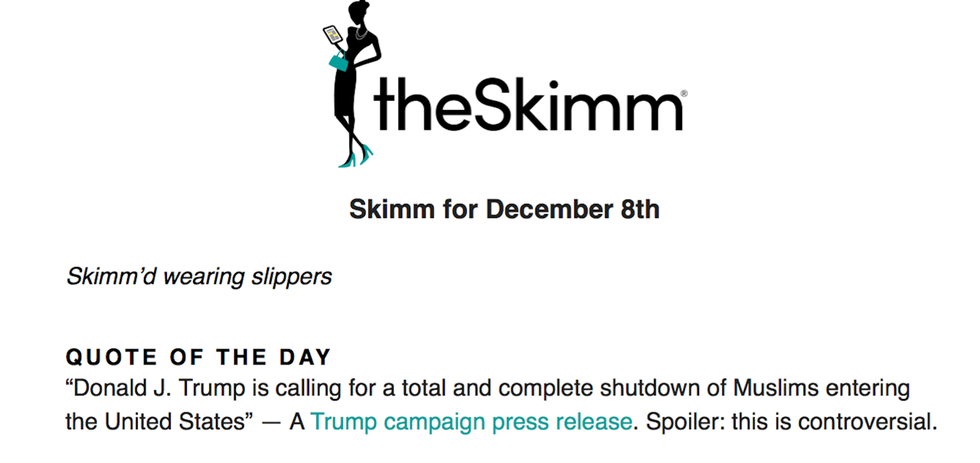
This statement was made in response to the persistence of ISIS threats and atrocities that have occurred over the past few months, and Trump’s decision to maintain a firm position on Muslim anti-immigration policies, has sparked an upheaval of discourse among American citizens. Further, the Press Release provides his direct quote, stating:
“Where the hatred comes from and why we will have to determine. Until we are able to determine and understand this problem and the dangerous threat it poses, our country cannot be the victims of horrendous attacks by people that only believe in Jihad, and have no sense of reason or respect for human life. If I win the election for president, we are going to make America Great Again.”- Donald J. Trump (Press Release,2015).
Over the course of the campaign cycle, Trump’s critique of Muslim national identity has aroused turmoil among the American populous. Though Trump insinuates that Muslim immigrants with affiliations to Jihad are at blame and therefore accountable for acts of terrorism, public opinion among Americans demonstrates little support for this accusation, as statistics display “25 % of those polled agreed that violence against Americans here in the United States is justified as part of the global Jihad” (Press Release, 2015).
I would then like to examine political polarization and its affects on my own social network that is connected to Trump’s PR reference. These effects are contrived from the diffusion of online information, and specifically look at the algorithms within the architecture of the Web, in order to understand the logic behind the culture of online connectivity, and the potential harms it instills for democracy.
During political campaigns especially, it is expected that candidates present firm reactions to breaking news stories that affect the entirety of the nation. Additionally, in light of the persistence of terrorist threats and mass killings occurring more frequently within and from that of border nations, measures taken to respond to these extreme violations against National Security, are generally expected to circulate from that of the nation's’ political leaders and news reporters. However from observations made within the realm of media studies, the immediacy and abundance of links pervasive on the Internet in reaction to this issue, pose serious questions that seek to understand how the Internet is shaped by broader social forces.
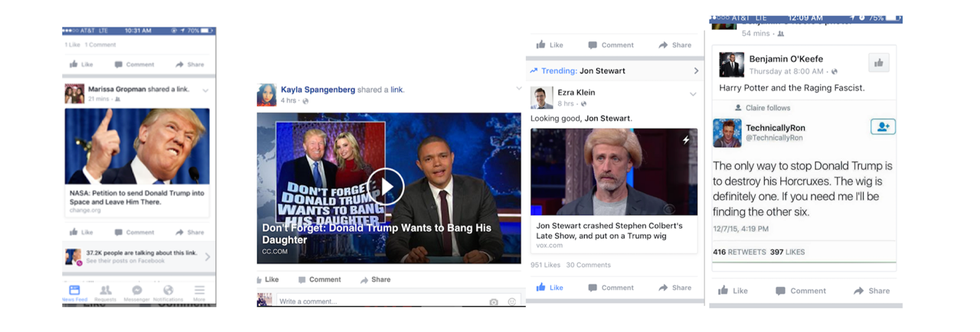
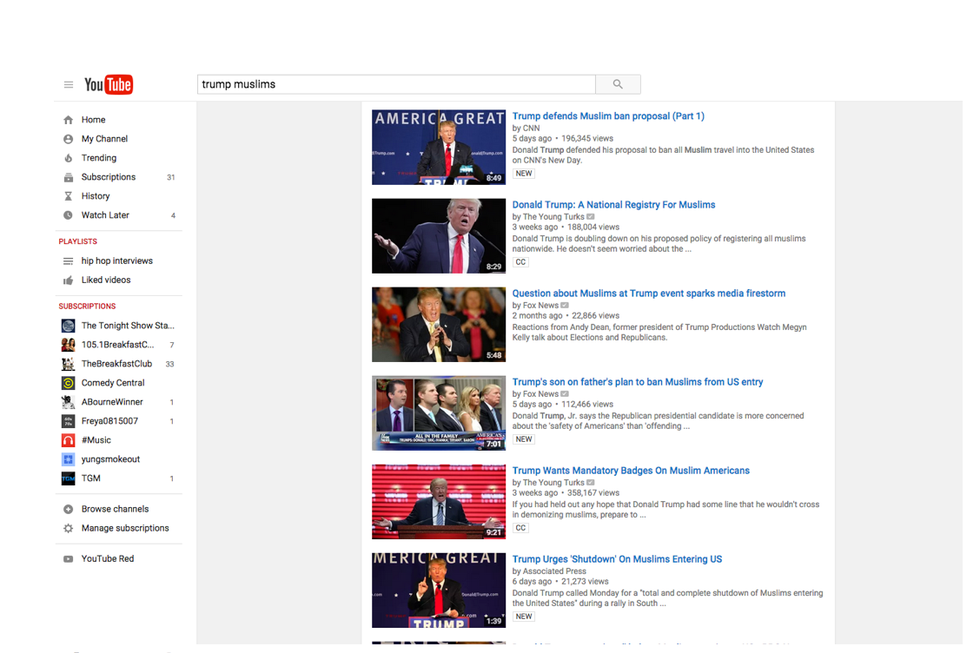
So, after Trump announced his statement back in 2015, the social media accounts registered under my username, including that of Facebook and YouTube, along with my Google Mail account, were swarmed with news updates, articles, and commentaries, related to Trump’s Press Release.
Why? Proceeding one step further, a key pattern began to arise. When these articles were clicked and explored and opened even without scrutiny, I noticed a transformation on the current home pages of these social media platforms, which shortly displayed more matters connected to Trump, and continued to do this throughout the next few days and eventually leading into weeks. Interestingly enough, patterns of polarization were noticed as clicking links that did not favor Trump’s statement tended to appear more frequently, as the majority of users on the social network I am affiliated with maintained this stance on this issue. Essentially the platforms connected to my accounts prioritized any information, (whether keyword, headline, publication, or subject) connected to negative reactions to Trump’s Muslim stance, and all that pertaining to the matter, remained at the top of the newsfeed or search results.
This observation may suggest the influence of the Internet's architecture and link structure, as manipulated and limiting in terms of presenting a user with a plurality of political topics on the web. (which will lead to further implications discussed later.)
This limited visibility of other news topics as well as positive views on the matter, serves to “deconstruct narratives about the ‘neutral’ nature of technology” which could lead to harmful consequences for the democratic principles afforded to citizens, also considered a breach of American constitutional rights to the freedom to information Act.
This abundance of information on my newsfeed regarding Trump’s testimony may indicate that algorithms designed on the web are in fact not at random. This means that the internet has control over the dissemination and visibility of certain news information.
Is it possible that the Web is constrained by broader social forces? If it’s architecture is controlled and influenced by market forces, governments and certain online communities are embedded deep within the automated system; then this system is designed to leave users blinded from the internet's dominant political power. We may be unaware of our own exploitation, especially when participating as daily users in the “free” social network and worldwide web.
As habitual online users, it is vital to be self aware of the patterns that arise on our social networks. By staying attuned, it will be easier to understand how government and market forces curate the media by manipulating user data information to shape online interaction that may not necessarily build a strong democratic public sphere.
In order to understand the Internets landscape and the nature of its architecture, one theoretical approach useful for analysis is through a political economist perspective. Political economy analysis of the Internet and connected social media platforms attempts to engage with the big picture of how economy (market forces) and politics (government agencies) shape the media environment. From this PE perspective, the term “free” is questionable, as the implications of free may be flawed. Though users have ‘free access” to the web and its social media platforms, there may be a devastating price to pay, as these platforms can only function by means of gaining some form of economic return. In this case, our property rights may be violated on the Internet without users consent or full disclosure. We should recognize that the rights to own our own data have been appropriated to third parties or other cites as a main source of revenue, however, these interfaces on social media platforms and search engines are designed to disguise this reality. This is because default settings appear as natural, leaving the user unaware of the updates embedded in the terms and conditions that infringe privacy rights of the user.
The political economy approach considers the extent to which the media is controlled by (search engine, Google, and social media platforms, Facebook & YouTube) which prevent democratizing effects.
The political economy of the internet touches on the themes of internet access as debated as a private or public good, the role of net neutrality, and the legislative effects of media regulated policies that alter power dynamics between conglomerates and the public sphere. Ultimately political economy approach seeks to gage, to what extent market and government forces prioritize their power interests of Internet communication services, over the ethical responsibilities necessary for the common good to build a democratic public sphere.So what does this mean for us users? Though we idealize the internet as being a platform to access open unbiased political information, we should realize…
From a political economy approach, the Internet is far from a neutral platform that promotes an open system of communication. The commercialization of these platforms along with algorithms dominated by associated online social network or communities, filter information so that the user has a constrained visibility to websites, links, or general content pertaining to a particular media topic.
So to make a long story short, because we have allowed the web to be apart of our everyday lives, we should be extremely cautious of the way news information can guide our political views. These social forces may keep us restricted to a one-sided representation of political commentary, instead of providing content that will compliment or deliver contradictory perspective necessary for the online user to become a well informed and educated citizen of democratic affairs. Watch out users. It’s time to start clicking those buried links.