Iranians and their way of life are misunderstood by many, an unfortunate occurring to an incredibly endearing civilization. The birthplace of winemaking that once boasted the most exquisite collection of Shirazi wines, home to the most enticing, invigorating tradition of poetry wherein love is the endless, supreme pursuit, Iran, or Persia, enjoyed the rightly attributed reputation of a land devoted to mysticism, an image that underwent serious change after the Iranian revolution of 1979. From being famous for her exciting, accommodating customs, Iran is now viewed to be an ambassador of fanaticism, almost as if the world has forgotten her applaudable persian character. Iranians represent a bigger, older culture than the regime that claims to represent Iranians.
The political storm that erupted after the University students took over the US embassy in Tehran in the same year as the revolution, deprived the United States of a politically strategic partner and distanced the world from a culturally significant ally. The gap, cultural and political, would only widen through the following decades as Iran sank into isolation. Iranians too, along with their majestic culture, were isolated. The current Iranian, Islamic regime, a mere thirty three year old creation, through its theocratic and isolationist nature, sadly, seems to have overshadowed the seven thousand year history of the Persian people, a tragedy that any global citizen would mourn, and fight against.
The Islamic Republic of Iran, world’s first “modern theocracy” as Robin Wright famously called it, was established in 1979. Toppling the iron fisted, extravagant monarch, Reza Shah Pahlavi, the new leadership comprised of the religious clerics led by the aged, exiled Ayatollah Khomeini. Seldom in the recent history of the Iranian people had the clerics been the caretakers of political affairs, a development that would propagate ideas incompatible with the Persian tradition causing friction between the two identities that Iranians held, citizens of the Islamic Republic and offsprings of Persia.
Wine, music, painting and poetry, ineradicable tenets of Persian culture, were either banned or severely censored under the new regime. Iran, or what was Persia, was reigned by multiple muslim dynasties and yet these tenets were spared the fundamentalist's wrath given their inextricable connection to Persian culture, until the formation of the Islamic Republic. Even a frenzied, much desired change in regime can seldom alter the historical, unsaid spirit of life, for Iranians it was the Persian spirit. Iranians still, covertly but definitely, are embodying the persian spirit, of poetry, of wine, of love, a reality we rarely recognize when speaking of Iran.
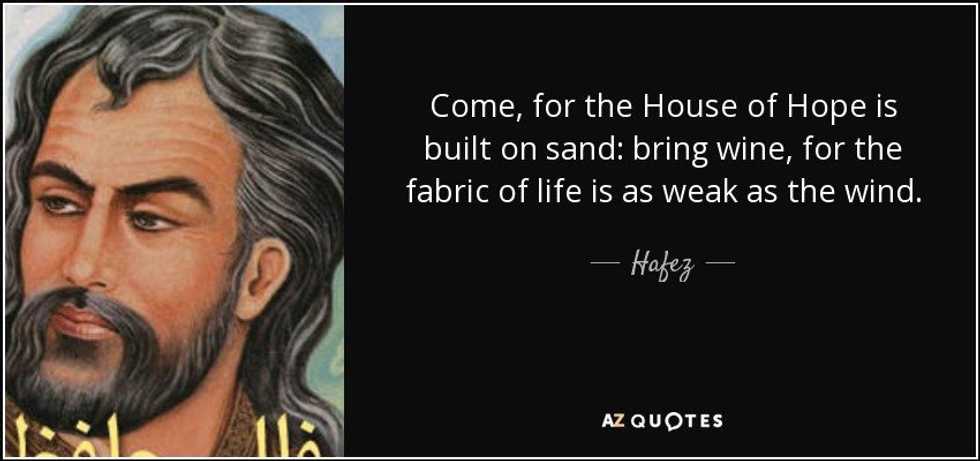
In the majestic city of Shiraz, south-eastern Iran, even today a Sufi’s legacy remains to be the foremost source of self help for the locales. One of the earliest sites of human civilization and for centuries a highly cosmopolitan city brooding with evergreen literature, Shiraz was the birthplace of a prolific sufi poet, Hafez Shirazi. To this day when the locales face an insurmountable obstacle, an emotional void or intellectual unrest, they make their way to the shrine, a decorated burial place, and consult with Hafez. The manner in which this consultation occurs is intriguing. After having explained the predicament to him at his grave, one is supposed to bring forth a copy of Diwan-i- Hafez, collection of Hafez’s poetry, and open a random page. The poem that one lands on, therein, the locales believe, lies the answer.
Now the most beautiful irony, Hafez was a man famous for his affection of wine, an elixir to connect to the supreme power Hafez called it, wine is a recurring theme in his poetry. Wine smugglers in Iran often attribute the enviable prosperity of the underground wine market to Hafez. The citizens of the Islamic Republic consult to man of literature, with no prophet like attributes, but a prophetic gift of phrase, a man who revered alcohol, dissed religious establishments and prostrated only to love. A nightmare for the theocratic regime is a matter of pride for its citizens, the people of Persia.
The historical trend of moderation and liberalism has re emerged politically as well, that too on multiple occasions. In 1997 the Iranian people gave an overwhelming mandate, 70 percent, to a reformer otherwise ostracized by the orthodox elements within the Government for favoring secularism, a man named Mohammad Khatami. An intellectual with theological roots, Mohammed Khatami emerged as the much needed respite for the stifled Persian culture. Suggesting the "dialogue amongst civilizations", President Khatami was overtly interested in restoring the cultural ties between two significant cultures, the west and Iran. This well meant proposal invoked an insincere, ill founded response from the White house, one of the major foreign policy debacles I would argue. Adding to the inexhaustible list of George Bush's regretful experimentation of the english language, "the axis of evil" in which he counted Iran was probably the most improper, counter productive. Bush administration's futile response to President Khatami's suggestion was as shameful as it was unnecessary.
A decade and half has passed, Iran and the West have yet another opportunity to restore "dialogue amongst civilizations" under the current popular, reasonable President of Iran, Hassan Rouhani. Endorsed by Khatami, President Rouhani is a prodigy of the same reformist, outward looking camp of Iranian intellectuals that Khatami captained. The dynamics of the middle east, fortunately or unfortunately are such that co-operation between the two Governments in beneficial to both, and, the need for the two cultures to begin flirting again is imminent. The opportunity is here to restore and respond to the vibrancy of an essential civilization, one that seeks to connect to us as much as we do.