


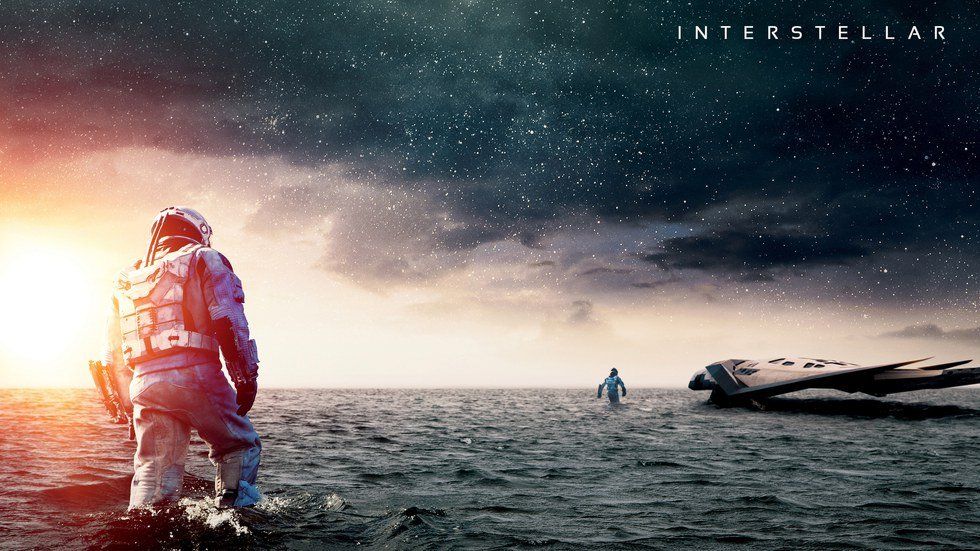
In celebration of the recent announcement and anticipation for Christopher Nolan’s next film confirmed to hit the cinema in July of 2017, I figured I would look back and analyze his most recent movie outing: Interstellar. Be warned, this analysis is both long and full of spoilers, so read at your own discretion.
There are so many reasons why Interstellar is a marvel in universal storytelling, original imagination and the industry of film as a whole.
Because the movie touches on such prevalent human themes and emotions, Interstellar is very approachable and relevant to all people despite its out-of-this-world ideas, effects and scientific concepts.
Even though Christopher Nolan’s most recent masterpiece is grounded in mostly realistic astrophysics and scientific theory, there is still that stigma of “sci-fi” that shrouds it in positive connotations for some fans of the genre and negative connotations for many critics.
While the genre of science fiction may still be a platform for many B-movies and simple storytelling made up for by flashing special effects and interesting concepts in some movies, Nolan shows in Interstellar that any brand of film can illicit the strongest of reactions if all the elements culminate into mastery well enough.
For me and many others, no other movie has made me feel such a mixture of swirling emotions and the urge to search deep inside my soul for answers that define my existence as a human being with the power of love and the capability to aspire. It has also forced me to think, maybe even overthink, about our universe and our place, as a species, that we have in it.
Of course, the climax of the film can cause the overwhelming majority of these thoughts and feelings that complicate and excite us to a point where we may even think it silly that “just” a film can do these things to us. But if we look at film as a medium of which that is created to help us relate and discover ourselves, that premise no longer seems that silly.
Then the dust literally settles as we see our hero Cooper live in a world consumed with the dirt that swallows the Earth’s livelihood: its crops and our only food. This opening sequence of the film on Earth is in such perfect contrast with the setting of the majority of the film for obvious reasons. The cornfields are relatively dull when compared with the vastness and magnificence of space and its wormholes, other planets and cosmic impossibilities that we see later.
But for now, we are treated to the lovely father-daughter storyline that is the core of Interstellar. It is a core that helps maintain the theme of the power of love and its transcendence across physical and figurative time and space, and all of this is honed and acted exceptionally through great setup and writing where every interaction counts from the ghost breaking Cooper’s lander to Murph stowing away in some blankets in Cooper’s truck to go on his first enticing mission.
Not only are all the elements set up for a fantastic and impactful story, but literary touches such as profound foreshadowing and symbolism are also implemented into the beginning act of Interstellar. The wondrous cornfield chase for the drone after the flat tire and explanation of Murphy’s bloody brilliant law parallels well with the desperate cornfield escape as the adult Murph tries to buy time to figure out the secret of solving gravity. Even the obviously hinted at colonies of the final shot of the movie are established in younger Brand’s dialogue regarding a new human population.
The news of textbooks labeling the moon landing a fraud and young lives being cliqued by one test score anger us and drive us into wanting Cooper to succeed, save the world and do the impossible as we root for him. To “rage against the dying of the light” is necessity here as the desperation and hopefulness of the Endurance mission is truly felt.
After the mind-bending travel through the awe-inspiring wormhole and most amazing visual spectacle in all of film (in my humble opinion), our astronauts arrive in a new galaxy and explore planets beyond our reach and locales beyond our imagination. The fact that Miller’s Planet, for example, exists in a form on Earth is an awesome thing to think about on its own merits.
What we cannot perceive as possible becomes that way as mountains transform to waves; because of the irresponsibility that Brand did not sense as such at first, what the travelers did not expect hit them harder than it should have, much as life, and Doyle, one of four, was lost because of it. The frustration of losing decades cannot simply be imagined by us. None of us have experienced such loss, but we can still feel it through the performances and the emotions of the characters.
This loss leads to an emotional recovery period in which our heroes, especially Cooper, must live vicariously their relative’s lives through a few recordings set against the backdrop of their new sun. The shock of his kids growing up unbelievably fast combined with the blend of happiness for them and sadness for himself create some unique tearful moments.
This transitions into the dual storytelling where, at first, Murph continues to work on the purposely unsolvable equation and younger Brand represents the power and draw of love in her arguments for her way to find her lost lover in space. The dialogue is beautiful and thought-provoking, and the decision of the Endurance crew to instead go to Mann’s Planet is later revealed as ironic; not listening to the heart’s wishes put Cooper and company in incredibly tough spots in the snow-covered planet and the orbit around it.
Mann symbolizes the ability in us all for the swaying of principle and responsibility out of survivalist need. Because he was lonely and desired the irreplaceable bonds of human connection, he faked his planet’s data and sought to finish the mission on his own terms. This plot of the coward (and the possible coward within us all) is told smartly and simultaneously with the reveal of older Brand’s plan to abandon saving Earth and tricking everyone around him into purposeless work, thereby shedding his humanity because what the survival of the human race needed was at its roots a heartless act and one out of sin, much like how in Christianity’s perspective, Adam and Eve gave birth to the human race. In some ways, one could argue that Cooper and younger Brand reuniting on Edmunds’ Planet in the film’s assumed resolution parallels the imagery of Adam and Eve but simply in a different galaxy where an established religion very well could be the veneration of the Lazarus and Endurance projects.
Zimmer’s most well-placed song, Coward, accompanies the fateful scuffle between Cooper and Mann as the latter’s plan is set into motion, resulting in the death of Romilly and jeopardy of Cooper’s desired return to Earth. The ethereal yet adrenaline-fueled organs that then complement Cooper’s attempt to perform the impossible, against the backdrop of the whiteness of the coward’s planet, haunt and stimulate in overtones that can be hopeful, religious and even spiritual in some senses as the impossible is truly accomplished. The mission is saved.
What happens next is told through well-written selflessness and fitting actions when Cooper sacrifices himself. A spot-on metaphor of Newton’s Third Law of Motion refers our human concept of letting go to make it further on with the action-reaction of propelling Brand to possible success while Cooper succumbs to the unknown singularity inside the black hole.
In the tesseract of unimaginably organized fields of light, gravity, time and space, events play out that are beyond human comprehension, echoing the possibility of our future fifth-dimensional selves that may later exist. For now, the film puts things in ways both the character and the audience can understand as Cooper moves in a place with only perceived space and without time to change the past and save Earth through the ultimate power of love. First however, love had necessary requirements that were met in the rest of the film’s plot: loss was felt in the deaths of Cooper’s comrades, faith and accomplishment were pillars in achieving impossible results from unfortunate situations, and finally ultimate sacrifice had to be made as Cooper assumed himself dead upon entering complete blackness.
Once the deeds were done through providence that saved the old Earth on Cooper’s part and made the new one on Brand’s end, the former was enveloped in light that returned him, and the latter was distraught in the lonely desert that left her the only living soul around her for an unbearable length of time. Mission complete, both characters go through their motions in the resolution, but the tie that made everything possible is wrapped up rather quickly; Cooper gets one chance to say good-bye to his elderly daughter and fittingly too. Love is never easy, and in the case of Cooper and Murph, these characters had to relish in the time they did have together as their life paths were not meant to intersect physically although they did across the universe. In many ways, the potential for their happy lives growing normally on Earth together was lost to a fated mission, but it was ultimately because Cooper was not meant to live through his child’s life with him in the background, at least not literally or typically as for most parents. In other ways he did, but through his actions in the tesseract that figuratively and plot-wise enabled him to save his entire species. While he floated in time and space, his daughter finished the work of her father and the plan A of Endurance.
In the ending monologue of Interstellar, we move past the despair, love and other mixed emotions that we have experienced with our characters and know only one thing: hope. The bright shining shot of Cooper’s eyes heading back into the titular wormhole around Saturn look bravely into, instead of with fear or worry of, the unknown. With an outro like this, it is no wonder why all of us in our generation here on Earth will want to have it all as said retroactively by Donald decades from now in Interstellar's fictional yet realistic world. We hope we can, but we also hope that the future that Interstellar predicts will not have to come to be. But if it is supposed to, all we can believe in is the power of our love that has the potential to transcend all bounds. If any success is to be hoped for in life, then that power must be strong enough to conquer the perceived impossible and venture into the sometimes scary, sometimes exciting unknown. What did Interstellar instill in you?

















