
Work starts in five minutes, and you are seven minutes away. In order to avoid being chastised by your boss, you are going to have to drive slightly recklessly. You have to get in the right-hand lane, but nobody is letting you over. Frantically, you cut next person off. That might not be the safest thing to do, but you have to get to work!
After your shift gets off, and you are driving home. Somebody is trying to get over. Nobody lets you over when you need it, so why should you let this person over? They end up getting over anyways, cutting you off. You are suddenly filled with rage that you let out by screaming insults and flipping them off. How could they drive so carelessly? Do they not care about anybody's safety? They must be stupid.
This is an example of a cognitive bias called the fundamental attribution error. Business Dictionary defines the fundamental attribution error as "a theory of social psychology that describes the inclination to overemphasize the influence of a human's dispositional factors while ignoring the influence of situational factors of a person's behavior." In other words, we blame other people's behavior on personality traits and do not take circumstance into account.
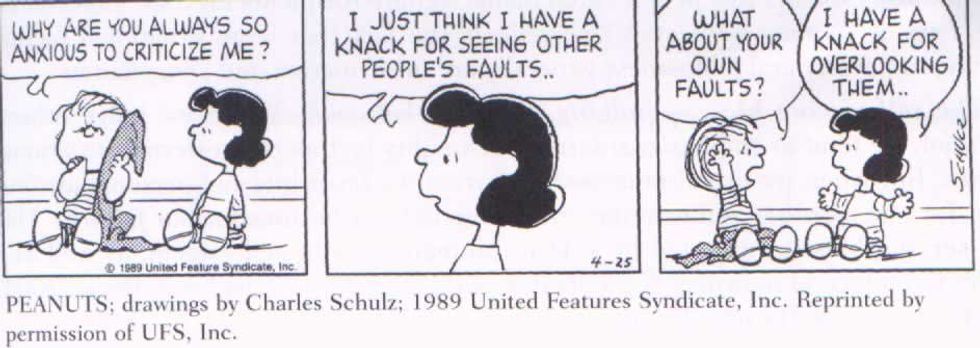
We do this all of the time. When somebody cuts us off, we think that they are stupid. When we cut somebody else off, it is because we have somewhere to be. When we are late to class, it is because we did not hear our alarm clock go off. When we see somebody else stumble into class 20 minutes late, we assume that they do not care about their education. When you do not answer a phone call, it is because you did not hear your phone go off. When somebody else does not pick up, we assume that they are giving us the silent treatment. We are quick to attribute situational factors to our own actions, and personality traits to other people's actions.
Unfortunately, the fundamental attribution error is something that everybody deals with and can lead to negative perceptions of other people. Fortunately, once people are aware of this effect, it is easier to change. Next time you find yourself mentally misattributing the cause of a person's misdoing, take a moment and put yourself in their shoes. You will become more empathetic and be happier overall.