
When I first heard the premise of the new Disney-Pixar movie Inside Out, I was entranced. I was pumped for some of my favorite people from Saturday Night Live and The Office to voice colorful animated characters. I thought characterizing emotions and showing the inner workings of the human brain through animation was such a clever concept. Then I remembered a SpongeBob episode with a similar concept. (In this particular episode, called “Squilliam Returns,” SpongeBob trains to be a waiter after Squidward attempts to temporarily turn the Krusty Krab into a five-star restaurant. The audience is exposed to the inner workings of SpongeBob’s brain, seeing multiple mini-versions of SpongeBob frantically scrambling to keep track of SpongeBob’s long term memory while making room for all of his new waiter training. It’s pretty fantastic.) However, after seeing Inside Out, I had two thoughts. One: this movie definitely did not copy SpongeBob. Two: this is definitely way more than a kid’s movie.
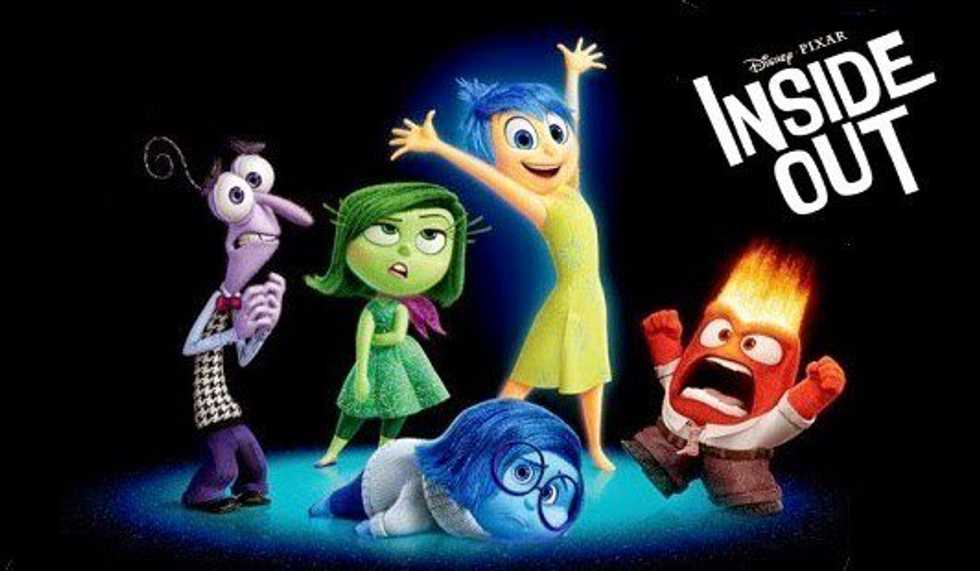
Sure, most other Disney-Pixar films are much more than just kid’s movies. Monsters Inc, Toy Story, Finding Nemo, and Up are films that generations of people can enjoy in different ways. However, Inside Out deals with such a complex concept: the spectrum of human emotion and memory. In the movie, the emotions of the main character, 11 year old Riley, are Joy (voiced by Amy Poehler), Sadness (voiced by Phyllis Smith), Fear (voiced by Bill Hader), Anger (voiced by Lewis Black), and Disgust (voiced by Mindy Kaling). These emotions are characterized not only through their personal quirks, but through their interactions with one another. Aspects of Riley’s personality are represented by various “islands,” including Family Island and Goofball Island, and her short-term and long-term memories are orbs glowing different colors depending on what emotion Riley associates with them. This movie has been widely praised by the media for its success in introducing children to the concept of neuroscience and how the brain works (for more info, see here). However, it goes further than that, animatedly demonstrating why we feel the things that we feel.

I went to see Inside Out in theaters with my parents because I was home for Father’s Day. The crowded theatre was full of younger children and their families. As I settled into my seat with my white-cherry Icee, trying to avoid getting continually elbowed in the side by the squirming five-year-old girl in the seat next to me, I anticipated the heart-warming emotional journey I was about to take via animated characters voiced by some of my favorite actors. However, I did not anticipate how connected to the movie I would feel.
The beginning of the movie shows the world through Riley’s eyes as a baby. For the first minute of her life, Joy is her only emotion, shortly joined by Sadness. The other emotions enter her brain later, as she experiences things like bring introduced to broccoli, which brings out Disgust. But when Riley first opens her eyes, the audience also gets a first view of her parents. And I couldn’t help but notice: these animated characters look exactly like my parents. The father has dark hair, dark brown eyes, and a thick mustache…just like my father. The mother has straight brown hair, brown eyes, and glasses…just like my mother. As the movie continued, the similarities to my life kept appearing. As a child, Riley has dirty-blonde hair she often wears in pigtails. She has glow-in-the-dark-stars on her ceiling. The family moves to another state because of one of the parent’s jobs, and Riley is faced with the challenge of leaving everything about her old life behind and making new friends. She sits by herself at lunch on her first day of school. She re-lives the horror of having to introduce herself to her class as a new student in a nightmare. I felt like I was watching an animated version of my own life.

After Riley battles confused feelings in her anxiety over the move, the resolution of the film occurs when Riley finally confesses to her parents how upset and sad she is about leaving their home in Minnesota. She is surprised to learn that her parents also have mixed feeling over the move and miss their old home, and the three of them embrace. Inside Riley’s brain, the first mixed color memory appears, an orb glowing both yellow and blue, as the memory contains both sadness and joy. The emotions finally learn that they are not separate entities, but work together.
This animated movie reflects one of the great truths of humanity. As moments in the film take its audience from tears of laughter to tears of sadness, the film mirrors its message. We all experience moments of sadness, joy, fear, disgust, and anger, and all of these emotions are important and essential to who we are, even sadness. Without sadness, there would be no compassion and empathy.
Inside Out includes many more moments of humor and heartache, expressed through a colorful animated world full of imagination and innovation. To experience them all, go see Inside Out in theaters!