


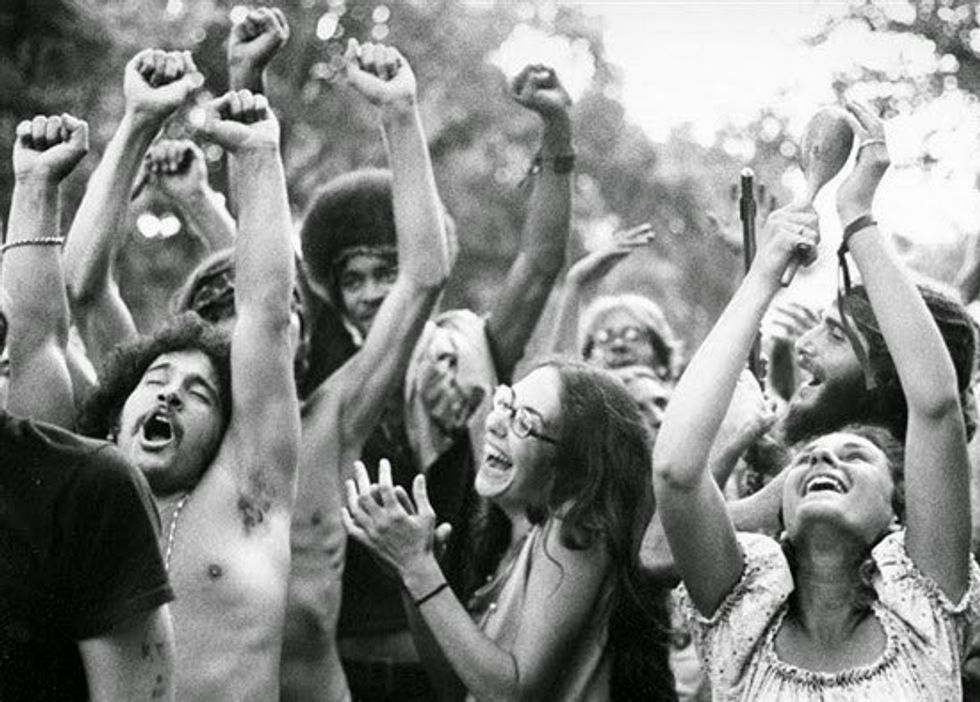
At some point in your life you have heard the phrase, "World peace." Whether it was from someone dressed in tie-dye or a woman in an evening gown with a sash and crown, world peace has been a popular topic of discussion. The notion that world peace can be achieved is not only outdated, but has somehow reached the conclusion of being impossible.
Nothing is impossible.
Aside from the stereotypes of the term, "flower power" which generalized modern references to the counterculture of drugs, psychedelic music, psychedelic art and social permissiveness, it also raised two questions:
1. Why are "we" fighting?
2. Who is the "enemy?"
During the 1960's, the idea of empowerment, or "em-flowerment," developed special meaning rooted in the opposition movement to the Vietnam War. A war in which many Americans could not understand why their husbands, sons, and other loved ones were fighting. The term was coined by poet Allen Ginsberg.
"Flower Power symbolized the path of passive resistance and supported a non-violence ideology."
The idea is not to give you a history lesson, but rather a wake-up call to the future. Without the past there is no way of identifying how to make a better tomorrow.
Whoever controls the media and the images ultimately controls the culture. - A.G.
Contrary to popular belief, history does not repeat itself, sin repeats. People make the same mistakes over and over again until shots are fired from guns with rubber bullets and government officials take away the rights we were promised (life, liberty, and the pursuit of happiness). The "pursuit" of happiness suggests that there will always be the quest for happiness. If happiness is the goal, mankind will constantly be striving for something better.
The fight we fight is not happening overseas, but in our own backyards. The ideology of peace over war, of happiness over violence -- leads down a much less destructive path than injustice and bloodshed. War will never be enough and will never be the end. It is only a temporary delay in combat giving "the man" some time to design a new reason for further unjustifiable actions.
It isn't enough for your heart to break because everybody's hearts are already broken. - A.G.
The late Muhammad Ali refused to be drafted into the U.S. Army in 1967 and was immediately stripped of his heavyweight title. His reasoning was commendable:
“Why should they ask me to put on a uniform and go 10,000 miles from home and drop bombs and bullets on . . . people in Vietnam while so-called Negro people in Louisville are treated like dogs and denied simple human rights? No I’m not going 10,000 miles from home to help murder and burn another poor nation simply to continue the domination . . . This is the day when such evils must come to an end. I have been warned that to take such a stand would cost me millions of dollars. But I have said it once and I will say it again. The real enemy of my people is here. I will not disgrace my religion, my people or myself by becoming a tool to enslave those who are fighting for their own justice, freedom and equality. If I thought the war was going to bring freedom and equality to 22 million of my people they wouldn’t have to draft me, I’d join tomorrow. I have nothing to lose by standing up for my beliefs. So I’ll go to jail, so what? We’ve been in jail for 400 years.” - M.A.
1. Why "are" we fighting?
2. Who "is" the enemy?
Seeking peace instead of violence is not easy, but the life you live after choosing peace will be worth it.

















