
Trigger Warning: Mentioning of sexual assault and rape
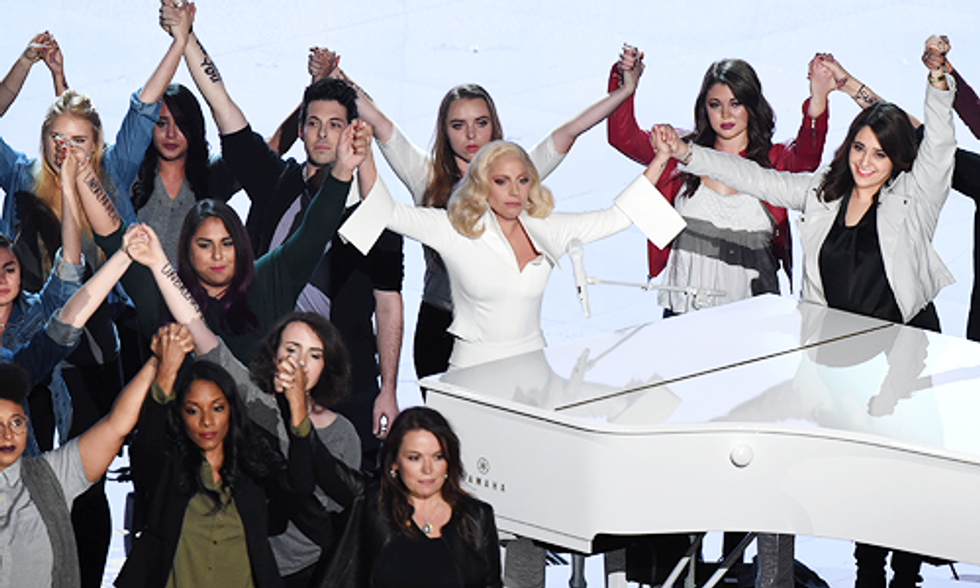
It was at the 88th Academy Awards that Lady Gaga sparked survivor empowerment with her Oscar-nominated song, “Til It Happens To You.” Gaga, alone at her piano, sang the emotional song about what it’s like to be a survivor of sexual assault, a song used in The Hunting Ground, a documentary about sexual assaults on college campuses. Towards the end of the performance, a crowd of men and women, all victims of sexual assault joined her with forearms exposed, revealing phrases including “Unbreakable”, “Survivor”, “Not Alone”, and “Not Your Fault.” They joined hands and raised them in solidarity. The cameras panned to audience members in tears. Twitter erupted with “It’s On Us”, the official hashtag of President Obama and Vice President Biden’s campaign to end sexual assault on campuses. The official YouTube video currently has 77,000 views not even 24 hours after airing.
A week before that, photos of Kesha in court surfaced on the web, her face crumpled in tears. Yes, Kesha, whose face used to be drenched in glitter and who once sang about brushing her teeth with Jack Daniels. This was because Kesha has been “denied a court injunction that would have allowed her to record new music outside of her record label Sony Music and working with producer Dr. Luke” (Rolling Stone).
As the public is now aware, Kesha had spent the past year and a half in a legal battle against her producer, Lukasz Gottwald, professionally known as Dr. Luke. Kesha claims that over the past 10 years, Dr. Luke sexually, verbally, physically, and emotionally abused her. Most notably, Kesha refers to a situation where Dr. Luke had given her a “sober pill” after a night of drinking together. The pill was a form of GHB, the date-rape drug. Kesha awoke naked in Dr.Luke’s bed with no memory of how she got there. She called her mother to tell her she had been raped and was taken to the emergency room.
The denial of said injunction prohibits any freedom for Kesha, chaining her to a ten-year contract under Dr.Luke. She will be forced to work with her attacker, or pay a steep price to buy herself out of her contract.
The case rapidly made it’s way to a top news story. An army of fans and celebrities, including Adele, Lorde, Lady Gaga, and Demi Lovato, publicly supported Kesha online and on air. Taylor Swift donated $250,000 to Kesha to help with court fees. #IStandWithKesha became a trending topic on twitter.
It is frustrating that Kesha came out of the dark with her case to find justice, and was denied it. This case could have easily been kept under wraps, but Kesha brought it to the public eye to make a stand for other women who have also been abused. This devastating loss shows how the legal justice system can let down the victims. In a country where we are innocent until proven guilty, the bad guys often prevail.
It was also last week that a statewide grand jury cleared three male students from Johnson & Wales University in Providence who were charged with sexually assaulting and drugging two 18-year-old female students. According to the Providence Journal, in October of 2015, the females met the three men at the Coliseum nightclub, and were taken back to their apartment. After smoking from a hookah, they began to feel ill. The women later recalled being sexually attacked in that apartment by three different men, unable to fight them off, clearly drugged. The victims notified the police and pressed sexual assault charges against their attackers. Five months later, those attackers are free of indictment, while two victims are forced to carry their pain for the rest of their lives. That Providence Journal article has only 733 Facebook shares.
The unfortunate truth is that many sexual assault cases get dropped, allowing rapists and attackers to go without punishment. We can’t control what happens in the courtroom, but we cannot allow the decisions of these juries to discourage victims from coming out with the truth. Victims of rape and sexual assault must know how important it is that they come forward as soon as possible. Because no matter what the court decides, they need to seek care for themselves; they need to allow themselves the proper tools to heal.
When stories about sexual assault become top news, it’s easy to speak out, through a hashtag, a share of an article, or sharply pointed tweet. It’s important we don’t turn the conversation on who is or isn’t speaking out. We need to keep the focus on the victims and ensuring that they are in a safe place to receive care and support. We have to fight hard and speak up to end sexual assault. We have to consistently make our voices heard, because sexual assault happens, and a lot of times it doesn’t make news. We have to fight even after time passes and different stories take the front page. Most importantly, we have got to support women, even if the court does not.
For Johnson & Wales University (Providence) students with questions about sexual assault, the Gender Equity Center is a welcoming space that offers support services or referrals for survivors of sexual and relationship violence. They make resources related to women's health, gender-based violence, and sexual orientation & identity available to the university community. They are located on the first floor of Wales Hall, or are available by e-mail (genderequity@jwu.edu) or phone (401-598-1138).