My alarm goes off and its intermittent buzz sounds like a klaxon in whatever dream entertains my still-sleeping brain. Hit snooze or turn it off. It takes a mere second for me to decide, a decision that determines the arc of my morning. Pushing a round switch from right to left and back again, I purchase our bedroom another twenty four hours of relative quiet. My legs find the edge of the bed and then the cool morning air as they swing down, feet touching floor. I’m sitting up, blinking, staring at the digital numbers, glowing with a pale emerald light. It’s 6:30 AM. I blink and squint and rub my eyes and then the clock reads 6:31. I stand up. In the far corner near the clothes hamper, hanging photo frames made from recycled wood lean against the wall, still in the same place we put them over three years ago. Dirty socks wreath the frames and will be attended to long before the frames are hung. We might not even hang the frames in the house, I don’t know. Some days this place doesn’t feel like home. Sometimes I wake up, uncertain of where I am. Emily stirs in bed, shifting her legs. Her alarm will go off in fourteen, now thirteen minutes, a small whirring motor in her cell phone that implores she start the day. Does this place, this house, feel like home to her? I think it does. I doubt it will ever feel like home for me, not even considering the fact we move out in five months. Before leaving for college Emily lived the entirety of her life in the same town in the same house, beholden to (blessed with?) weekly routines of place, community, and family. She dreads the move, I can tell, with a quiet apprehension. For me, it seems there has only ever been the move, only ever been impermanence.
I shuffle into our bathroom, do my business (you know the kind), and spend a moment contemplating the effects of freshly brushed teeth upon the taste of coffee. There are no windows in this or any other bathroom in the house. A bare expanse above the toilet offers some prime real estate for a potential double-framed affair, but it’ll never happen. This house was manufactured, shipped in four separate pieces and assembled on a summer day fifteen years ago. The whole village, some 60 or 70 people all told, turned out to watch. At the time of the assemblage, I was a junior at Colerain High School in Cincinnati, Ohio, gearing up for band camp at a new school. Emily was preparing for her freshman year at Lake Shore High in Stevensville, Michigan. Colerain was my second high school, and my eighth school altogether. My father has been a United Methodist minister for over forty years, a willing participant of the denomination’s itinerancy system. My brother and I, and later our step-sisters, were essentially hostage to that same system. Always moving, always the new kids. We never lived in one place for more than three years. Was that long enough to make an impression on the places we so briefly inhabited? Did they affect us? Me?
The Colgate’s on the brush. I’ll brew the coffee strong and take it black, as is my habit. Any residual tooth paste will be obliterated. Coffee fuels both mind and body most mornings, ensuring alertness while I commute to school. Today class begins at 8:30 AM, and hoping to be punctual I’ll leave no later than 7:30 AM. Not so long ago, in the scheme of things, I had the luxury of walking to school it was so close. Less than a mile from the parsonage, I attended Jackson High School of Jackson, Ohio during my freshman and sophomore years. The faculty of JHS evinced a wincing, lazy, bumpkin blandness, complacently churning out graduates equipped for an American industrial sector that had long since withered. While attending I didn’t have to work very hard for good grades, the academic culture (or lack thereof) instilling in me apathetic study habits that would one day provide for me a mountain of collegiate “Incompletes.” That was my takeaway. I don’t remember the town fondly; it was a rusty, faded mausoleum of midwest industry, choked with ignorance and that pervasive corporate commercial sameness. Nor do I recall the people with any great affection, so fleeting was our shared experience, if you could even say we shared it. If any place in Jackson, Ohio edified me it was the public library. That institution introduced my young mind to the works of Asimov, Clarke, Tolkien, Lovecraft, Poe, and others. I remember that place for the experience of those books, isolating me from my immediate condition while connecting me to a larger, abstract community, those unknown contemporaries with whom I shared Middle-earth, the Caves of Steel, and the Great Old Ones. But we, the readers, are scattered, divided, and our experiences are not mirrored, nor strengthened through internet message boards and conventions I’ll never attend, but rather smeared across time and memory, consumed by an amorphous, ill-defined and consumeristic fandom. I step into the shower before it’s hot enough, but the cold only lasts a moment.
I’ve collected my books and papers, prepared a lunch, brewed coffee, kissed my wife goodbye, and pulled my 1995 Toyata Camry LE out of the driveway. The parsonage is situated roughly 45 yards west of the church, a great old thing of brick, buttresses, and high stained glass. A weather-beaten bell tower rises from the southern corner of the four peaked roof, the wrought-iron bell only breaking its silence Sunday mornings. It was built in the middle of the 19th century, burned down, then built again in 1885. Some of the folk who aided in construction left their progeny in the area, perhaps hoping they might perpetuate the church community. Today fewer than 10 of the 60 or 70 immediate residents of Girard attend service, with the rest of the congregation traveling from miles away. I suppose that says something about the pull the place has for those that grew up here and have since moved. But the community fostered here focuses more on exclusive sociability than on inclusive faithfulness. They will have to change, or they will die. They’re already dying; Emily has performed over a dozen funerals since we came here. Every Sunday morning a sea of blue-gray hair floods the pews, always socializing. Do they truly worship in that environment? Can they? I don’t know, and it’s really not my place to know.
I drive past the church to the exit of the parking lot, glance north and south along Marshall Road, and pull out heading north.
In seven minutes I’m in Tekonsha and my coffee is cool enough to sip. I pass the Tekonsha Café, a little establishment recently acquired by a parishioner and situated in a turn of the century storefront. There’s an Allis-Chalmers tractor in one of the parking spots along the street. That’s funny, charming really; I haven’t seen that before. I catch the briefest glimpse of the Café’s interior: wood paneled walls surround 70’s era tables which host aged men with doughy faces and shaded glasses, sipping their own coffee and discussing seeds or water tables or Obama. Some have beards, but all wear flannel. What is time for them? How do they experience its passage, and what is their history? Not their personal stories, but their history, their understanding of the past, their past, as a people group, as a community. What is that like? They are tied to this land, those who farm it, in a way I cannot know, will possibly never know. The ghost of Junior Morrison haunts their little breakfast palaver, as does the ghost of his father and his father’s father. Emily buried Junior in Girard Cemetery two years ago, and the land he farmed for decades still bears his name, will still bear his name as he slips into legend and then myth and then obscurity. Morrison Acres will become a name without significance in a hundred years, maybe less.
The speed limit is only 30 mph, but it takes just a minute to drive through Tekonsha, past the Café, the bar named “Bar”, the Citgo run by a stout old Seikh, the defunct local pharmacy, the desiccated remnants of an auto body garage, the sour and hollow grunge of the long empty liquor store. These places hold, or once held, meaning for people I will never know, and I don’t know that I care to know them. A product of my rootless existence perhaps, this depersonalizing, anti-relational isolation of my self. Or maybe Mom and Dad raised a sociopath. My shrink can’t say. Was it always like this? There was a time when I yearned for the permanence I imagine these people experience. There were people I loved and there was a place we found holy. Ceta Canyon, a United Methodist Camp near Happy, Texas, played home to five children and their aging grandparents for one week every summer between ’88 and ’98. Bruce and Mary Parks called that week Cousin’s Camp, and it was the best week of the year. Bruce – Grandaddy – led hikes through the Canyons and up onto the Mesas, waxing with a kind and folksy wisdom on the wonders of nature, the past, this place, and God. As Grandaddy lost himself in his lecture/reverie, we studied the ground for fossils and arrowheads, watched birds of prey wheel through the white hot sky, and listened for the dry rattling of diamond backs. The morning hike terminated at the Waterfall, a small wonder in that arid place. It poured over a cavernous sandstone outcrop into a deep but modest pool. Swallows nested behind the Waterfall, in the high places of the outcropping, building their homes with spit and mud. We ate our lunch beneath their nests, taking care to avoid their droppings. At the camp, we explored the surroundings, never straying far, but freed in that place, made safe in love and trust. All five of us had hurt at home. We sang songs in the open air tabernacle, ate in the mess with program campers, got stung by wasps, fell on cacti, played card games, and listened to ghost stories. I never wanted the week to end. My grandparents knew the importance of that place, had known it for decades, and they gifted it to us. Grandaddy died three years ago, and Granny… she’s not long. I see the little cemetery on the hill, the one with a greenhouse beside it. Without thinking I’ve turned onto M60 and am now halfway to Homer. In another six minutes I’ll be there.
I can see the water tower before I enter town. It looms against the drab morning, imperious, proclaiming “Homer… is Home!” But for who? The video rental hut on the edge of town is now home to a little Bible Church (I wonder if they rented VHS tapes….). Where did the proprietors go? People pull in and out of the Shell station. I see a kid get out of a truck way too big for him. Shouldn’t he be in school? What time does school start around here? There are some houses along the main drag through town, a Citgo station with another kid in a hilariously large truck, a little park near a river, and a shuttered health food shack. I blink and miss the sign informing me of when some people I don’t know founded this place, and then I’m out of town and the speed limit is back to normal. There’s a pizza joint called Cascarelli’s nestled back in there somewhere. Emily and I have been there a few times. Good food, great selection on tap. Joe Mullen works there, or did. I’m acquainted with Joe from Spring Arbor, had a few classes with him. SAU is a… well it’s a difficult place. In 2011 I returned there after a single abortive semester and a six year hiatus. And I felt out of place almost immediately. My classmates looked like kids and my professors looked like me. I didn’t really know what to do, how to behave, where to go, who to talk to, or even how to talk to them. Desperate for a friend I vomited my toxic emotions upon a professor. He smiled a strained smile, and I sensed in him revulsion to my particular brand of crazy. As far as I know there wasn’t, and still isn’t, any sort of support structure for non-traditional students. I guess it’s just assumed that since we have our own lives outside of campus life we’ve got it all covered. Well I didn’t, and I’m pretty sure I still don’t. Maybe that’s alright. I’m an adult (or at least purport to be), and I shouldn’t expect anyone to hold my hand. But I’ve come to understand that I need people, I need that support. I need to feel placed, and I don’t know what that looks or feels like. So I’ve fought for some semblance of it SAU, taken the scraps I can get, forged a flimsy network in danger of collapsing any second, and praying to God I make it through the week with my heart and soul and mind intact. Over the past three years I’ve spent a lot of time on campus, but I still feel like an outsider, like I don’t belong, like just another orphan. How much of this is reality, and how much is just in my head? Might it be different with a simple attitude adjustment? Could that place be a sanctuary, a haven? It is for others, why not me? I don’t know. I’ve got too much else to think and worry about. It’s easier to wring my hands and cry woe than to exert the needed effort at the (perceived) expense to my marriage, grades, and sanity. But it might be worth it, and it might not be as bad as all that.
I’m in Concord now, and on the radio “Satisfaction” by the Rolling Stones has yielded to “Ooh La La” by Faces. I breeze through Concord at 45 mph as Ronnie Wood laments “I wish that I knew what I know now when I was younger.” Yeah Ron, I get that, you’re talking about love and relationships, but I get that sentiment. “I can’t get no satisfaction, ‘cause I try and I try and I try and I try, I can’t get no, I can’t get no.” Jagger was decrying the perpetual now, the ennui experienced when bludgeoned by the mantra of materialism, consumerism, and sex. For decades I swam in that soup, without awareness of it or myself. Willingly I cast aside my connections to people and places in pursuit of my own selfish ends, but got no lasting satisfaction. I wish I knew then what I know now. I need people. Will they have me back? I need place. But where to find it? It’s been over a decade since I hiked Ceta Canyon, and I barely know my cousins now. But maybe place is more than geography, a fixed location in a centerless world. Maybe place is an openness of heart, an other-centeredness, and the presence of mind and spirit in the present. I want this, this surrogate of place. The cynic in me denies this, clings to the impermanence of existence, and curses the idealism of this notion, of place in general. That guy’s an idiot half the time. I need hope, I need to cling to it, even if it’s hopeless. I need God at the center, I need a place nested in him. “He’s here!” they say, a relational God with me in the quagmire of my fear and doubt and lack of place. I wish I could feel that, feel him. I wish I had stronger faith. So have stronger faith. It takes work and perseverance. Be present to the people around you, even if it’s only for a short time. Love them. We are all the same, in the end, so much dust for the stopping of bungholes. The clock tower rises above the barren winter limbs of the sleeping wood. A mile from SAU. I think of Siddhartha, his moment of enlightenment and the winding path that led him there. We are all the same. We are all here, on this earth. This is my place, and these are my people. This is our place, and we are God’s people. I know this in my head, I know it with my intellect in an abstract kind of way. But I don’t yet know it with my heart. The emotional and spiritual internalization of such an optimistic and hopeful notion presents great difficulty. Others make it look so easy.
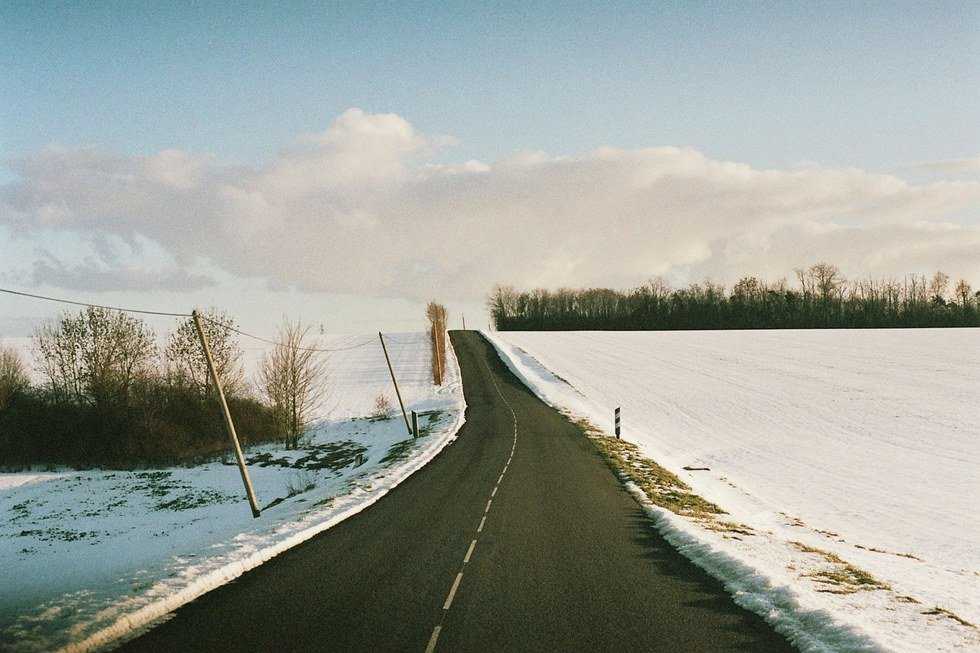
I pull into the commuter parking lot and kill the engine. Other commuters have arrived, are arriving, will arrive. They juggle their bags and gloves and coffee as they exit their vehicles. Quiet snow drifts on the wind, alighting on their heads. I juggle my own things and get out of the car. Snow falls on me, melts on the lenses of my glasses. We trot across the road onto campus and to our respective classes, leaving indistinct footprints in the shallow snow. Soon the footprints will disappear into a blank canvas of soft white. A few phrases of Bilbo Baggins’ traveling song come to me. Then the rest
The Road goes ever on and on,
Down from the door where it began.
Now far ahead the Road has gone,
And I must follow, if I can,
Pursuing it with eager feet,
Until it joins some larger way
Where many paths and errands meet.
And wither then? I cannot say.
There has only ever been the move, impermanence. But isn’t there a kind of place in impermanence? Can’t the Road become place? And what is the Road but all God’s world? The people we meet on the Road, God’s people. Let me love them and be present where I meet them. My heart fills with a tragic optimism and I enter the classroom, greeted by tired but smiling faces. Life has to be better than what I’ve lived, it has to be. I smile back, and mean it.