
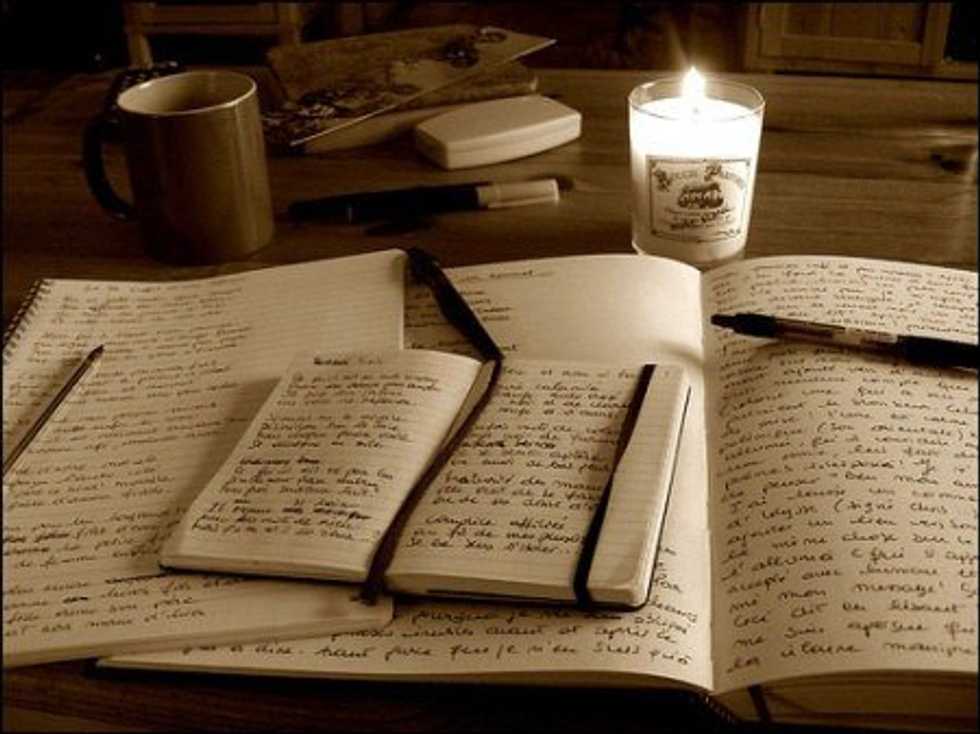
Whether it's a lack of inspiration or a plethora of scattered ideas, the creative writing process faces perpetual opposition. As a writer, having something to fall back on for direction, stimulation and vision can be the difference between mediocrity and greatness, fragmentation or completion. Below is a list of six types of journals that every writer should regularly update and refer to in order to simplify the troublesome writing process. These journals provide everything you need to complete your next creation at your fingertips: a clear head, an abundance of ideas, and archives of inspiration.
1. The Do's
Gather advice from writing blogs, critics, and personal observation, and record it all.
Entry Examples:
— Intermix dialogue and action.
— Begin telling the story as late as possible, and end as early as possible.
— Stories gain their universality only through their themes, so make your themes universal.
2. The Do Not's
An ongoing list of common story-telling cliches and composition faux pas will keep your writing in check and help ward off the cheesiness.
Entry Examples:
— Don't open with scenery description.
— Don't use dialogue to info dump.
— Don't let a character be too perfect.
3. Unconventional Vocabulary
Whenever you read, take time to jot down any unique words that catch your eye- ones you wouldn't find in a thesaurus.
Entry Examples:
— Jaundiced: yellowed
— Unbaked: immature, not ready
— Willowy: tall and slim
4. Brilliant Quotations
Along with taking note of your favorite authors' vocabularies, you should also accumulate a collection of their best literary quotes. Whenever you come across a unique description or a golden combination of words, write it down. Take note of quotable quotes so that eventually you too can be quotable.
Entry Examples:
— “I cannot fix on the hour, or the spot, or the look or the words, which laid the foundation. It is too long ago. I was in the middle before I knew that I had begun.” -Jane Austen, Pride and Prejudice
— "I need not sell my soul to buy bliss. I have an inward treasure born with me, which can keep me alive if all extraneous delights should be withheld, or offered only at a price I cannot afford to give.” -Charlotte Bronte, Jane Eyre
— "And so with the sunshine and the great bursts of leaves growing on the trees, just as things grow in fast movies, I had that familiar conviction that life was beginning over again with the summer.” -F. Scott Fitzgerald, The Great Gatsby
5. Story Premises
As soon as a clever idea for a story's premise pops into your mind, write it down. For years before I implemented this, whenever I tried to write, I would find myself thinking "I know I've had lots of ideas. Why can't I think of any of them now?" But since I started keeping record of every premise idea in a journal, I can easily flip through the pages and decide which one I feel like developing.
Entry Examples:
— A man discovers that he was born into an experiment and that everything he knows is not part of the real world.
— A college student begins to suspect that her room mate is obsessed with her.
— A woman becomes fixated on projecting the successful working woman image.
6. Themes
Beneath the surface level plot of any compelling story lies the subterranean realm of morality and theme. Keep record of the themes that are important to you and that you would enjoy writing about. Thumbing through the journal of story premises along with your themes journal can allow you to figure out which themes can be incorporated into which plots.
Entry Examples:
— Human accomplishment, even the kind that appears to be self-effacing and virtuous, is motivated by purely selfish ambition.
— A leader who treats his people well will always be more powerful than one who exploits his people.
— Knowledge is worth dying for because lack of knowledge can lead to death.
I have found these journals to be essential to my writing process, and I believe they would be hugely beneficial to any struggling writers. With organized thoughts, excellent inspiration, and a plethora of ideas, a writer's possibilities are endless.