


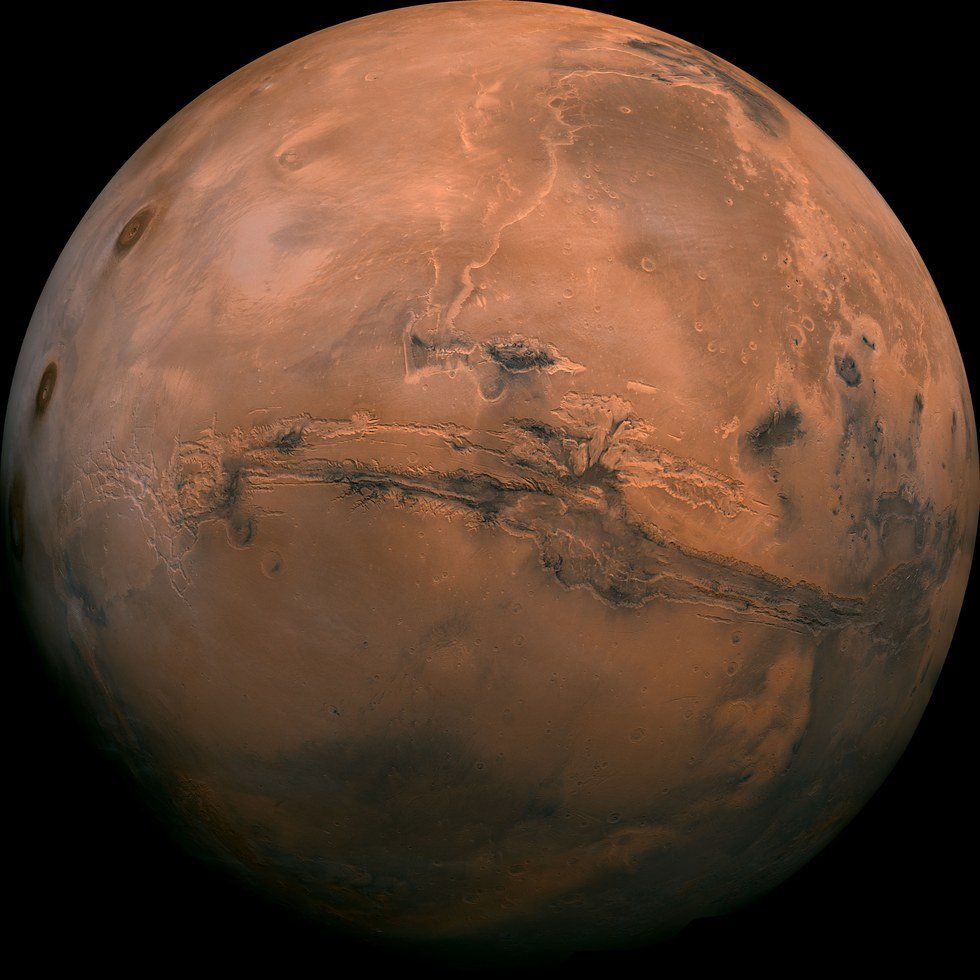
Four humans from planet Earth will blast off into space at Earth in 2026.
These will be the first people to be setting foot on Mars, where they hope to establish permanent human settlement.
Every two years, they will be joined by four more new astronauts from Earth, all of whom will have a diverse skill set that will enable them to expand and maintain Mars facilities for habitation, research and development and recreation.
It will take astronauts roughly seven months to travel to their new home, where conditions are most similar to Earth in comparison to the Moon and Venus.
While the Moon lacks resources for sustainable life, and Venus experiences temperatures above 400 degrees, Mars has been found to have traces of water in its soil, an atmosphere that offers protection from the sun's radiation, and enough sunlight to make solar panels effective. Mars also experiences habitable temperatures, a similar day/night rhythm to Earth, and sufficient gravity for human survival—roughly 38 percent that of Earth's.
Dust storms are the most significant variable that could challenge settlers, as dust on Mars is far finer than that on Earth and could affect technology and machinery.
However, Mars One—the organization responsible for this mission—believes settlers will be well prepared for success.
Many unmanned missions will be conducted prior to the first human trip to Mars. In 2024, materials will be sent to Mars that will serve to provide habitable facilities for the astronauts upon their arrival.
Six groups of four astronauts are expected to be prepared for the first human trip to Mars in 2026. It is expected that, as there will be such a small group of individuals on Mars, all decisions will be made dependent upon agreement among all members of the settlement. However, as the settlement grows in number of members, a more complex system of government and social hierarchy will have to be developed, but as of yet, it is unclear as to what form it will take.
It is clear, however, that the Mars settlement will be a sustainable one, recycling nearly all materials used and relying 100 percent upon solar generated electricity.
It is clear that this is an ambitious undertaking by Mars One—seemingly futuristic and removed from the reality of life on Earth. But could this settlement stand as a template for our own future here on our native planet?
Progress is the goal of the developed world, and the idea of sustainability has experienced a significant rise in attention, as a lifestyle in recent decades. So let us welcome in the future and man's next big leap into the greater universe with this first permanent settlement on another planet.

















